On August 12, 1960, the National Aeronautics and Space Administration did not launch a sleek, solar-paneled machine packed with microchips. Instead, they hurled a giant, highly polished sphere made of thin aluminized Mylar into low Earth orbit. It was one hundred feet across, completely hollow, and carried zero onboard electronics.
This craft was Echo 1, the world's first successful passive communications satellite. Rather than receiving and actively retransmitting data like modern transponders, Echo 1 operated as a celestial bounce pad. Ground stations aimed powerful microwave transmitters at the metallic balloon, ricocheting telephone calls, radio broadcasts, and voice recordings across the curvature of the Earth.
Decades before fiber-optic cables crisscrossed ocean floors and geostationary constellations blanketed the globe in broadband, engineers had to prove that signal relay through the vacuum of space was even physically possible. The story of Project Echo is rarely told in full context. It was a high-stakes gamble born of Cold War paranoia, brilliant radio engineering, and a bizarrely simple piece of physics.
The Engineering Behind the Shiny Sphere
To understand why NASA put a giant balloon into the sky, you have to look at the severe limitations of 1960 electronics. Transistors were in their infancy, heavy power sources were impractical for orbit, and active signal repeaters were notoriously unreliable.
John R. Pierce of Bell Telephone Laboratories proposed a radically different route. If space itself was an obstacle-free highway, why bother building heavy transceivers to put up there? A simple reflector would do.
The mechanics were straightforward yet brutally demanding. The satellite had to be large enough to catch a faint signal from Earth and bounce it back with enough integrity to be read by receivers thousands of miles away. It also had to pack down tightly into a small rocket nose cone.
Engineers manufactured the sphere using Mylar polyester film thinner than a strand of human hair—only 0.0127 millimeters thick. Coated in vapor-deposited aluminum to maximize reflectivity, the shell weighed a mere 76 kilograms. Inside the folded skin, a small amount of sublimating powder used residual heat from space and trapped air to inflate the structure automatically once orbit was achieved.
An early test flight in May 1960 had ended in catastrophic failure when the second-stage attitude control jets malfunctioned, destroying the spacecraft before deployment. When the Thor-Delta rocket cleared the pad at Cape Canaveral on August 12, failure was not an option.
Bouncing Voice Across a Continent
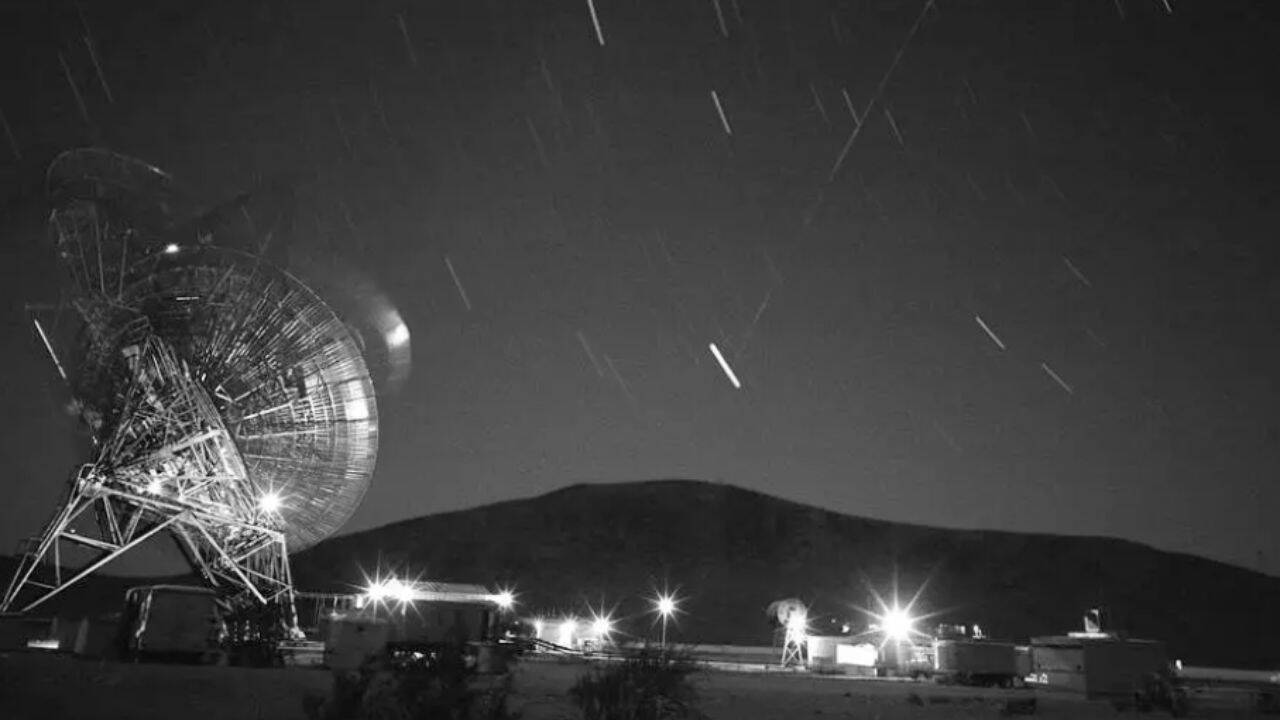
Hours after achieving orbit, Echo 1 proved its worth. A massive horn antenna at Bell Labs in Holmdel, New Jersey, locked onto the shimmering point of light passing overhead. It transmitted a pre-recorded audio signal to NASA's Jet Propulsion Laboratory facility in Goldstone, California.
The voice that echoed out of the speakers belonged to President Dwight D. Eisenhower:
"This is the President of the United States speaking. This peerless communication is made possible through the-pioneering capabilities of Echo 1."
It was a brief message, but it completely reoriented global telecommunications. For the first time, transcontinental communication did not rely on vulnerable undersea cables or terrestrial radio towers limited by the horizon. Space was officially open for business.
The Hidden Legacy of a Passive Moon
Echo 1 had a secondary superpower. Because it was massive and highly reflective, it shone brightly in the night sky, easily visible to the naked eye as it crossed overhead. Millions of people worldwide stepped outside to watch the American satellite glide past the stars. This visibility served a vital geopolitical purpose, providing undeniable visual proof of American technological capability during the peak of the space race.
Yet the true value of the project extended far beyond a shiny spectacle.
- Geodesy Breakthroughs: Tracking the orbital perturbations of Echo 1 allowed scientists to calculate atmospheric density at high altitudes and map the exact shape and gravitational field of the Earth with unprecedented precision.
- Antenna Perfection: The massive horn antenna built at Holmdel to track the satellite was later repurposed by researchers Arno Penzias and Robert Wilson. While using it to search for residual noise, they discovered the Cosmic Microwave Background radiation, providing the definitive smoking gun for the Big Bang theory and earning a Nobel Prize.
- The Death of Passive Tech: The project also proved the limits of passive relay. Because the signal lost immense amounts of power during its round-trip journey off a distant reflector, ground stations required monstrous transmitters and extraordinarily sensitive receivers. The industry immediately pivoted toward active communications satellites like Telstar, which could receive, amplify, and rebroadcast signals on their own.
Echo 1 decayed safely in the atmosphere on May 24, 1968, burning up after nearly eight years of service. It left behind no digital footprint, no persistent orbital debris field, and no complex code. It was simply a mirror thrown into the void, proving that humanity could reach past the sky to talk to itself.