The glow hits your retinas long before the coffee starts working. It is 8:14 on a Tuesday morning, and the world is already asking too much of you. There are three browser windows open, each one screaming for attention with overlapping audio streams, spreadsheets stacked like cordwood, and a tiny red notification dot pulsing in the corner of a chat app like an anxious heartbeat. You squint. You rub the bridge of your nose where the indent from your glasses has turned into a permanent groove.
We spend our lives staring at rectangles. We build our careers, write our children's stories, file our taxes, and watch the sun set through backlit panes of glass. Yet, most of us treat the primary window to our digital existence—the monitor sitting right there on the desk—as an afterthought. An appliance. A piece of plastic that came bundled with a machine or picked out in a rush because it fit the budget three years ago.
Consider Marcus, a fictional graphic designer whose lower back has been quietly conspiring against him since 2021. Marcus sits in a chair that cost as much as a short vacation, typing on a mechanical keyboard that clicks with satisfying precision, staring into a screen that flickers imperceptibly seventy-five times every second. He doesn't know why his eyes feel like they are coated in fine sand by three in the afternoon. He assumes it is age. He assumes it is too much screen time. He blames his coffee intake, his sleep schedule, the general weight of being alive in the middle of a decade that feels perpetually sped up.
The culprit isn't time. It is resolution, pixel pitch, and a hardware panel that gave up its ghost of competence years ago.
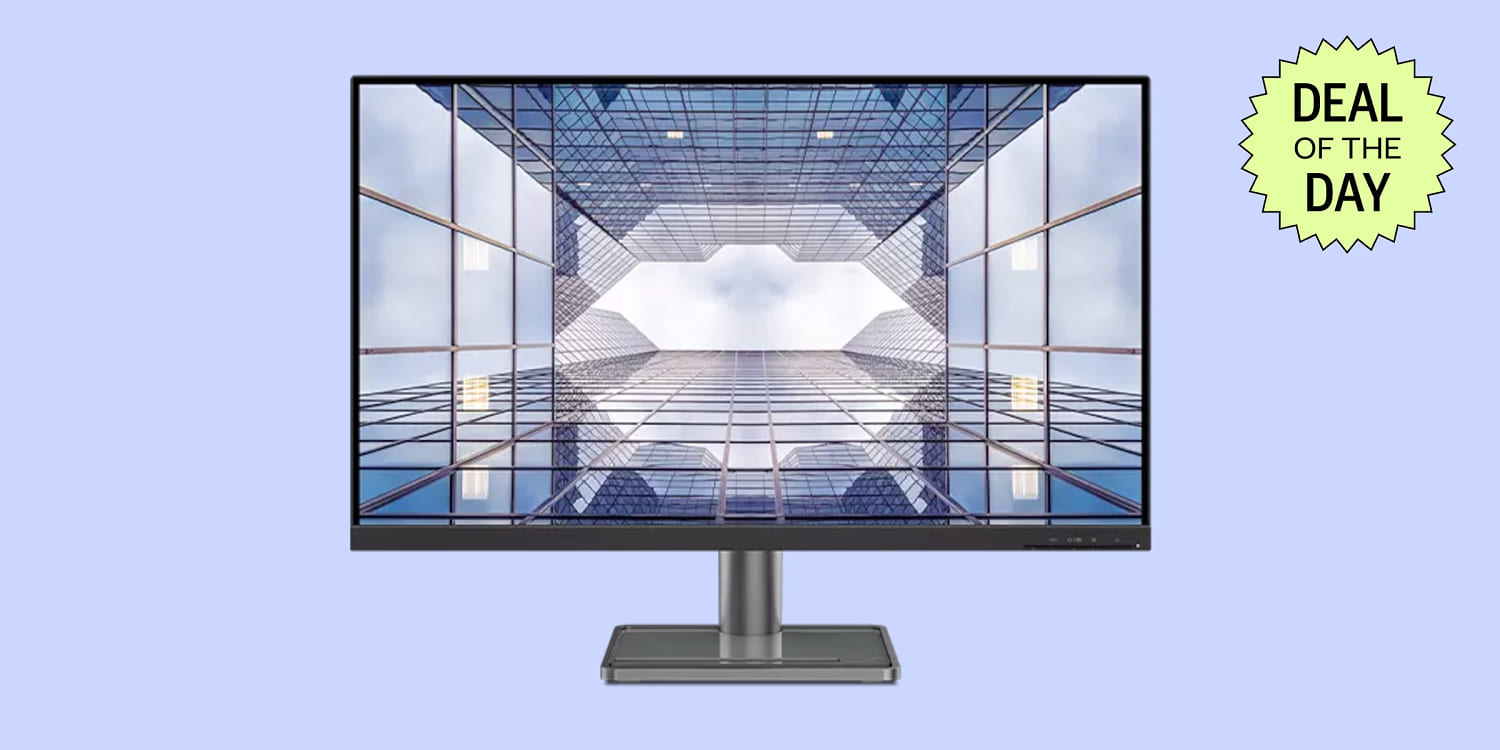
When a piece of technology drops in price by more than a hundred and thirty dollars, retail algorithms usually shrug and call it a promotion. A clearance event. Inventory management. But look closer at what is happening when a genuinely capable display—specifically the sort of performance-driven Lenovo monitor currently seeing a massive price cut down from its usual sticker—suddenly becomes affordable to the masses. It changes the geometry of how we live inside our work.
Think about the physical barrier between thought and execution. When you type a sentence, you want it to appear instantly, smooth as ink on heavy rag paper. When you drag a timeline in an editing suite, you want the motion to track your hand without stuttering. Cheap glass lies to you. It smears dark colors into muddy gray patches. It forces you to lean forward, craning your neck like a turtle leaving its shell, just to read a footnote at the bottom of a PDF.
Physics matters here. Let us talk about contrast ratios without turning into a textbook. Imagine a room painted entirely in shades of charcoal. If you turn on a single candle, the shadows matter just as much as the flame. A poor monitor turns those shadows into a flat, washed-out gray sea where details drown. A high-end panel separates the dark from the darker. It gives depth back to flat images. When you write code, or edit a photograph, or simply stare at two spreadsheets side-by-side without needing a magnifying glass, your brain stops spending energy just trying to decode the visual noise.
Marcus made the swap last Thursday. He unboxed the Lenovo unit with the cynical detachment of someone who has bought too many gadgets that promised salvation and delivered only extra cables. The box was heavy. The stand was solid metal, not hollow plastic that wobbled every time he typed an angry email.
He plugged it in.
The first thing he noticed was the silence. Not audio silence, but visual quiet. The IPS panel rendered white spaces like clean stationery rather than a glaring lightbulb. The extra screen real estate meant his reference materials didn't have to hide behind active windows anymore; they lived beside them, patient and visible.
By Friday afternoon, something strange had happened. He hadn't rubbed his eyes once. His shoulders weren't hitched up toward his ears.
We underinvest in the things we use the most. People will spend two thousand dollars on a bicycle they ride twice a month, yet hesitate to spend three hundred dollars on a display they stare at for ten hours a day, five days a week, fifty weeks a year. It is a strange inversion of priorities, born of the old desktop era when screens were just dumb terminals waiting for the CPU to tell them what to do.
Now, the display is the environment. It is the room you sit in.
When a machine like this sees a steep discount, it lowers the barrier to entry for ergonomic sanity. You no longer have to be a corporate art director or a competitive esports athlete to afford color accuracy and high refresh rates. The technology trickles down from the bleeding edge into the hands of the freelance writer, the remote accountant, the student pulling an all-nighter in a cramped apartment.
There is a quiet dignity in tools that simply work without demanding your attention. A great monitor does not look like a spaceship. It doesn't flash neon lights or scream for you to notice its specs. It disappears. It leaves you alone with your thoughts, your work, and whatever corner of the internet you happen to be building or exploring.
The morning light shifts across the desk. The coffee cup is empty. The red notification dot is still blinking, but the text beside it is sharp, clean, and effortless to read. The ghost in the machine has finally been laid to rest, replaced by a clarity that was there all along, waiting for the glass to catch up.