The throat goes dry first. Then the skin on the back of your neck begins to prickle, not from the chill of a Vancouver morning, but from a low, vibrating hum that feels less like a sound and more like a tectonic shift.
For three decades, being a Canadian soccer fan meant mastering the art of the lonely vigil. You sat in half-empty bleachers, freezing in late October, watching your national team play a home game where eighty percent of the stadium wore the away team’s colors. You watched world-class talents born on Canadian soil choose to play their international football for England or Wales because the alternative was a lifetime of obscure qualifiers in empty stadiums. To believe in Canadian soccer was to be a romantic in a country that preferred its ice frozen and its sports predictable.
Then came the summer of 2026.
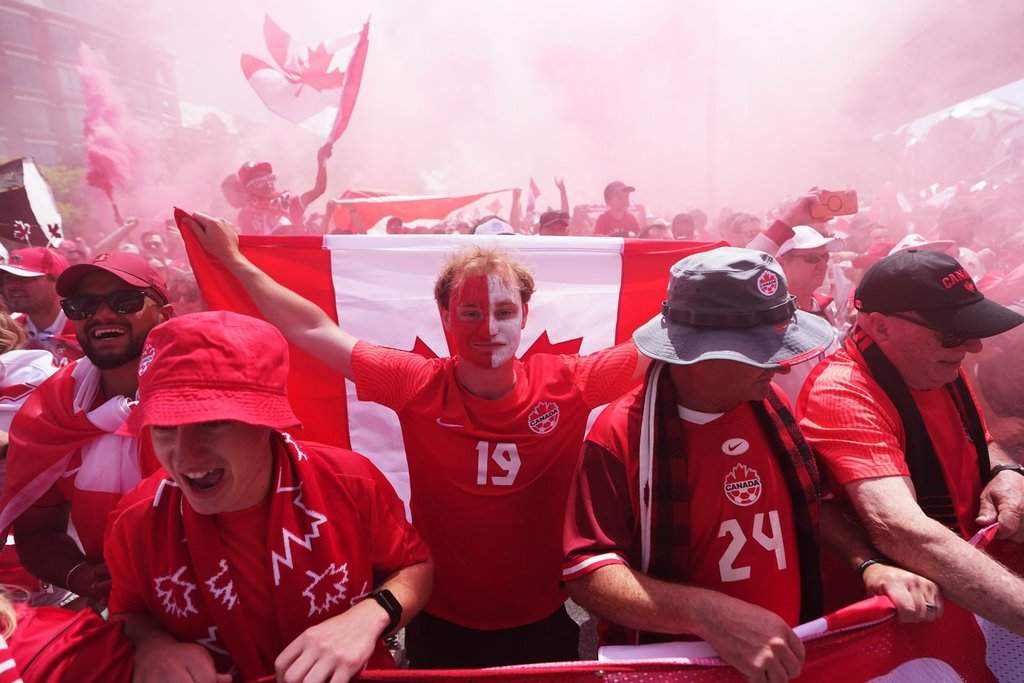
On a bright Tuesday morning, a crowd gathers near Quebec and Central streets. They are wearing red. Not the polite, muted crimson of a casual sports fan, but an aggressive, unapologetic sea of scarlet. Red smoke canisters bleed into the crisp air. Drums beat an irregular, driving pulse. At the front stands a person clutching a megaphone, veins bulging in their neck, screaming a bilingual battle cry into the wind.
Allez les Rouges!
The crowd of thousands roars it back. This is the Voyageurs. They are walking the "last mile" toward BC Place, and they are carrying the emotional weight of a nation that finally learned how to sing.
The Paper Fortress
To understand why thousands of people marching down a street in Vancouver matters, you have to go back to 1996. Imagine a couple of banners hung over the concrete railings of Commonwealth Stadium in Edmonton. The match was against Panama, the kickoff to an ultimately doomed 1998 World Cup qualifying campaign. A handful of fans, frustrated by the total absence of a domestic soccer identity, decided to call themselves the Voyageurs. The name was chosen because it was bilingual and because it explicitly acknowledged the brutal, uphill trek ahead of them.
For years, the Voyageurs were a nomadic tribe. They pooled private donations just to forge a trophy—the Voyageurs Cup—because the country’s domestic clubs had no official national championship to play for. They organized desperate, failed petitions to convince teenage prodigies to commit to the red and white. They were an island of noise in a sea of indifference.
Consider what happens when that isolation vanishes. Rob Notenboom, now the president of the organization, joined the group back in 2005. For nearly twenty years, he worked in the shadows of the sporting landscape, planning logistics, distributing flyers, and hoping for a spark. When the 2026 World Cup ticketing cycle began, the spark became an inferno. The group's membership surged to 3,000 official card-carriers, a number that completely fails to capture the casual thousands who now swallow the streets whole before every kickoff.
The transition from a fringe subculture to a national heartbeat happened so fast it left the organizers breathless. Notenboom admitted that he led a massive march through the streets, completely unaware of the scale of the human wall behind him until he watched drone footage on his phone the following morning.
The entity they built had outgrown them. It had become alive.
The Empty Space on the Pitch
The beautiful game is rarely just about the ball. It is about what happens when the ball stops rolling.
Last week, during Canada’s historic 6-0 dismantling of Qatar, the euphoria of the tournament fractured in an instant. Ismaël Koné, the brilliant 24-year-old midfielder who serves as the creative engine of the Canadian transition, went down. The diagnosis was brutal: a broken leg. Just like that, his World Cup was over.
In the sterile logic of sports commentary, an injury is a tactical problem. It is a matter of depth charts, formation shifts, and substitution minutes. But to the men inside the locker room, and to the people in the stands, it felt like a death in the family. Defender Moïse Bombito, who had survived a similar injury himself, hurried to Vancouver General Hospital after the match just to sit by Koné’s bed, to assure him he wasn't marooned in the dark.
But how do 50,000 people in a stadium tell a young man in a hospital bed that he isn't alone?
You print his story three thousand times.
Ahead of the crucial Group B finale against Switzerland, the Voyageurs didn't just write a new chant. They went to print shops. They organized assembly lines. They manufactured 3,000 individual copies of Koné’s number 8 jersey silhouette to distribute throughout the supporter sections. They laid out a massive canvas banner at their pre-match gathering, inviting thousands of strangers to sign their names in permanent ink, creating a physical manifestation of a collective embrace.
When striker Cyle Larin spoke to reporters at training, his voice softened when the fan initiative was mentioned. He noted that the team is a closed circle, a brotherhood, but having the fans stand directly behind that circle changes the physics of recovery. It turns a tragedy into a rallying point.
The Language of the Bleachers
There is an art to noise. For decades, Canadian stadium culture was a polite, fractured thing. If you went to a game, you heard a smattering of British soccer cliches mixed with hockey-style chants that died out after three seconds.
Alex Ho, one of the Voyageurs' executive directors, traveled from Ottawa to help choreograph the madness. He knows the skepticism that domestic soccer culture faces. Critics from Europe and Latin America often look at North American fans with a patronizing smirk, viewing them as consumers rather than supporters. The task handed to the Voyageurs was to build a vocal tradition that could hold up under international scrutiny without losing its distinct Canadian identity.
The solution was simplicity and honesty. They pulled raw energy from the Major League Soccer supporter groups in Toronto, Montreal, and Vancouver, blending regional subcultures into something cohesive. They stripped away overly complex lyrical songs that casual fans couldn't follow, replacing them with booming, rhythmic call-and-response anthems.
Ca-na-da! Ca-na-da!
Come on you boys in red!
It is basic. It is tribal. And when delivered by forty-three thousand lungs inside a packed stadium, it becomes a physical wall of sound that visiting teams have to play through. The old days—the era when visiting teams from Central America or Europe looked at a match in Canada as a neutral-site game because their own expatriate fans would buy up all the tickets—are dead. The sea is exclusively red now.
The Unfinished Journey
The stakes on Wednesday at BC Place are mathematically clear, yet emotionally boundless. A win or a draw against an aggressive, nineteenth-ranked Swiss squad means Canada wins Group B outright. It guarantees that their round-of-32 knockout match remains on home turf, right here in Vancouver.
But the real victory has already occurred on the asphalt outside the stadium.
The Voyageurs began as a coping mechanism for a sport that didn't think it belonged here. Today, they are the architects of a permanent shift in the country's cultural fabric. Long after the temporary pitches are rolled up and the FIFA dignitaries fly home, the kids who marched through Vancouver, breathing in the red smoke and screaming until their voices broke, will remember what it felt like to belong to a football nation.
The drums keep beating. The line of red jackets stretches as far as the eye can see down the pavement, moving forward, step by step, filling the last mile with a noise that took thirty years to find.