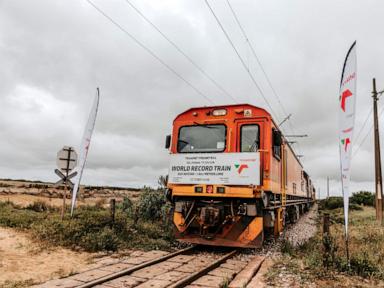
On June 21, 2001, BHP Iron Ore assembled a train in Western Australia that measured 7.353 kilometers—roughly 4.57 miles—from lead locomotive to tail car. Powered by eight General Electric AC6000CW locomotives distributed throughout its consist, the train hauled 682 ore cars loaded with 82,000 metric tons of iron ore across the Pilbara region from Yandi mine to Port Hedland. Total gross weight hit 99,734 metric tons. More than two decades later, that Pilbara run remains the longest and heaviest freight train ever operated in a single scheduled movement.
Records like this make for neat trivia, yet the obsession with length misses the actual story. Nobody builds a four-mile train for bragging rights. Railroads push length boundaries because Precision Scheduled Railroading and extreme operating-ratio discipline demand moving maximum tonnage with minimum crew starts, fewer locomotives idling in yards, and tighter asset utilization. When Wall Street rewards Class I carriers for driving operating ratios below 60 percent, stretching trains past two or even three miles stops being an engineering stunt and becomes standard operating procedure.
How Physics Punishes Extreme Train Length
Putting 15,000 or 20,000 feet of steel on a single track introduces mechanical forces that standard rail infrastructure was never designed to absorb. Every freight car connects to its neighbor via a knuckle coupler with roughly three to six inches of free play, known in the industry as slack. Multiply four inches of slack across 250 cars and you have more than 80 feet of accordion movement inside a single consist.
When the engineer at the head end notches up the throttle or applies dynamic braking, that energy does not travel instantaneously down the line. It moves as a kinetic wave. If the front of a three-mile train crests a hill and accelerates downhill while the rear is still climbing the grade, the resulting in-train forces—measured in hundreds of thousands of pounds of buff (compression) and draft (tension)—can snap a steel drawbar like dry kindling or lift empty cars straight off the rails in a stringline derailment.
Air brakes compound the problem. Conventional pneumatic braking relies on a pressure drop traveling through a brake pipe running the length of the train at roughly the speed of sound—about 1,100 feet per second. On a 15,000-foot train, it takes nearly 14 seconds just for the brake signal to reach the rear car. During those 14 seconds, the front of the train is already slowing down while the back end continues barreling forward at full track speed, slamming thousands of tons of momentum into the lead consist.
To keep these trains from tearing themselves apart, railroads rely on Distributed Power Units (DPUs). Instead of lashing six locomotives together at the front, dispatchers splice remote-controlled locomotives into the middle and rear of the train. Radio telemetry links the lead cab to the mid-train and rear units, allowing the engineer to apply power and air brakes simultaneously from multiple points. DPUs cut brake propagation times in half and balance drawbar pull across grades, turning an unmanageable whip of steel into controllable segments. Even with distributed power, however, radio dead zones in mountain canyons or rural valleys can sever communication between lead and remote units, forcing engineers to manage massive inertia blind until telemetry reconnects.
The Record Breakers and Why Geography Matters
Comparing the 2001 BHP Pilbara record to everyday North American freight operations requires looking at track geometry and traffic density. BHP operates a private, heavy-haul desert corridor built specifically for high-axle-load iron ore unit trains. The grades are engineered for predictable descending profiles toward the coast, there are no commuter trains sharing the right-of-way, and highway grade crossings are virtually nonexistent.
Contrast that controlled desert environment with the shared-use, bottlenecked freight corridors of the United States and Canada.
| Record / Benchmark | Operator | Year | Length | Gross Weight | Primary Cargo |
|---|---|---|---|---|---|
| All-Time World Record | BHP Iron Ore (Australia) | 2001 | 4.57 miles (7.35 km) | 99,734 metric tons | Iron ore |
| Sishen-Saldanha Record | Transnet Freight Rail (South Africa) | 1989 | 4.54 miles (7.30 km) | 71,600 metric tons | Iron ore |
| Routine US Mega-Train | Union Pacific / BNSF | Present | 2.5 to 3.2 miles | 18,000–25,000 short tons | Intermodal / Manifest |
In North America, Class I carriers routinely run intermodal and manifest trains stretching 12,000 to 16,000 feet across mixed terrain—crossing the Continental Divide, threading through river valleys, and slicing straight through downtown business districts in Ohio, Illinois, and Texas. A 2023 report by the U.S. Government Accountability Office found that average train lengths across major U.S. freight railroads increased by roughly 20 percent between 2008 and 2017 alone, with trains exceeding 10,000 feet becoming everyday fixtures on mainlines.
Here is the catch. While trains grew longer, the physical infrastructure built to let them pass one another stayed frozen in the 20th century.
The Siding Bottleneck and Blocked Crossings
Single-track mainlines depend on passing sidings—parallel stretches of track with switches at both ends—so two trains traveling in opposite directions can meet and pass without stopping the network. Most legacy sidings across North America were built to accommodate 6,000- to 8,000-foot trains.
Run a 14,000-foot train on a corridor with 8,000-foot sidings, and dispatchers lose operational flexibility immediately. The mega-train cannot pull into the siding because its tail end would foul the mainline switch. Instead, the dispatcher has to hold shorter, higher-priority trains in sidings for hours waiting for the monster consist to clear, or worse, stop the mega-train on the mainline with its rear stretching across three or four public road crossings.
For small towns built along rail corridors, the fallout is immediate and visible. Municipal fire departments, ambulance crews, and school buses routinely sit trapped behind stationary two-mile trains for 45 minutes or more while crews wait for a dispatcher signal or repair a broken air hose half a mile down the ballast. In states like Indiana, Ohio, and Texas, blocked-crossing complaints filed with the Federal Railroad Administration number in the tens of thousands annually. Yet federal preemption under the Interstate Commerce Commission Termination Act repeatedly strikes down state and local laws attempting to fine railroads for blocking intersections, leaving municipalities with zero enforcement leverage.
What Happens Inside the Cab When Things Go Wrong
Ask a veteran locomotive engineer about running a 15,000-foot mixed-manifest train—one carrying heavy tank cars of chemicals on the rear and empty boxcars near the front—and you will hear a very different story than the investor presentations given in Omaha, Jacksonville, or Fort Worth.
Train makeup rules exist specifically to prevent heavy rear blocks from crushing lighter front blocks during braking, a phenomenon known as jackknifing. Under intense cost pressure to turn yards quickly, however, terminal managers frequently build trains based on departure deadlines rather than optimal weight distribution. When a mixed-manifest train combines varying car lengths, different braking ratios, and uneven tonnage across three miles of undulating track, the engineer becomes a tightrope walker managing invisible forces two miles behind the cab.
If an emergency brake application occurs—triggered either by the engineer or by an unintended air-hose separation—the crew faces an immediate diagnostic nightmare. In freezing winter weather, walking two miles of uneven ballast in the dark to locate a parted air hose or a broken knuckle can take over an hour. Until that defect is found and repaired, the mainline is dead. Every train behind it stacks up like dominoes across multiple subdivisions.
Consider a hypothetical scenario on a single-track mainline in the Midwest during a January cold snap. A 15,200-foot manifest train experiences an unintended emergency brake application when extreme cold shrinks rubber air-hose gaskets, causing a coupling to part 110 cars back from the lead locomotive. The conductor steps down from the cab into sub-zero windchill and begins walking the ballast—over a mile each way—carrying a 40-pound replacement knuckle and tools. Because the train sits across two county roads and a state highway, local emergency vehicles must detour twelve miles around the blockage, while three following intermodal trains sit stopped at red signals for two hours, burning diesel and blowing delivery windows for downstream warehouses. Nothing crashed, no hazmat spilled, and no regulator logged an accident—yet an entire regional supply chain ground to a halt because the train outgrew the railroad.
The Labor and Regulatory Fault Lines
The push toward mega-trains sits squarely at the center of the fiercest labor and safety battles in modern freight transportation. Over the past decade, major North American carriers reduced total headcount by roughly 30 percent while consolidating operations into fewer, longer trains. Fewer trains mean fewer two-person crews required to move the same total freight volume—a direct boost to operating margins.
Rail labor unions, including the Brotherhood of Locomotive Engineers and Trainmen (BLET) and SMART-TD, argue that stretching trains beyond two miles degrades safety margins while pushing crew fatigue to breaking points. Handling a 15,000-foot consist requires constant cognitive calculation of terrain profiles miles ahead and behind the cab, leaving zero margin for distraction. When railroads simultaneously campaign to reduce crew sizes from two people down to a single engineer assisted by ground-based mobile conductors, unions warn that the industry is stripping away its last human redundancy just as train physics grow most unforgiving.
Federal regulators have struggled to keep pace. In 2024, the National Academies of Sciences, Engineering, and Medicine released a comprehensive congressionally mandated study examining trains longer than 7,500 feet. The report confirmed that while longer trains are not inherently unsafe when properly built and operated, they introduce distinct operational risks: higher probabilities of broken knuckles, increased communication dropouts with distributed power units, greater demands on engineer skill, and severe disruption to emergency responders at blocked grade crossings.
Despite those findings, the Federal Railroad Administration still imposes no statutory cap on freight train length in the United States. Railroads argue—correctly, from a pure macro-emissions standpoint—that consolidating freight onto fewer trains reduces locomotive fuel burn per ton-mile and keeps tens of thousands of long-haul semi-trucks off interstate highways. Taking freight off rubber tires and putting it on steel wheels remains the most energy-efficient way to move bulk goods overland.
The Real Limit Isn't Engineering
BHP proved back in 2001 that if you control the track, own the mines, eliminate public crossings, and match every locomotive and ore car to a single purpose, you can run a train nearly five miles long without losing control. Engineering is not the bottleneck.
The real ceiling on train length is compatibility with the world outside the rail corridor. Public freight railroads do not operate in closed Australian deserts; they run through living cities, over century-old bridges, and across thousands of public roads shared with commuters and ambulances. Every time a carrier stretches a consist another thousand feet to shave a tenth of a point off its operating ratio, it shifts hidden costs onto local towns, tired crews, and aging track geometry. Until railroads invest as aggressively in lengthening passing sidings, upgrading grade separations, and enforcing strict train-makeup rules as they do in cutting crew starts, the longest trains on the network will remain a monument to short-term accounting rather than operational mastery.