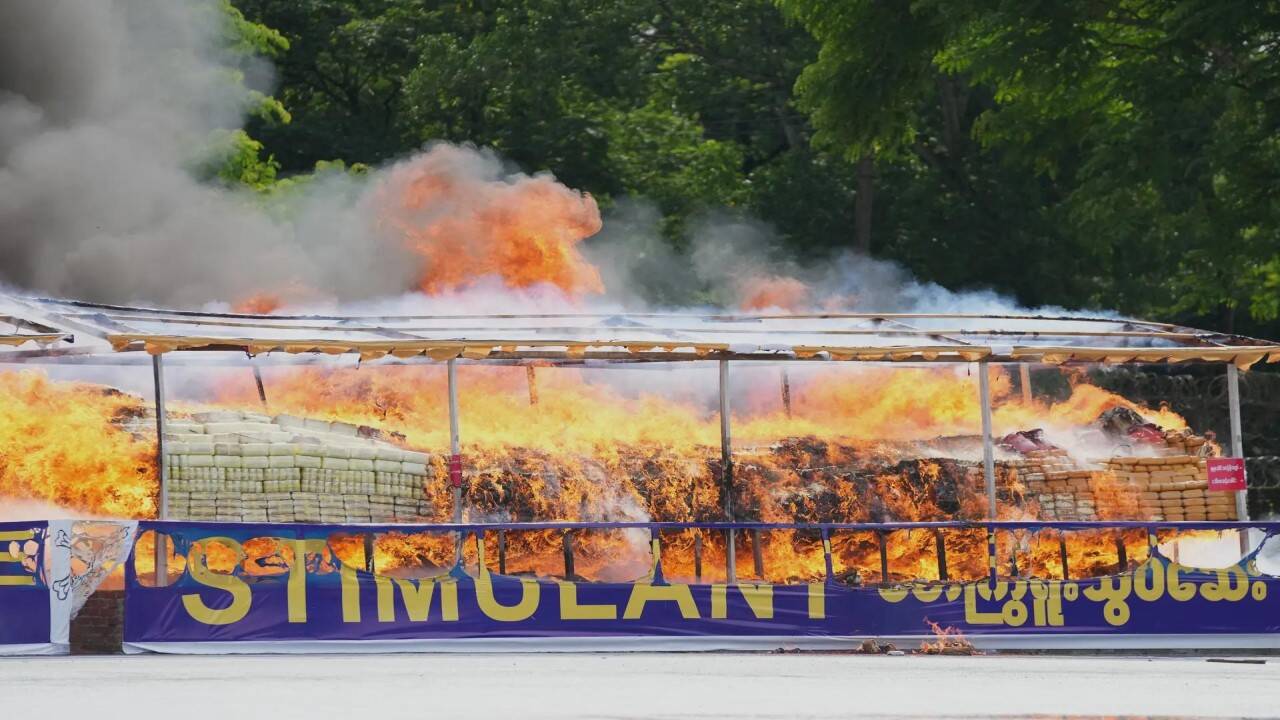
The heat from the bonfires hits your face long before you can see the flames clearly through the midday haze. It is an unnatural, chemical heat. It smells of scorched plastic, vinegar, and something deeply metallic that catches in the back of the throat.
On the outskirts of Yangon, black smoke billows into a pale June sky. Uniformed officials toss neat bricks of compressed white powder and plastic bags filled with brightly colored pills into the roaring pits. According to the official ledger, more than $600 million worth of heroin, methamphetamine, cannabis, and opium is turning to ash. It is a massive, highly synchronized public spectacle timed perfectly with the International Day Against Drug Abuse and Illicit Trafficking.
To the casual observer watching the evening broadcast, it looks like a victory. The sheer scale of the destruction is designed to stun. $600 million is an astronomical figure, a sum that could build hospitals, fund schools, or modernize crumbling infrastructure. Watching it burn feels like a definitive, crushing blow to the syndicates running the trade.
But if you look past the wall of fire, at the quiet edges of the crowd where local spectators and weary journalists stand, the mood is entirely different. There is no celebration. There is only a heavy, exhausting sense of déjà vu.
Because we have seen this exact fire before. We see it almost every year. And every year, the syndicates keep cooking.
The Illusion of the Dent
To understand why a $600 million bonfire changes absolutely nothing, we have to look at the math of modern narcotics manufacturing.
Imagine a local farmer in the rugged hills of Shan State. For generations, his family has cultivated small plots of land. He is not a cartel boss. He is a father trying to survive in a region fractured by decades of civil conflict, where the central government’s reach is a theory rather than a reality. When the local armed group tells him to plant poppies instead of cabbage, he plants poppies. If he refuses, the consequences are immediate and violent.
From his fields comes the raw opium, which is bought for pennies on the dollar. It is transported down hidden mountain tracks to mobile, makeshift laboratories hidden beneath the jungle canopy.
In the past, the drug trade was bound by the laws of nature. You needed land, the right climate, a harvest season, and months of vulnerable growth before you could produce a single gram of heroin. If authorities found the fields and sprayed them, the supply chain collapsed for the year.
That old world is dead.
Today, the Golden Triangle—the border region where Myanmar, Laos, and Thailand meet—is dominated by synthetic drugs. Methamphetamine doesn’t require a harvest season. It doesn't care about the weather. It requires only precursor chemicals, blue plastic barrels, and a few chemists working in a hidden shed.
Consider how cheap it is to make a single "yaba" pill—the cheap, caffeine-laced methamphetamine tablet that floods Southeast Asia. The raw chemical cost is a fraction of a cent. By the time it reaches the streets of Bangkok or Dhaka, the markup is thousands of percent.
When authorities seize and burn $600 million worth of these drugs, they are not burning the cartels' profit margins. They are burning their excess inventory. In the language of corporate supply chains, it is an acceptable write-off. The cost of doing business in a lawless zone.
The Invisible Stakes at the Border
The real tragedy of the Yangon bonfires is that they act as a smoke screen for a much deeper, more systemic crisis. While the cameras focus on the flames, the true engine of the crisis remains completely untouched.
That engine is instability.
Since the 2021 military coup, Myanmar has slipped into a complex, multi-sided civil war. The economy has fractured. The banking system is hobbled. Young people face a bleak choice between conscription, poverty, or fleeing the country. In this environment, the illicit economy isn't just a side venture; it is the only economy functioning at scale.
For many of the ethnic armed organizations and pro-regime militias controlling the borderlands, drugs are a survival strategy. They fund weapons. They pay soldiers. They buy political influence.
But the damage isn't confined to Myanmar’s borders. The drugs produced in these jungle labs flow outward like a massive, invisible tide, washing over neighboring countries with devastating force.
In Thailand, rural communities are grappling with an explosion of psychiatric crises linked to long-term meth abuse. In Bangladesh, refugee camps are targeted by traffickers looking for desperate couriers. In communities across the region, families are quietly tearing themselves apart trying to save children hooked on pills that cost less than a cup of coffee.
When you stand near the fires in Yangon, you realize the true cost isn't measured in dollars. It is measured in the broken lives of people who will never see these press conferences, but who bear the full weight of the supply chain's efficiency.
Shifting the Lens
For decades, global drug policy has treated the narcotics trade as a game of whack-a-mole. Seize the shipment. Arrest the low-level courier. Burn the product on television. Repeat next year.
It is a strategy based on a profound misunderstanding of human behavior and economics. You cannot arrest your way out of a supply chain fueled by systemic poverty and political chaos. As long as a young man in Shan State has no legal way to feed his family, and as long as regional militias need untraceable cash to buy ammunition, the labs will keep running. The blue barrels will keep bubbling.
True progress doesn't make for good television. It doesn't involve dramatic explosions or walls of orange fire against a dramatic sky.
It looks like building a dependable road so a farmer can get his legal crops to a market before they rot. It looks like creating stable jobs that pay a living wage. It looks like treating addiction as a public health crisis rather than a criminal failure, dampening the massive demand that pulls these drugs across the border in the first place.
Until that slow, unglamorous work happens, the spectacles in Yangon remain hollow.
The fire eventually dies down. The officials pack up their folders and step into air-conditioned SUVs, driven away down roads cleared of traffic. The black smoke thins, leaving behind a gray, caustic ash that settles over the grass and into the nearby soil.
Tomorrow, a thousand miles away in the deep mist of the northern hills, a generator will sputter to life in a hidden bamboo shack. A worker will tip a plastic jerrycan of cold chemicals into a vat. And the machine will start turning all over again.