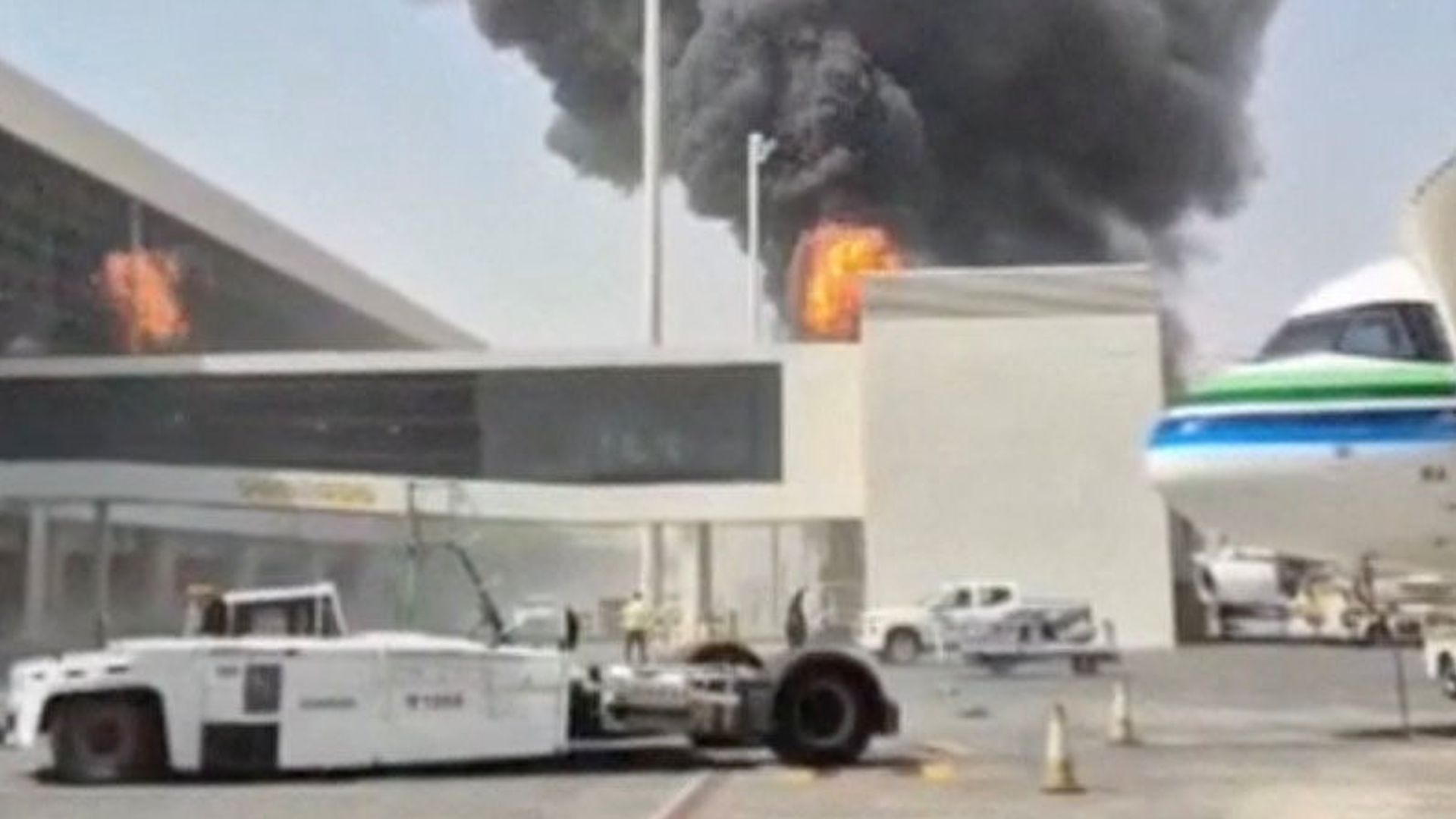
When a commercial aviation hub becomes a combat zone, the rules of modern defense rewrite themselves overnight. Three people lost their lives and multiple others sustained injuries when a drone strike claimed by Houthi forces struck Abha International Airport in southwestern Saudi Arabia. If you think this is just another regional skirmish in a distant corner of the globe, you aren't paying attention to how vulnerable civilian infrastructure has become to low-cost asymmetric warfare.
Airports are massive, sprawling, glass-fronted targets. They are designed to move thousands of travelers smoothly through security lines and boarding gates, not to withstand explosive-laden drone swarms. When Houthi fighters launched explosives across the border, they weren't aiming for a military bunker. They hit a parked civilian airliner, sparking fires and terrifying passengers.
Let's look at why standard defense systems struggle with this. Billions of dollars spent on Patriot missile batteries can stop high-altitude ballistic missiles. But firing a multi-million-dollar interceptor at a modified consumer drone costing a few thousand dollars is a losing economic game. Insurgents and proxy groups know this math. They exploit the gaps in traditional radar coverage by flying low, utilizing terrain masking, and launching from commercial vehicles.
The Anatomy of a Border Air Defense Crisis
Abha International Airport sits roughly seventy miles from the Yemeni border. Its high-altitude location in the Asir province makes it a vital economic and transit link for southwestern Saudi Arabia. It is also well within the operational range of crude loitering munitions and modified delta-wing drones that the Houthis assemble using smuggled foreign components.
Security analysts often miss the logistical reality of intercepting these threats. Traditional military radar networks optimize for fast, high-flying jets. They routinely struggle with slow, low-radar-cross-section drones that blend into civilian air traffic and ground clutter.
- Radar blind spots: Low-altitude horizon clutter makes tracking small uncrewed aerial vehicles notoriously difficult.
- Response windows: Warning times drop from minutes to seconds when strike drones cross rugged mountainous terrain at low speeds.
- Collateral risks: Intercepting a drone directly over a crowded terminal carries massive risks of falling debris and secondary explosions.
Governments across the Middle East are scrambling to upgrade electronic warfare capabilities, investing heavily in directional radio-frequency jammers and mobile short-range air defense systems. Yet, retrofitting thousands of square miles of civilian infrastructure with military-grade counter-drone tech remains an ongoing challenge.
Economic Fallout and Regional Stability
Air travel drives modern economies. When attacks disrupt operations at major regional hubs like Abha or nearby Jizan, international carriers pause flights, insurance premiums spike, and business confidence takes a direct hit.
Tourists don't book tickets to destinations where airspace security feels uncertain. Saudi Arabia has poured immense capital into transforming its tourism sector and opening its economy under Vision 2030 initiatives. Events like these force security planners to rethink how open, welcoming spaces can simultaneously maintain fortress-level defense readiness.
You can't put a Patriot battery at every domestic airstrip. That reality forces a shift toward localized electronic countermeasures, sensor-fusion networks, and intelligence-led disruption of supply chains before the launch platforms ever leave the ground.
What Travelers and Observers Must Understand
Most mainstream news coverage focuses purely on the casualty counts and diplomatic condemnations that follow these strikes. They rarely explain the underlying technological shift taking place in modern conflicts. War is democratizing downwards. Cheap technology is punching holes in expensive defense umbrellas.
Monitoring these developments requires looking past the immediate headlines. Pay attention to how air traffic management agencies coordinate with defense ministries, how insurance markets reprice regional risk, and how quickly nations adopt laser and microwave directed-energy weapons to solve the cost asymmetry problem.
The security posture of global aviation must adapt to a world where anyone with an off-the-shelf drone and GPS coordinates can threaten international commerce. Ignoring these vulnerabilities is no
Why Regional Security Flared Up When Abha Airport Took the Hit
news
Airports are supposed to be safe zones. They are commercial hubs, transit points for families, and neutral ground in the middle of geopolitical chess matches. But conflict zones rarely respect international norms. When Houthi-claimed strikes targeted Saudi Arabia's Abha International Airport, leaving multiple people dead and several others injured, it wasn't just a localized tragedy. It was a stark escalation in a long-running regional war that continues to threaten civilian infrastructure across the Middle East.
If you have been following the Yemen conflict from a distance, you might view these events as isolated skirmishes in a remote desert. They aren't. They represent a dangerous shift toward targeting commercial aviation and civilian transit hubs to maximize psychological and political impact. Let's look at what actually happened, why Abha Airport became a primary target, and what this means for regional security moving forward.
The Anatomy of the Strike on Abha Airport
Abha International Airport sits in the southwestern corner of Saudi Arabia, relatively close to the Yemeni border. Because of its geographic location, it has frequently found itself in the crosshairs of cross-border projectiles launched from territory controlled by Houthi forces in Yemen.
Previous attacks typically involved crude explosive-laden drones or ballistic projectiles aimed at interceptor batteries or military installations nearby. However, strikes hitting active commercial terminals change the entire calculus. When civilian casualties occur at a functioning airport, the incident immediately transcends a localized military engagement. It becomes an international headline.
The strikes caused immediate chaos. Flights were grounded, passengers scrambled for shelter, and emergency responders flooded the tarmac. Three people lost their lives, and several others sustained injuries ranging from shrapnel wounds to severe trauma.
Why Commercial Aviation Keeps Getting Targeted
Militant groups don't strike airports by accident. They choose these locations deliberately.
First, there is the psychological factor. Striking an airport strikes at the heart of economic confidence and travel mobility. It sends a message that no place is entirely safe, even hundreds of miles away from the front lines of active ground combat.
Second, Saudi Arabia's coalition involvement in Yemen made Saudi infrastructure a primary objective for retaliatory actions. The Houthis have consistently utilized asymmetric warfare tactics, relying on cheap loitering munitions and ballistic systems to pressure the Saudi-led coalition. When conventional military targets prove difficult to penetrate due to advanced air defense systems, civilian and semi-military dual-use facilities often bear the brunt of the strategy.
Air defense systems like the Patriot batteries deployed throughout the kingdom intercept a massive percentage of incoming threats. Yet, no defense net is impenetrable. A single drone or fast-moving projectile slipping through the cracks can cause catastrophic damage in a crowded terminal.
The Regional Ripple Effects
Incidents like this ripple far beyond the tarmac in Abha. They harden diplomatic stances and complicate fragile peace talks. Every time civilian casualties mount, retaliatory airstrikes usually follow, creating a grim cycle of escalation that is brutally difficult to break.
International aviation authorities monitor these events closely. Heightened threat levels lead to rerouted flight paths, increased insurance premiums for carriers operating in the region, and stricter safety protocols. The economic toll on regional tourism and trade adds another layer of pressure to governments already dealing with complex domestic challenges.
You have to look at the broader picture. The war in Yemen has created one of the worst humanitarian crises in modern history, driven by proxy dynamics, fractured governance, and relentless cross-border violence. Until a comprehensive, binding political settlement addresses the root causes of the conflict, infrastructure sites like Abha Airport will remain dangerously exposed to the fallout of regional instability.
Moving Past the Cycle of Retaliation
Understanding these clashes requires stripping away the sanitized language of military briefings. War isn't just a series of coordinated tactical movements. It's shrapnel tearing through civilian terminals, flights canceled for terrified passengers, and families mourning loved ones caught in the crossfire of a regional struggle.
The international community faces persistent challenges in securing ceasefires and holding accountable those who target civilian transit. Until diplomatic frameworks have real teeth and security architecture adapts to modern asymmetric drone warfare, airports near conflict zones will remain vulnerable high-value targets.
Keep a close eye on diplomatic channels in the coming months. Real stability in the region won't come from better missile defense systems alone. It requires genuine political compromise at the negotiating table, where the safety of civilians finally takes precedence over military posturing.