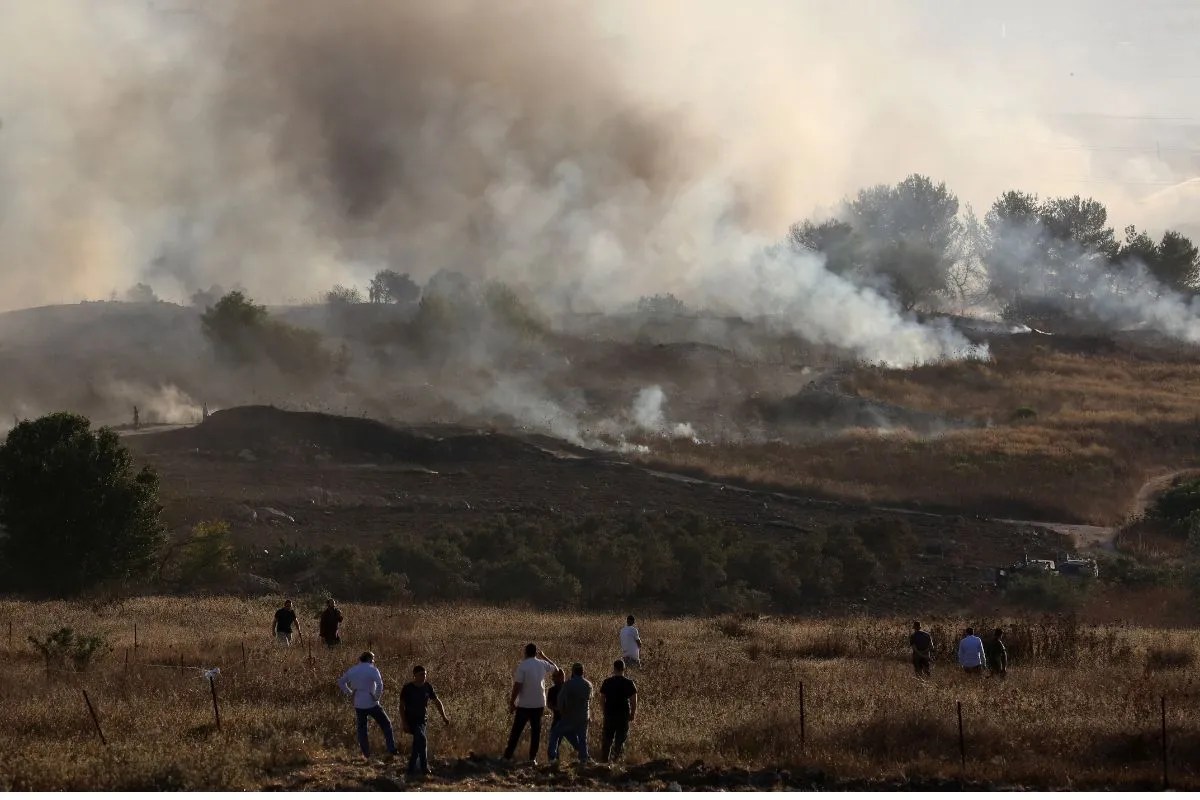
Strikes on Yemen's interim capital, Aden, do not merely reflect tactical harassment by Houthi forces; they test the operational coherence of the anti-Houthi coalition and expose the trade-off between coastal control and rear-area security. Conventional conflict reporting often treats missile barrages, drone activity, and ground advances near Aden as isolated news items or symbolic provocations. A sharper strategic reading looks at how pressure on Aden forces coalition planners to reallocate scarce forces, disrupts logistics and diplomacy, and alters the balance along the Red Sea and Bab el-Mandeb corridor.
The core mechanism driving this escalation is asymmetric force diversion. When Houthi forces threaten Aden—whether through long-range strikes on infrastructure such as the airport or ground pushes along approaches into Lahij and surrounding districts—they compel Saudi-backed Yemeni government and allied forces to prioritize defending the seat of government over offensive operations elsewhere. Even when air defenses intercept incoming threats or counter-operations push attackers back, the mere threat forces commanders to shift troops, air defense assets, and command attention away from coastal offensives or contested fronts.
Deconstructing Standard Coverage of the Aden Escalation
Typical news coverage of Houthi strikes on Aden relies on an event-driven reporting model. It catalogs individual incidents—missile launches, airport disruptions, clashes on nearby fronts, and diplomatic reactions—and presents them sequentially. That approach captures immediacy, yet it leaves three analytical blind spots.
First, standard coverage often treats political legitimacy and physical security as interchangeable. Aden functions as the internationally recognized government's administrative hub and diplomatic entry point. Striking or threatening Aden degrades confidence among officials, travelers, and external partners even when military damage is limited. Yet physical disruption of a hub does not automatically equate to territorial capture, and treating every strike as an imminent collapse of state authority conflates psychological leverage with decisive ground control.
Second, event-driven reporting frequently understates force-allocation trade-offs. In a theater marked by fragmented Yemeni factions, rugged terrain, and finite coalition resources, reinforcing one sector usually means thinning another. Pulling units back from coastal or western axes to screen Aden's approaches can preserve the interim capital while surrendering momentum or exposing flanks elsewhere.
Third, surface accounts often separate local Yemeni fighting from regional maritime and cross-border dynamics. In reality, pressure on Aden interacts directly with control over the Bab el-Mandeb strait, Red Sea shipping lanes, and broader regional bargaining between Riyadh, Tehran, and Western partners. An escalation in southern Yemen is rarely just a local battle; it is a lever in a wider contest over deterrence and leverage.
Four Structural Pillars of the Aden Front
To move beyond headline tallying, analysts can evaluate escalations around Aden through four interconnected pillars: hub vulnerability, the coastal-interior trade-off, infiltration and rear-area friction, and escalatory signaling.
Hub Vulnerability and Institutional Friction
Aden's strategic value rests on its role as a node connecting external support to domestic governance. Ports, airfields, communications, and government compounds act as concentration points where a small number of disruptions can ripple through administration and logistics. When strikes target transport nodes or force temporary flight suspensions and security lockdowns, the friction is operational as well as symbolic: diplomatic visits slow down, supply chains face delays, and decision-makers operate under constant threat.
The Coastal-Interior Trade-Off
Coalition strategy in Yemen repeatedly confronts a classic resource-allocation dilemma: push along the Red Sea coast and Bab el-Mandeb approaches to weaken Houthi maritime reach, or anchor security around Aden and key interior corridors. Advancing along the coast stretches supply lines and leaves flanks exposed if allied forces lack unified command and depth. Conversely, pulling back to shield Aden protects the political center at the cost of ceding coastal initiative and giving Houthi forces breathing room to consolidate positions.
Infiltration and Rear-Area Friction
Modern irregular and semi-conventional campaigns in Yemen rarely rely solely on frontal assaults. Attackers often probe terrain, test gaps between disparate anti-Houthi units, and attempt small-unit infiltration or harassing fire to stretch defenders thin. Where anti-Houthi forces have overlapping chains of command or differing local priorities, rear-area security becomes a force multiplier for the attacker. Defenders must spend manpower patrolling wide perimeters and guarding checkpoints rather than concentrating combat power for counteroffensives.
Escalatory Signaling and Bargaining Leverage
Strikes near Aden also serve as a signaling mechanism. By demonstrating reach toward the government's interim base while simultaneously engaging along other fronts or across borders, Houthi leadership communicates that pressure will rise if political or military demands go unmet. This dynamic is a working hypothesis in any given flare-up rather than a proven sole motive—commanders may combine opportunistic local gains with broader bargaining signals—but its effect on negotiation dynamics is real: it raises the perceived cost of inaction for Riyadh and its partners while complicating any rapid stabilization.
Facts Versus Analytical Inference
Clear analysis requires separating verified battlefield mechanics from broader interpretation. Known facts include the geographic centrality of Aden as the Yemeni government's interim base, the recurring use of drones, missiles, and ground probes in multi-front Yemeni fighting, and the recurring tension between coastal operations near Bab el-Mandeb and defensive commitments further south.
What remains educated inference—subject to change as intelligence and ground reporting evolve—is the precise degree to which a given strike reflects degraded coalition air-defense coverage versus a deliberate choice to conserve interceptors, as well as whether local clashes represent a sustained push toward siege conditions or a bounded campaign aimed at forcing coalition redeployment. Treating tactical events as proof of long-term strategic outcomes is one of the fastest ways to misread Yemeni war dynamics.
Operational Realities and Strategic Limitations
From an operational standpoint, stabilizing Aden and the surrounding approaches involves several concrete steps:
- Unify perimeter command and intelligence sharing across local security forces, government units, and coalition advisors so early warning of drone, missile, or ground probes translates into rapid, coordinated response rather than fragmented reactions.
- Harden critical nodes and disperse logistics, reducing reliance on single points of failure for fuel, medical supplies, communications, and air or sea access.
- Establish tiered air and counter-drone defense that matches interceptor cost and availability to threat volume, preventing expensive stocks from being depleted by lower-cost drones or rockets.
- Pair defensive screening around Aden with mobile reserve forces, allowing defenders to blunt infiltrations without permanently locking elite units into static guard duty.
- Align military moves with clear political and economic objectives, ensuring local stabilization supports governance and service delivery rather than merely freezing frontlines.
None of these measures offers a silver bullet. Yemen's geography, factional politics, and regional entanglements impose hard limits on any external or domestic actor. Air and missile defenses have leak rates and reload constraints; dispersed logistics can still suffer intermittent disruption; and fragmented coalitions often struggle to maintain unity of effort once immediate crisis pressure eases. Even well-executed defensive improvements can only buy time and bargaining space unless paired with durable political arrangements.
Strategic Recommendation
Coalition planners and Yemeni authorities should treat threats to Aden as a deterrence and force-economy problem, not a cue to abandon broader coastal or strategic objectives wholesale. The sharpest strategic play is to ring-fence Aden with layered, cost-effective point defense and tight rear-area security while holding a dedicated mobile reserve—avoiding a wholesale collapse of coastal and Bab el-Mandeb posture while denying Houthi forces a cheap psychological or logistical victory at the interim capital.