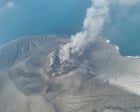
Modern aviation architecture assumes an atmosphere free of particulate abrasives, a baseline assumption shattered when subterranean pressure systems discharge silicate-heavy tephra into commercial flight corridors. When Mount Anak Krakatau initiated a sudden eruptive sequence in the Sunda Strait, discharging a dual-vector plume reaching heights of 50,000 feet, the immediate consequence was not merely a localized travel inconvenience. It triggered a cascade failure across eight Indonesian airports, forcing the complete suspension of operations at Soekarno-Hatta International Airport and stranding tens of thousands of passengers. Evaluating this event requires stripping away standard journalistic accounts to examine the mechanical, economic, and logistical mechanics governing airspace shutdowns under volcanic stress.
The Aeromechanical Threshold of Volcanic Particulates
Jet turbine engines operate at internal temperatures exceeding the melting point of silicate minerals found in volcanic ash. When an aircraft ingests microscopic glass and rock fragments, these particles liquefy within the combustion chamber, subsequently coating the turbine stator blades and cooling passages as they hit slightly cooler downstream regions. This vitrification process induces rapid engine stall, thrust loss, and potential flameout. Beyond thermal degradation, abrasive tephra erodes compressor blades, pits cockpit windscreens, and clogs vital pitot-static systems, neutralizing instrumentation accuracy.
Regulators operate under a zero-tolerance threshold for particulate density in active flight paths. Satellite observations tracking the Krakatau plumes revealed two distinct vectors: a lower 20,000-foot drift heading northeast over Jakarta, Banten, and West Java, and a high-altitude 50,000-foot plume stretching westward toward Sumatra and the open Indian Ocean. AirNav Indonesia and meteorological agencies utilized these dispersion metrics to execute preemptive closures. Because volcanic ash clouds are visually indistinguishable from ordinary meteorological clouds under nocturnal or overcast conditions, radar systems alone are insufficient; air navigation service providers must rely on Volcanic Ash Advisory Centers to map particulate concentration boundaries, enforcing hard operational stops long before visual confirmation from flight decks.
The Cascading Cost Function of Hub Disruption
Soekarno-Hatta International Airport functions as the primary hyper-concentrated hub for the Indonesian archipelago, creating a high-beta vulnerability node for commercial carriers. When air traffic management implements a ground stop, the economic and logistical damage extends far beyond the direct flight cancellations.
- Fleet Rotation Immobilization: Commercial aircraft operate on tight utilization schedules designed to maximize revenue hours per airframe. Grounding aircraft at a central hub breaks network rotations, preventing downstream airports from receiving incoming equipment. A single aircraft stuck in Jakarta cascades into cancellations across remote domestic outposts from Bali to Sulawesi.
- Ground Service Recovery Stress: Terminal capacity limits force airport operators to activate emergency protocols, such as the Service Recovery Action framework deployed by state operator InJourney. Providing sustenance, alternative routing, and holding capacity for over 150,000 affected travelers strains terminal retail infrastructure and security perimeters.
- International Network Friction: Long-haul carriers including Singapore Airlines, Malaysia Airlines, and Qantas were forced to terminate or reroute regional legs, illustrating how localized tectonic activity instantly impacts multi-lateral international airline alliances and slot coordination.
Mitigation Mechanics and Forecasting Limitations
Disaster mitigation agencies face significant constraints when attempting to clear atmospheric tephra through active intervention. The deployment of weather modification operations, specifically cloud-seeding via aircraft to induce heavy rainfall and wash suspended particulate matter out of the lower troposphere, represents an aggressive attempt to accelerate environmental recovery. However, cloud-seeding is bounded by atmospheric humidity and wind shear dynamics; it cannot influence high-altitude stratospheric plumes driven by jet stream velocities.
Predictive modeling for Anak Krakatau remains fundamentally probabilistic rather than deterministic. Geological assessments confirming magma and gas replenishment beneath the crater indicate that eruption frequency does not correlate linearly with structural stability. The 2018 flank collapse and subsequent tsunami demonstrated that structural failure can occur independent of major vertical explosions. Consequently, civil aviation authorities cannot rely on static exclusion zones; they must maintain dynamic, multi-agency synchronization loops involving the Center for Volcanology and Geological Hazard Mitigation, state meteorologists, and air traffic controllers to adjust safety margins in real-time.
Airlines and regulatory bodies must transition from reactive airspace closures to dynamic four-dimensional trajectory-based routing that utilizes real-time laser-based ash detection pods mounted on commercial fleets. Airport operators operating within the Pacific Ring of Fire must decouple terminal revenue models from single-hub dependencies, constructing decentralized aircraft staging reserves to absorb network shocks when primary gateways are compromised by subterranean volatility.