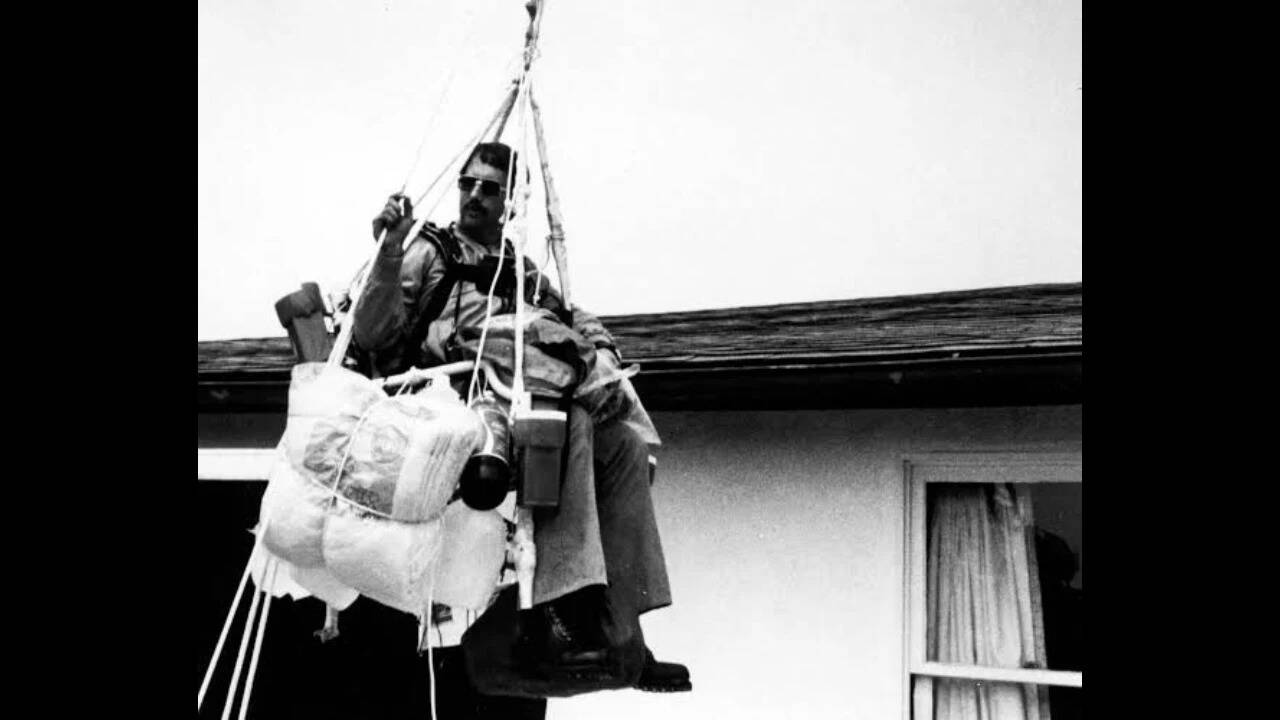
On July 2, 1982, a truck driver named Larry Walters untethered a lawn chair outfitted with forty-two helium-filled weather balloons in a San Pedro backyard, expecting a gentle drift over a local park. Instead, a catastrophic miscalculation of payload weight and atmospheric physics propelled him to sixteen thousand feet, directly into the approach corridor of Long Beach Airport.
Media narratives frame the event as a whimsical novelty or a classic human-interest anecdote about chasing childhood daydreams. This surface-level interpretation ignores the underlying operational failures. The flight was not merely an eccentric stunt; it was a total breakdown of risk management, regulatory compliance, and mechanical redundancy. Deconstructing the incident reveals a clinical blueprint of systemic failure that extends far beyond a backyard aeronautical experiment.
The Mechanics of Uncontrolled Ascent
The primary engineering flaw in the assembly, dubbed Inspiration I, lay in the absence of a controlled ballast gradient. Walters intended to maintain a low altitude by tethering the chair to his Jeep and slowly releasing line, supplemented by a pellet gun to puncture balloons for descent. When the primary anchor line snapped prematurely, the upward net force vector surged violently.
The physics governing the ascent operated on simple buoyancy principles. Each eight-foot weather balloon displaced a fixed volume of air, generating lift proportional to the density differential between ambient air and helium. Forty-two balloons generated a positive lift force vastly exceeding the combined mass of the aluminum chair, ballast water jugs, and Walters himself.
Without a rate-of-climb indicator or a graduated venting system, Walters entered an uncontrolled vertical trajectory. The ascent rate accelerated until reaching the mid-troposphere, where decreasing atmospheric pressure caused the latex walls of the weather balloons to expand. This expansion increased internal stress, pushing the vessel into freezing, hypoxic altitudes where cognitive function degrades rapidly.
Regulatory Deficits and Airspace Intrusion
The operational hazard of the flight escalated once the craft crossed horizontal boundaries into controlled federal airspace. Aviation regulators enforce strict separation minimums around commercial hubs to mitigate collision risks. Walters possessed zero flight training, no radio equipment capable of two-way communication on commercial frequencies, and no transponder to alert air traffic control.
Commercial pilots flying into Long Beach and Los Angeles reported sighting a man sitting in a lawn chair at fifteen thousand feet, creating an immediate hazard to civil aviation. The regulatory response was swift. Upon his descent—terminated when the balloon rigging snagged high-voltage power lines and triggered a twenty-minute neighborhood blackout—law enforcement detained him immediately.
The Federal Aviation Administration initially assessed violations totaling four thousand dollars, later reduced to fifteen hundred dollars through administrative appeals. These penalties targeted specific operational infractions:
- Operating an unairworthy civil aircraft without certification
- Navigating within an airport traffic area without communication clearance
- Endangering the life and property of others through reckless operation
The Post-Operational Collapse
The trajectory of public notoriety mirrors the physical flight profile: a rapid, uncontrolled ascent followed by an unstable plateau and a destructive crash. Following brief appearances on late-night television and a minor surge in motivational speaking inquiries, the novelty dissolved. The structural mismatch between momentary public fascination and sustainable long-term viability created acute psychological strain.
The aftermath exposed the dangers of unanchored public identity. Walters transitioned through sporadic employment as a security guard and volunteered with the United States Forest Service. The psychological baseline required to sustain a normal life eroded under the weight of unfulfilled expectations and the sudden evaporation of external validation. On October 6, 1993, Walters died by suicide in the Angeles National Forest at the age of forty-four.
Evaluating extreme personal risk requires measuring the systemic cost function against the marginal utility of the objective. When individuals bypass established safety protocols to achieve compressed, high-variance outcomes, the resulting structural instability often outweighs any temporary gain. Long-term operational survival depends on redundant controls, strict adherence to environmental constraints, and a realistic assessment of systemic vulnerabilities.