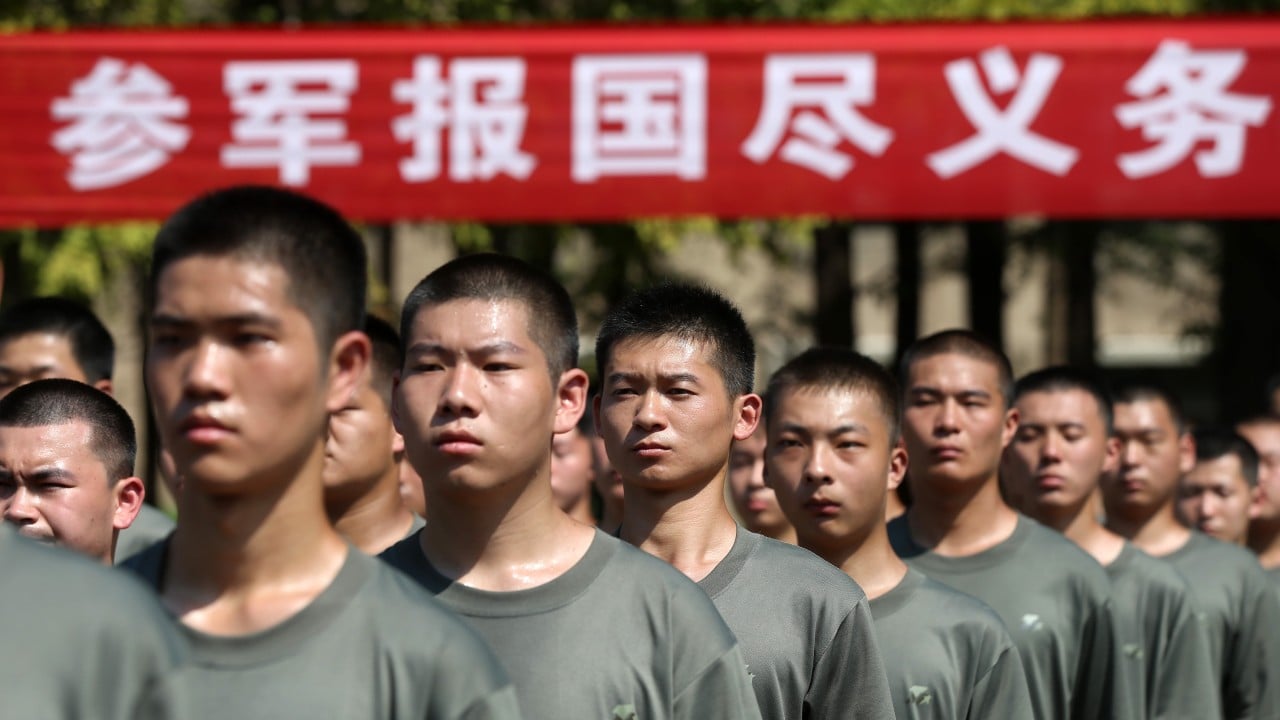
The red envelope used to weigh heavier than paper.
Picture a kitchen table in a third-tier Chinese city, sometime around the turn of the century. Let us call the father sitting at that table Wei, a hypothetical factory foreman whose hands are stained with machine oil and whose entire life has been a quiet, grinding negotiation with local bureaucracy. Across from him sits his twenty-year-old son. Between them lies an envelope containing several thousand yuan—an astronomical sum for a family counting fen at the grocery market—intended not for a wedding or a down payment on an apartment, but for the local armed forces recruitment officer. In that era, putting on the olive-drab uniform of the People’s Liberation Army was one of the few reliable escape hatches from rural poverty or dead-end factory work. Everyone knew the unwritten rules of the transaction. If you wanted your boy to pass the physical, if you wanted his file moved to the top of the stack, you paid the gatekeepers.
Greed. Quiet, systemic, suffocating greed.
For decades, that kitchen table scene repeated itself across thousands of counties, creating a silent rot inside the world’s largest standing military. When promotion, enlistment, and specialty assignments are auctioned off in smoke-filled backrooms, you do not end up with the sharpest minds or the most resilient bodies. You end up with the sons of people who could afford the envelope, managed by officers who spent more energy calculating kickbacks than studying modern warfare.
I have spent years watching how massive, opaque institutions try to cure themselves of corruption without relinquishing control. Usually, they fail because they rely on human virtue to police human temptation. You send an inspector to watch the recruiter, and within six months, the inspector is sharing tea and envelopes with the recruiter. You cannot audit your way out of a cultural habit when the ledger is kept in pencil and locked in a drawer.
Beijing eventually realized that a military built on favors could never fight a twenty-first-century war. You cannot bribe a hypersonic missile to miss its target, and you cannot buy your way out of an electronic warfare blackout. To modernize, the People’s Liberation Army needed software engineers, drone operators, satellite technicians, and logistics specialists—young men and women who had options in the booming private tech sector and zero interest in paying a corrupt local official for the privilege of scrubbing barracks floors.
So the military turned to the one thing it trusted more than human integrity: cold, unblinking code.
The Architecture of Sunlight
In official state parlance, the initiative is called "sunshine conscription." The phrase sounds like something dreamed up by a municipal sanitation department, conjuring images of freshly swept streets and public bulletin boards. In reality, it is one of the most ambitious, invasive, and technologically sophisticated human-sorting machines ever constructed.
To understand how it works, you have to stop thinking about a traditional military draft and start thinking about a high-frequency trading floor combined with a credit-scoring algorithm.
The core problem of the old system was discretion. Whenever a human being has the power to say "yes" or "no" in private, corruption breeds in the shadow of that decision. The architects of sunshine conscription decided to eliminate the shadow entirely by stripping local recruiters of their ability to make unilateral choices. Every step of the process—from initial registration on the national conscription portal to the final assignment of a recruit to a specific unit—was digitized, centralized, and subjected to automated cross-checking.
Consider a hypothetical twenty-two-year-old computer science graduate from Chengdu. Let us name him Lin. Ten years ago, Lin’s path into the military would have depended heavily on who his parents knew at the local People’s Armed Department. Today, the moment Lin enters his national identification number into the recruitment system, a sprawling web of big data wakes up.
The algorithm does not care who Lin’s uncle is. It pulls his university transcripts directly from the Ministry of Education databases. It scrapes his medical history from regional hospital networks, looking for anomalies that a bribed doctor might have previously overlooked. It cross-references his social credit metrics, his financial records, his travel history, and his digital footprint. Before Lin ever steps foot inside a recruitment center, the system has already built a high-resolution profile of his cognitive abilities, his physical baseline, and his ideological reliability.
This is what happens when a state decides that transparency is not a moral virtue, but an engineering problem.
The Death of the Gatekeeper
The physical examination, historically the easiest stage to manipulate, was redesigned to resemble an assembly line where nobody knows anyone’s name.
When Lin arrives at the medical screening facility, his smartphone is confiscated. He is given a wristband encoded with a randomized barcode. The doctors conducting the vision tests, the cardiograms, and the psychological evaluations do not see Lin’s name, his hometown, or his family background. They see only a string of digits on a tablet screen. The diagnostic equipment itself—the blood pressure cuffs, the eye charts, the blood analyzers—is wired directly into a central provincial server. A technician cannot manually type in a passing score for a recruit with flat feet or high blood pressure because the machine transmits the raw data straight to the cloud the second the test concludes.
If a doctor attempts to override a flagged result, the system triggers an immediate audit alert in a command center hundreds of miles away. Every keystroke is logged. Every anomaly is mapped.
Even the final selection—the moment a young person is officially accepted and assigned to a branch—has been handed over to a randomized computer lottery monitored by live cameras and public observers. Local officials sit in the room, watching screens flash with identification numbers, reduced to spectators in a process they once ruled like feudal lords.
It is an astonishing display of state capacity. By digitizing the pipeline, the PLA effectively broke the back of the petty bribery networks that had plagued its grassroots recruitment for generations. Families no longer need to empty their savings accounts to buy a uniform. In many provinces, public hotlines and QR codes are plastered across recruitment posters, inviting citizens to report any official who hints at a favor or a fee, promising swift, career-ending retaliation.
What the Data Actually Wants
Cleaning up the process was only half the equation. The deeper, more urgent driver behind this technological overhaul is a brutal demographic and strategic reality.
Modern warfare has changed its appetite. The PLA of the 1980s was a massive, infantry-heavy force designed to absorb casualties and overwhelm adversaries through sheer human volume. Today, Beijing is shrinking its overall troop numbers while pouring billions into artificial intelligence, cyber warfare, space systems, and naval aviation. A soldier who cannot read complex schematics, write basic code, or troubleshoot a jammed communications array is no longer an asset; he is dead weight.
For years, the military struggled with a painful mismatch. Rural recruits were often physically tough and eager to serve, but lacked the technical education required to operate sophisticated weaponry. Meanwhile, university graduates from coastal cities had the exact skills the military desperately needed, but viewed barracks life as a career killer—two years of rigid discipline, low pay, and lost momentum in a hyper-competitive job market.
Big data offered a way to hunt for needles in a haystack of 1.4 billion people.
Instead of waiting for talent to walk through the door, the recruitment system actively mines national databases to identify young people with high-value skills. Did a student win a regional robotics competition in Shenzhen? Did a vocational college graduate in Wuhan earn certifications in heavy diesel mechanics or drone maintenance? The algorithm flags them. Local recruitment offices receive automated lists of "precision targets," complete with tailored incentive packages.
The pitch to these young people has evolved dramatically. It is no longer just about patriotism and duty. It is a calculated financial and career transaction. The state offers full tuition reimbursement, guaranteed civil service exam advantages upon discharge, substantial cash bonuses from municipal governments, and fast-track entry into specialized technical units where recruits spend their service working with advanced hardware rather than digging trenches.
The Human Friction
Yet, for all its sleek efficiency, there is something deeply unsettling about watching a human life get reduced to a series of predictive variables.
I find myself wondering about the edge cases—the people who do not fit neatly into the parameters of an algorithm. History is full of extraordinary soldiers, leaders, and innovators who looked terrible on paper. Think of the kid from a struggling family who failed a couple of university exams because he was working night shifts to pay his mother’s medical bills, or the restless, unconventional thinker whose minor disciplinary infractions in high school would cause an automated screening tool to discard his file in milliseconds.
When you replace corrupt human judgment with incorruptible machine logic, you eliminate the bribes, yes. You also eliminate grace. You eliminate the seasoned sergeant who looks a nervous, underweight kid in the eye and sees a spark of grit that no biometric sensor can measure.
And there is another, quieter tension humming beneath the surface of this high-tech recruitment drive. Total transparency in an authoritarian system is rarely a two-way street. "Sunshine conscription" means the state can see everything about the citizen—every medical record, every academic grade, every financial transaction, every online association—while the citizen sees only what the state chooses to display on a public leaderboard.
For a young recruit like our hypothetical Lin from Chengdu, entering the military through this system means surrendering the last shreds of digital privacy before he even puts on a uniform. The same big data infrastructure that guarantees he won't be cheated out of his spot by a rich kid's bribe also ensures that his every movement, health metric, and behavioral shift will be tracked, scored, and archived indefinitely.
The Quiet Transformation
Walk past a recruitment station in a Chinese city today, and the atmosphere feels worlds apart from the tense, transactional environments of twenty years ago. There are no nervous fathers clutching thick envelopes in the hallways. Instead, there are sleek kiosks, facial recognition scanners, and young men and women staring at their phones, checking their real-time application status on mini-programs that look indistinguishable from food delivery apps.
The transformation is working. The educational profile of the average PLA recruit has risen sharply over the past decade, with college students and graduates now making up the vast majority of new enlistees in many regions. The complaints of local extortion have plummeted, replaced by a clinical, almost corporate efficiency.
Still, as I look at this seamless fusion of state surveillance and military manpower, I cannot shake a lingering sense of unease. We tend to assume that cleaner, smarter systems naturally produce better human outcomes. We cheer when technology strips away corruption and replaces cronyism with meritocracy.
But a cleaner, smarter recruitment machine is still a machine built for a singular, lethal purpose. By removing the friction of human greed, Beijing has not made its military softer or more humane; it has simply made it sharper, faster, and infinitely more capable of projecting power in the decades ahead.
Somewhere tonight, in a quiet apartment lit by the blue glow of a laptop screen, a twenty-one-year-old student is opening a message from a recruitment portal. No money has changed hands. No favors were asked. No laws were broken. The algorithm simply ran the numbers, found a match, and extended an invitation—clean as sunlight, and just as impossible to escape.