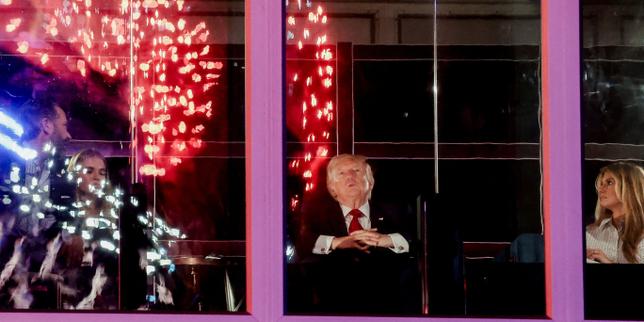
Mainstream media networks spent the entirety of the United States Semiquincentennial running the exact same script. They broadcasted glossy montages of fireworks over the National Mall. They dissected every syllable of Donald Trump’s address, hunting for partisan red meat or grand historical parallels. Left-leaning commentators decried the event as a nationalist rally wrapped in a historic milestone; right-leaning pundits heralded it as a triumphant restoration of the American spirit.
Both sides fell face-first into the same intellectual trap.
They treated the 250th anniversary of the United States as a living, breathing testament to ideological triumph. They want you to believe that the speeches delivered on the steps of the nation's monuments actually dictate the trajectory of the country. This collective obsession with political theater ignores a cold, structural truth: the American experiment survived two and a half centuries not because of its political rhetoric, but in spite of it.
The flag-waving spectacle hiding behind the media’s 250-year retrospective obscures a far more significant reality. America's true staying power has nothing to do with the symbolic pageantry broadcast to millions. It is driven by an unyielding, indifferent machine of institutional inertia, massive capital concentration, and geographic privilege that operates entirely independent of whoever happens to hold the microphone.
The Myth of the Great Man Anniversary
Media coverage of major national milestones always defaults to the "Great Man" theory of history. Journalists analyze the president’s speech as if words alone can steer a global superpower. We saw it during the Centennial celebrations in 1876 amidst the wreckage of Reconstruction, we saw it during the Bicentennial in 1976 following the trauma of Watergate, and we are seeing it again now.
This focus is entirely misplaced. A nation does not reach its 250th year because a leader gives a compelling speech or because crowds gather to watch fighter jets fly in formation.
History shows us that the real mechanics of American survival are deeply unglamorous. They exist in the dry, bureaucratic underpinnings of the civil service, the predictable enforcement of contract law, and the structural design of the financial system. When pundits obsess over presidential optics, they miss the actual foundation of the state.
Consider the baseline structural advantages that ensure American dominance regardless of political volatility:
- Geographic Isolation: Flanked by two vast oceans and bordered by non-threatening neighbors, the domestic core requires exponentially less defensive maintenance than any European or Asian counterpart.
- The Global Reserve Currency: The dominance of the US dollar allows the federal government to run deficits that would trigger immediate sovereign debt crises anywhere else on earth.
- The Invariant Bureaucracy: While political administrations cycle through the White House every four to eight years, the deep administrative state manages the logistics of empire with absolute continuity.
I have spent decades analyzing institutional operations and policy execution. I have watched administrations change, promises collapse, and ideological trends vaporize. The core apparatus never changes. To believe that a single commemorative speech or a political rally alters the vector of a 250-year-old superpower is to mistake the hood ornament for the engine.
Decoding the History of Milestone Distractions
To understand why the current commentary is so fundamentally flawed, look at how the United States marked its previous major milestones. Every single one was held during a period of intense domestic fracture, and every single one used hyper-patriotism to paper over structural rot.
The 1876 Centennial: A Republic in Splints
In 1876, Philadelphia hosted the Centennial International Exhibition. The media praised the event as a glorious reunion of a nation healed from the Civil War.
The ground reality? The country was trapped in the deepest economic depression it had ever faced up to that point. The presidential election of that exact year between Rutherford B. Hayes and Samuel J. Tilden was so corrupt and contested that it nearly triggered a second civil war, ultimately ending in a backroom deal that abandoned millions of newly freed citizens to Jim Crow segregation. The celebration was a deliberate, manufactured distraction from a broken political system.
The 1976 Bicentennial: The Hangover of Empire
Fast forward to 1876's sequel. The 1976 Bicentennial featured tall ships sailing into New York Harbor and endless corporate tie-ins. The media narrative focused on a resilient America bouncing back.
The actual state of the union was abysmal. The country was reeling from the humiliation of the Vietnam War, the resignation of Richard Nixon, staggering stagflation, and an energy crisis that forced citizens to line up for gasoline based on their license plate numbers. The Bicentennial did not cure those structural ills; it merely offered a temporary hit of cultural dopamine to a exhausted populace.
The current media circus surrounding the 250th anniversary follows the identical playbook. Pundits present a binary choice: view the images as a symbol of a dying democracy or a shining city on a hill. They completely miss the third, more accurate option. The celebration is an annual shareholder meeting for an empire that has automated its operations.
The Decoupling of Politics and Economic Power
The lazy consensus insists that political polarization is on the verge of tearing the nation apart. Every broadcast warns that the intense divisions showcased during national events threaten the country’s foundational stability.
This view ignores the complete decoupling of political rhetoric from corporate and economic reality.
While the political class fights cultural wars for television ratings, the actual machinery of American power—capital allocation, technological dominance, and industrial infrastructure—continues its expansion completely undisturbed. The entities that dictate the daily lives of global citizens do not care about the optics of a July 4th speech. They care about supply chain security, treasury yields, and intellectual property enforcement.
Imagine a scenario where the federal government grinds to a complete legislative halt for an entire year due to partisan gridlock. History demonstrates exactly what happens: the markets adjust, the Treasury continues issuing debt, private equity continues consolidating assets, and the tech giants continue deploying automated infrastructure. The political noise has become entirely decoupled from economic utility.
The true risk to the nation is not the polarization broadcast on the news. The danger lies in the collective delusion that electing one specific faction or delivering a better speech will magically resolve deep, structural, demographic, and fiscal imbalances.
The Flawed Questions Dominating Public Discourse
Public debate around national milestones routinely centers on the wrong questions. The mainstream media addresses queries that are fundamentally broken from the start. Let us dismantle the most prominent ones.
"Is America more divided now than ever before?"
This question displays a profound ignorance of history. The nation survived a literal civil war that killed hundreds of thousands of citizens on domestic soil. It survived the labor wars of the late 19th century, where private corporate armies used machine guns against striking workers. It survived the late 1960s, which saw routine domestic bombings, political assassinations, and entire cities burning from civil unrest.
The current division is highly visible because it is hyper-monetized by digital algorithms, but it lacks the physical, existential stakes of previous eras. It is a simulated conflict fought through screens, designed to drive engagement rather than mobilize armies.
"Can a president unite the country during a national milestone?"
No. The expectation that a single political figure can act as a unifying tribal chief for over 330 million people in a highly balkanized media environment is absurd. Unity is an outdated metric for a modern continental empire. Empires do not require ideological unity to function; they require operational compliance, tax revenue, and a functional legal framework. Seeking emotional unity from a political speech is a childish misinterpretation of how state power operates.
The Harsh Realities of the Next Era
Stepping away from the comforting illusions of the national anniversary broadcast reveals the real structural challenges that will define the upcoming decades. These issues cannot be solved by patriotic appeals or political posturing.
The primary challenge is fiscal unsustainability. The United States reached its 250th year carrying a national debt load that exceeds 100% of its Gross Domestic Product. Interest payments on that debt now outpace the entire national defense budget. No country in human history has ever inflated or spent its way out of this specific mathematical trap without enduring severe currency devaluation or structural reorganization. Neither political party addresses this reality because doing so requires demanding actual sacrifice from voters.
The secondary challenge is the decay of physical infrastructure contrasted against the boom of digital monopolies. The country possesses world-class digital architecture and financial engineering systems, built alongside crumbling physical bridges, an outdated electrical grid, and a failing public education system. The celebration of past achievements acts as a psychological defense mechanism against the reality of current physical decline.
Rejecting the Manufactured Narrative
The ultimate takeaway from the images of the 250th anniversary celebrations is not found in what was broadcast, but in what was deliberately omitted.
Stop looking at the podium. Stop analyzing the tone of the president's voice. Stop letting corporate media networks sell you an emotional narrative of either impending doom or exceptional rebirth.
The United States is an immense, institutional machine that has survived for 250 years because its foundational architecture was built to withstand the incompetence and vanity of its political class. The speeches are just noise. The fireworks are just smoke. The machine keeps running, indifferent to the theater we construct around it.