Navigating remote terrain without terrestrial cellular infrastructure creates a high-stakes operational equation where technical redundancy determines survival. When an 88-year-old driver and his dog became stranded in thick mud along a remote back route between Carefree and Bloody Basin in Yavapai County, Arizona, standard emergency protocols failed instantly. The traditional failure point in such scenarios is not vehicular immobilization, but communication latency. Without local cell towers, conventional voice calls and data packets cannot transmit. The incident highlights the mechanics of satellite-enabled emergency text protocols, demonstrating how precise geospatial data transmission bypasses regional communication blackouts.
The Triad of Backcountry Failure Modes
In remote navigation emergencies, structural collapse typically follows a sequential pathway rather than a single catastrophic event.
- The Infrastructure Void: Terrestrial cellular networks rely on line-of-sight propagation to local towers. Mountainous topologies, canyons, and remote desert basins create total signal shadows. When vehicles enter these zones, mobile devices drop from active networks into no-service states, severing standard dispatch channels.
- Environmental Degradation: Regional weather events, such as Arizona monsoon storms, alter soil mechanics rapidly. Dry dirt roads transform into saturated, high-viscosity clay mixtures that exceed standard tire traction thresholds, resulting in sudden vehicle entrapment miles away from primary thoroughfares.
- Behavioral Entropy: Stranded individuals frequently commit critical tactical errors by abandoning their vehicles to seek signal or shelter. Movement through unmarked, hostile terrain dramatically increases physiological stress, dehydration risk, and the geometric search area for rescue authorities.
The Cost Function of Positional Uncertainty
Search and rescue efficiency is defined by time-to-contact, which correlates directly with positional accuracy. When dispatchers receive vague locational descriptions, search teams must expand their operational footprint across vast perimeters.
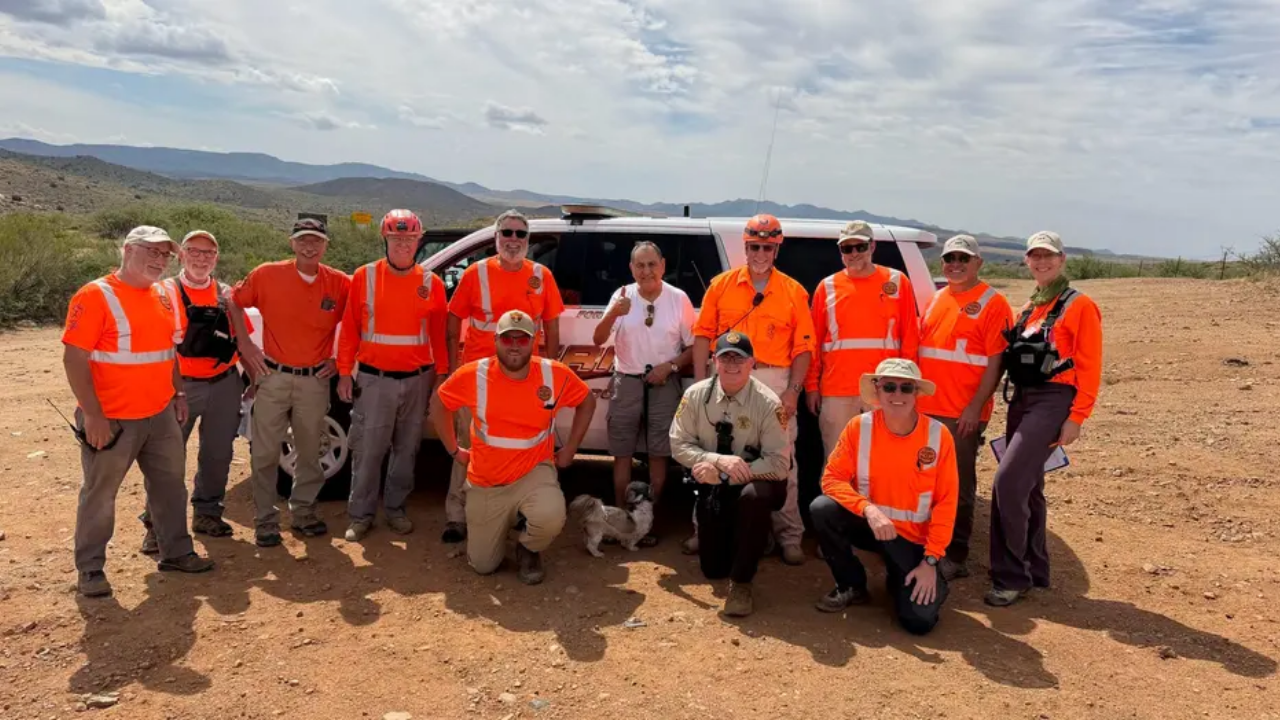
Satellite-based emergency text systems alter this cost function by transmitting precise GPS coordinates directly through low-earth-orbit constellations. By converting an open-ended regional search into a fixed-point coordinate retrieval, the protocol reduces resource allocation times from days to hours. In the Yavapai County incident, the transmission of exact geospatial coordinates enabled the Yavapai County Sheriff's Office Forest Patrol, Jeep Posse, and 4x4 search-and-rescue units to navigate directly to the vehicle despite treacherous, waterlogged terrain.
Operational Variables in Remote Extrication
Mitigating risk in unpaved backcountry environments requires strict adherence to preparation vectors and behavioral constraints.
- Positional Stability: Remaining with the vehicle maximizes visibility for aerial and ground search units while conserving metabolic energy. Vehicles act as structural shelters against environmental exposure and provide storage for critical provisions.
- Proactive Resource Staging: Surviving an overnight entrapment requires carrying essential physiological inputs. Sustained hydration, caloric intake, and uninterrupted access to necessary prescription medications prevent minor logistical delays from escalating into medical emergencies.
- Hardware Redundancy: Relying exclusively on standard cellular connectivity in remote environments introduces unacceptable operational vulnerability. Equipping communication devices with direct satellite messaging capabilities ensures an open pipeline to emergency services independent of terrestrial grid integrity.
Deploy emergency communication hardware with direct satellite-to-device messaging enabled before entering regions with known terrestrial coverage gaps, verify onboard supply inventories to support a minimum seventy-two-hour self-sufficiency window, and commit to absolute positional stasis inside the vehicle if transit failure occurs.