A series of large-format vinyl banners depicting Donald Trump’s likeness and political slogans has emerged on the exterior facades of federal executive department headquarters across Washington, D.C. While casual observers view this through a purely partisan lens, a structural evaluation reveals a complex intersection of federal appropriations law, public procurement mechanics, and the strategic deployment of executive branding.
Documents uncovered by Senator Adam Schiff (D-Calif.) outline a decentralized, agency-by-agency purchasing pattern totaling hundreds of thousands of dollars. Investigating this systematic deployment requires moving past political outrage to analyze the statutory frameworks, procurement pathways, and operational mechanisms that govern how federal dollars are legally—and illegally—allocated toward executive promotion.
The Legal Framework: Appropriated Funds versus Self-Aggrandizement
The fundamental legal constraint governing this issue is the Consolidated Appropriations Act, which has contained a standard, recurring rider since 1951. This rider explicitly prohibits agencies from utilizing appropriated funds for "publicity or propaganda purposes" or for "preparation, distribution, or use of any kit, pamphlet, booklet, publication, radio, television, or film presentation designed to support or defeat legislation pending before the Congress."
To determine whether a federal agency has crossed this line, the Government Accountability Office (GAO) applies a three-part analytical framework:
- The Self-Aggrandizement Test: Does the materials' primary purpose serve to emphasize the importance, authority, or personal status of an agency head or the President, rather than the mission of the agency itself?
- The Covert Propaganda Test: Is the government’s role in producing or disseminating the information hidden or heavily obscured from the public?
- The Purely Partisan Test: Is the content completely devoid of administrative or educational value, serving exclusively to advance a political party, candidate, or campaign?
The current tension lies in the first test. While executive departments regularly display standard $8 \times 10$-inch portraits of the sitting President and Cabinet officials in lobby areas, scaling these likenesses to three-story and eight-story external vinyl installations represents a fundamental shift in scale and intent.
From an administrative perspective, the distinction between routine agency signaling (e.g., "This is a federal facility") and self-aggrandizement relies on the ratio of functional agency information to personal political imagery.
Quantifying the Procurement Footprint
The acquisition of these banners is not managed through a single, centralized White House budget. Instead, the administration leverages decentralized agency-level procurement, distributing the cost across multiple departmental budgets to avoid a single, high-visibility line-item trigger.
The individual agency expenditures uncovered in the federal contracting data reveal the following distribution:
| Agency | Cost | Specifications & Imagery | Slogan / Theme |
|---|---|---|---|
| Federal Aviation Administration | $114,000 | Multi-banner series | Systemic agency branding |
| Department of the Interior | $39,000 | 30-foot dual portrait with George Washington | "America First" |
| Department of Health & Human Services | $33,726 | $11.5 \times 88$-foot vinyl installation | "Make America Healthy Again" |
| Department of Agriculture | $16,400 | Temporary dual portrait with Abraham Lincoln | Systemic agency branding |
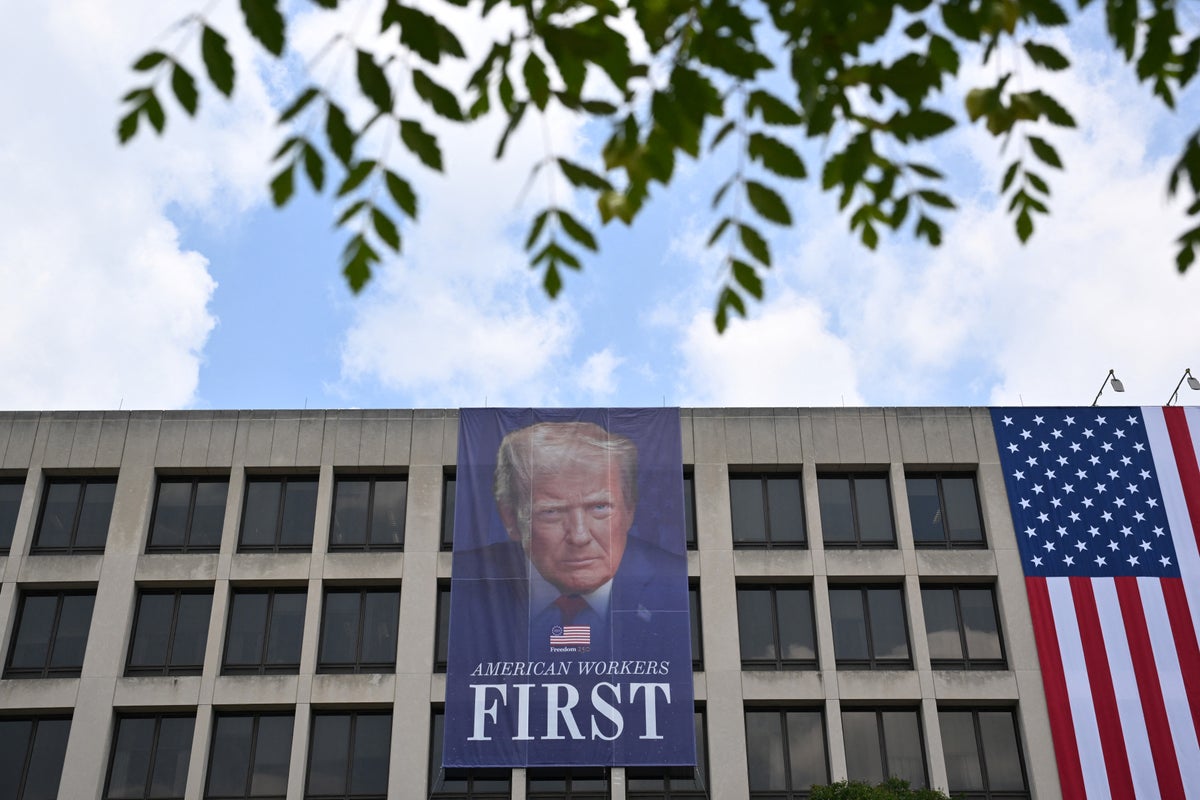
| Department of Labor | $6,000 | Three-story portrait alongside Theodore Roosevelt | "American Workers First" |
The Procurement Mechanism
Federal agencies utilize the Federal Acquisition Regulation (FAR) to execute these contracts. Under FAR Part 13 (Simplified Acquisition Procedures), purchases under the Simplified Acquisition Threshold ($250,000) face significantly lower competitive bidding requirements.
By keeping individual banner contracts below this threshold—and in several cases, under the micro-purchase threshold—political appointees within these departments can bypass rigorous competitive solicitations, awarding contracts directly to specialized or newly formed vendors with minimal public scrutiny.
The Co-Branding Strategy: Historic Legitimacy Mapping
An examination of the visual assets reveals a clear psychological and strategic pattern: Historic Legitimacy Mapping. The executive branch does not present the President’s image in isolation. Instead, the design layouts pair Trump side-by-side with historically revered, non-partisan presidents:
- Department of Agriculture: Trump paired with Abraham Lincoln.
- Department of Labor: Trump paired with Theodore Roosevelt.
- Department of the Interior: Trump paired with George Washington.
+----------------------------------------+
|                                        |
|   [ HISTORIC ICON ]  [ SITTING EXEC ]  |
|   (George Washington) (Donald Trump)   |
|                                        |
|         "AMERICA FIRST" SLOGAN         |
|                                        |
+----------------------------------------+
This layout attempts to exploit a cognitive bias known as the halo effect. By placing the sitting executive in the same visual frame, color scheme, and physical scale as historical figures, the design attempts to transfer the established, uncontested legitimacy of those historical leaders to the current administration’s highly contested, contemporary policies.
The primary vulnerability of this strategy is the explicit integration of campaign-adjacent slogans. While "America First" and "Make America Healthy Again" have been integrated into official administrative policy, their origins as active campaign intellectual property complicate the legal defense that these banners serve a strictly neutral, informational government purpose.
The Precedent Defense and Strategic Realities
Defenders of the administration's branding initiatives frequently invoke the precedent defense, pointing to the ubiquitous signage deployed during the implementation of the Infrastructure Investment and Jobs Act (IIJA) and the American Rescue Plan Act (ARPA) under the Biden administration. Those signs featured prominent text crediting the sitting President for the construction projects.
However, a structural comparison reveals a fundamental operational and legal divergence between these two approaches:
- Infrastructure Signage (Previous Administration): The physical media consisted of standard highway construction project signs. The text read: "Project Funded by President Joe Biden's Bipartisan Infrastructure Law." The primary visual element was informational text regarding a specific, geographically localized public works project. No photographic likeness or stylized portrait of the President was utilized.
- Large-Format Exterior Banners (Current Administration): The physical media consists of massive, customized vinyl installations measuring up to 88 feet high, mounted directly onto historical federal facades in the nation's capital. The primary visual element is a highly stylized, oversized photographic portrait or graphic illustration of the President’s face. The text elements are minimized and restricted to broad, ideological slogans.
The strategic reality is that while both administrations sought to leverage federal expenditures for political brand equity, they utilized entirely different mechanisms. The previous administration focused on credit attribution linked to material capital improvements, whereas the current administration focuses on iconographic projection linked to executive authority.
Strategic Action Plan for Oversight Challenges
To challenge these expenditures effectively without becoming mired in protracted, slow-moving litigation, legislative oversight bodies and watchdog organizations must pivot away from broad rhetoric about "authoritarian aesthetics" and focus on administrative mechanics. The most direct operational lever is the enforcement of the Anti-Deficiency Act (ADA).
Under the ADA, federal officers are prohibited from making expenditures or incurring obligations exceeding an appropriation. Because Congress has explicitly banned spending appropriated funds on unauthorized "publicity or propaganda," any official who authorized these banner contracts has potentially committed an ADA violation.
Watchdog groups should immediately file formal requests for joint investigations by the respective Departmental Inspectors General and the GAO. Rather than litigating the subjective definition of "propaganda," these investigations should target the underlying procurement files:
- Verify whether the simplified acquisition procedures were artificially split to avoid the threshold rules of FAR Part 13.
- Audit the source-selection process to ensure that the chosen printing vendors were selected based on standard commercial terms, rather than political affiliation.
- Demand a strict accounting of the operational staff hours utilized to install, maintain, and remove these temporary structures.
By shifting the battlefield from ideological messaging to granular procurement compliance, oversight entities can force the administration to defend the literal line-item mechanics of its branding campaign, turning a visual political asset into an active administrative liability.