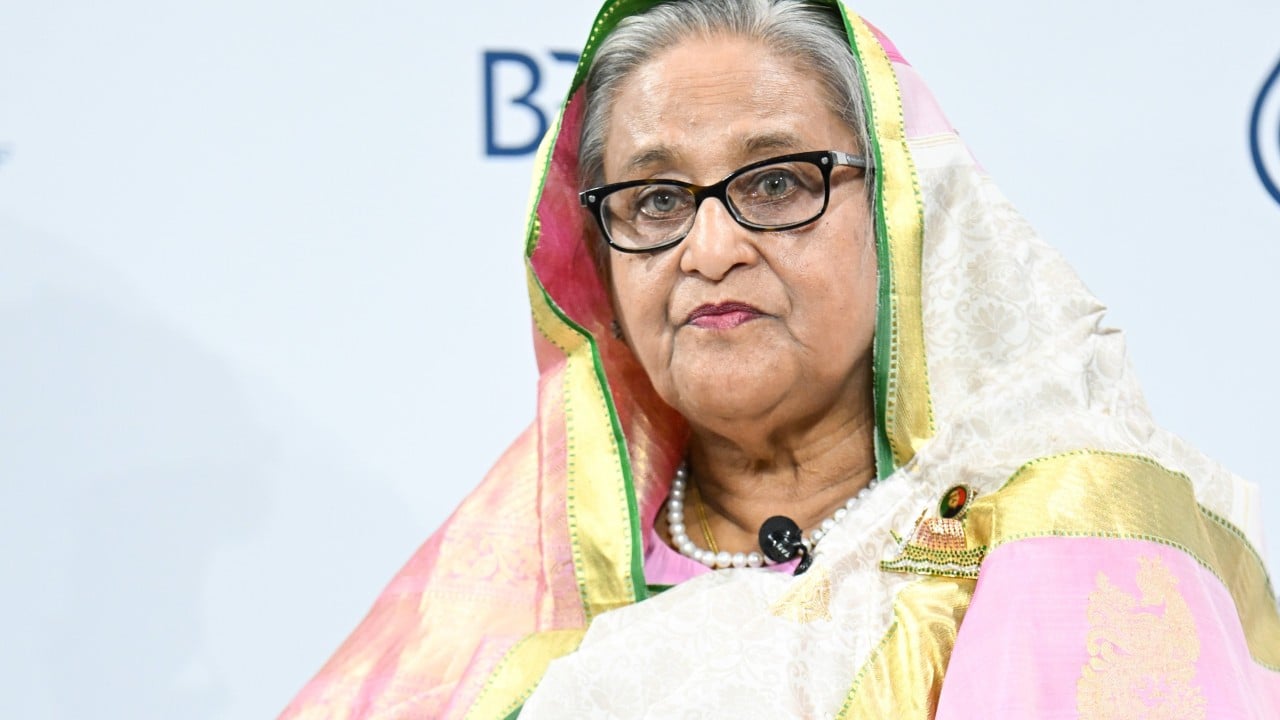
Ousted Prime Minister Sheikh Hasina’s declared intention to return to Dhaka establishes a volatile geopolitical and domestic collision course. The announcement disrupts a fragile equilibrium managed by Prime Minister Tarique Rahman’s Bangladesh Nationalist Party (BNP) administration. This development is not merely a localized political shift; it is a calculated stress test applied to Bangladesh's freshly reorganized state structures, its legal apparatus, and its hyper-sensitive bilateral relationship with India.
Understanding the mechanics of this political friction requires looking beyond the immediate rhetoric of restoration or retribution. The situation operates as an interplay between state-level legal frameworks, institutional vulnerability, and regional security vectors. Don't forget to check out our recent post on this related article.
The Structural Mechanics of a Contested Return
The domestic landscape has shifted structurally since the August 2024 collapse of the Awami League regime. Following a period of interim governance led by Dr. Muhammad Yunus, the February 2026 general elections delivered a landslide victory to the BNP, effectively consolidating executive power under Tarique Rahman. A return by the former premier introduces three destabilizing operational variables into this new administrative framework.
+-----------------------------------------------------------------+
|               TRIAD OF DOMESTIC INSTABILITY                    |
+-----------------------------------------------------------------+
|  1. THE RE-MOBILIZATION VECTOR                                  |
|     • Banned structural core retains 15-20% baseline voter base |
|     • Latent networks activated by a central physical figure     |
+-----------------------------------------------------------------+
|  2. THE IMMINENT LEGAL JOLT                                     |
|     • Capital sentence issued via International Crimes Tribunal |
|     • Immediate arrest mandate tests enforcement capabilities  |
+-----------------------------------------------------------------+
|  3. THE STATE LAW ENFORCEMENT BOTTLENECK                        |
|     • Outbreaks of mob and retaliatory factional violence       |
|     • Strain on state security assets to maintain order        |
+-----------------------------------------------------------------+
The Re-Mobilization Vector
The Awami League’s operational activities were legally suspended by the interim administration following mass demonstrations. The current government maintains this ban, yet the party retains a baseline loyalist constituency estimated at 15% to 20% of the electorate. This dormant political capital lacks a domestic focal point. A physical presence by the party's leader provides a central figure capable of transforming passive dissent into active, coordinated street-level resistance. If you want more about the background of this, The New York Times provides an excellent breakdown.
The Imminent Legal Jolt
The legal environment awaiting the former prime minister is definitive: an active capital sentence issued by the International Crimes Tribunal (ICT) for actions taken during the 2024 crackdowns. Her entry through any sovereign border crossing triggers an immediate statutory mandate for arrest. The administration faces an operational bottleneck. It must execute a high-profile detention under maximum scrutiny while preventing the judicial process from becoming a catalyst for mass civil unrest.
The State Law Enforcement Bottleneck
The state's internal security apparatus remains in a phase of post-transition restructuring. Human Rights Watch has noted persistent vulnerabilities, including outbreaks of localized mob violence and targeted political friction. Forcing the police and military forces to manage simultaneous counter-protests, secure detention facilities, and suppress retaliatory factional violence will exhaust state security assets, temporarily reducing their capacity to govern peripheral districts.
The Extradition Dilemma and Bilateral Friction
The international dimension operates on an entirely separate set of strategic calculations. New Delhi’s policy toward Dhaka has been highly reactive since offering refuge to the ousted leader in 2024. This creates a complex diplomatic cost function for both nations.
       NEW DELHI'S DIPLOMATIC COST FUNCTION

   High Cost  +-----------------------------------+
              |  Option A: Extradition            |
              |  - Surrenders historic ally       |
              |  - Damages credibility in region  |
              +-----------------------------------+
              |  Option B: Continued Asylum       |
              |  - Sustains friction with Dhaka   |
              |  - Limits strategic engagement    |
              +-----------------------------------+
   Low Cost   +-----------------------------------+
              |  Option C: Voluntary Return       |
              |  - Absorbs no direct policy blame |
              |  - Resets bilateral baseline      |
              +-----------------------------------+
The Rahman administration has consistently sought extradition, a request previously met with institutional delays by India's Ministry of External Affairs. A voluntary return by the former prime minister effectively breaks this diplomatic deadlock. For India, it removes an acute point of friction with the new BNP government, opening avenues for constructive bilateral agreements on critical trade corridors and border security.
The strategic risk for New Delhi shifts from a dilemma over political asylum to managing the regional fallout of potential internal chaos in Bangladesh. Should her return trigger deep domestic instability, the resulting security vacuum could impact cross-border logistics and disrupt regional supply chains.
The Radicalization Factor and Institutional Legitimacy
A primary structural challenge facing the BNP government is managing its volatile political coalition and the broader anti-fascist alliance. The 2026 election results established the Bangladesh Nationalist Party as the dominant legislative force, with Bangladesh Jamaat-e-Islami securing the second largest block of seats. This legislative distribution creates an ideological friction point.
- The Secular-Islamist Cleavage: The Awami League leadership has explicitly positioned its return as an effort to counter growing right-wing and Islamist political influence within the state. This framing forces a reaction from groups like Jamaat-e-Islami and the National Citizen Party, both of which demand strict enforcement of the judicial verdicts against the former regime.
- The Risk of State Overreach: If the Rahman government employs overly repressive tactics to suppress Awami League loyalists during a return crisis, it risks undermining its own institutional legitimacy. International observers and human rights organizations are already monitoring the state’s adherence to due process. Excessive use of state force would validate claims of democratic backsliding, threatening foreign direct investment and international aid lines.
Strategic Playbook for the Rahman Administration
To mitigate the systemic risks of a high-profile political return, the current administration cannot rely on ad-hoc security measures or inflammatory public statements. A structured, preventative strategy must be executed across three specific dimensions.
1. Depoliticize the Judicial Execution
The state must strip the arrest and subsequent legal proceedings of political theater. The Ministry of Law must establish a transparent, internationally monitored appellate process for the ICT verdicts. By inviting neutral international legal observers to review the enforcement of the sentence, the administration insulates itself against accusations of running a farcical trial or executing a political vendetta.
2. Decentralize Security Mobilization
Law enforcement agencies must avoid massing visible security forces exclusively in Dhaka's urban core, which inadvertently creates a high-stakes arena for media coverage and clashes. Security command structures must be decentralized, using pre-emptive intelligence to disrupt logistical networks and transport routes used for large-scale political mobilization well before they reach the capital.
3. Finalize the Bilateral Security Baseline with India
Dhaka must formalize its security and economic guarantees with New Delhi prior to December. By reassuring India that its strategic transit rights, port access, and border integrity will remain fully protected under BNP governance, Bangladesh removes any external incentive for foreign intelligence agencies to quietly back or facilitate a disruptive political comeback. Securing the bilateral perimeter isolates the domestic challenge, reducing it to a manageable matter of local law enforcement and judicial compliance.