Mass casualty highway incidents rarely occur as isolated anomalies; they represent the catastrophic intersection of systemic transit dependencies, driver behavioral variance, and kinetic energy management failures. When a multi-vehicle collision on a primary transport corridor claims twenty-one lives, the event demands an operational post-mortem rather than a passive recounting of tragedy. Deconstructing the mechanics of such disasters reveals specific structural vulnerabilities in long-distance public and commercial transit corridors.
The Kinematics of Multi-Stage Impacts
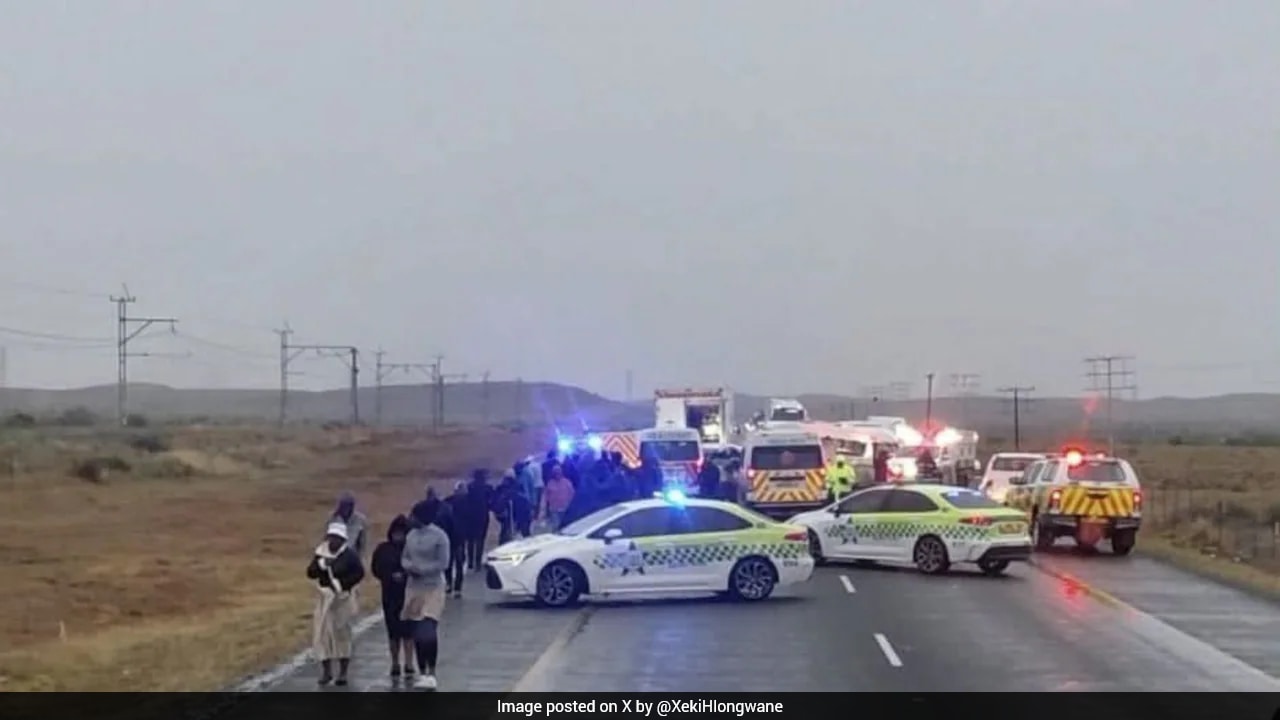
The collision sequence on the N1 highway in South Africa's Western Cape province, involving a primary head-on vector between two high-capacity transport vehicles followed by a secondary kinetic transfer from a trailing vehicle, highlights a predictable failure mode in high-speed, two-lane or undivided transit routes.
Physical analysis of high-fatality road crashes demonstrates that severity scales exponentially with closing speeds. When two transit vehicles—frequently optimized for passenger volume rather than structural crash energy management—collide along a directional vector, the primary impact dissipates available cabin survival space. The introduction of a secondary mass, such as a trailing sport utility vehicle or light commercial unit, acts as a secondary dynamic crusher. This compresses the deformation zones of the initial wreckage beyond structural tolerances, converting survivable deceleration thresholds into fatal forces.
The Economic and Operational Cost Function of Informal Transit
A critical variable in high-fatality corridor accidents involves the heavy reliance on minibus taxi networks for regional and inter-provincial passenger transport. In many emerging transit markets, these networks fill a structural capacity gap left by underfunded rail systems. However, their operational model introduces distinct risk multipliers:
- Extended Operating Hours: Commercial incentives encourage continuous vehicle utilization, elevating driver fatigue levels beyond cognitive safety thresholds.
- High Occupancy Loadings: Maximizing passenger density per trip increases absolute casualty counts per failure event, changing the statistical severity curve of individual accidents.
- Maintenance Variances: Decentralized fleet ownership correlates with uneven adherence to preventative maintenance schedules, particularly concerning tire integrity, braking systems, and steering linkages.
These factors form an operational cost function where efficiency gains in transit availability are directly offset by systemic vulnerability to catastrophic failure.
Environmental and Infrastructure Variables
Corridor design heavily dictates error tolerance. Long-distance routes traversing arid or semi-arid regions—such as the Central Karoo—introduce specific physiological and environmental hazards that affect driver performance:
- Monotonous Visual Fields: Extended stretches of uniform landscape induce highway hypnosis and micro-sleep events, reducing reaction times during critical path deviations.
- Thermal Stress: Elevated ambient temperatures compromise vehicle cooling systems and tire pressure stability, increasing the probability of mechanical blowouts at velocity.
- Absence of Physical Medians: Undivided high-speed segments remove the margin for error, converting momentary driver distraction or mechanical failure directly into head-on trajectories.
Mitigating Systemic Risk
Reducing fatalities on high-capacity transit corridors requires shifting focus from post-incident punitive measures to preventative engineering and regulatory enforcement. Interventions must target the core failure points:
- Infrastructure Upgrades: Prioritizing the installation of physical median barriers on high-volume national routes to eliminate the mechanics of head-on collisions.
- Digital Monitoring and Enforcement: Implementing telemetry-based tracking for commercial passenger fleets to monitor speed profiles, continuous driving hours, and route compliance in real time.
- Structural Safety Standards: Enforcing minimum crashworthiness requirements for high-occupancy passenger transport units to preserve occupant survival space during primary impacts.
Sustained reduction in mass transit mortality relies entirely on designing transport systems that anticipate human error and mechanical degradation rather than assuming optimal conditions.
Multi-vehicle crash claims 21 lives in W Cape
This footage provides visual context of the highway layout and emergency response operations following the multi-vehicle collision on the N1 corridor in the Western Cape.