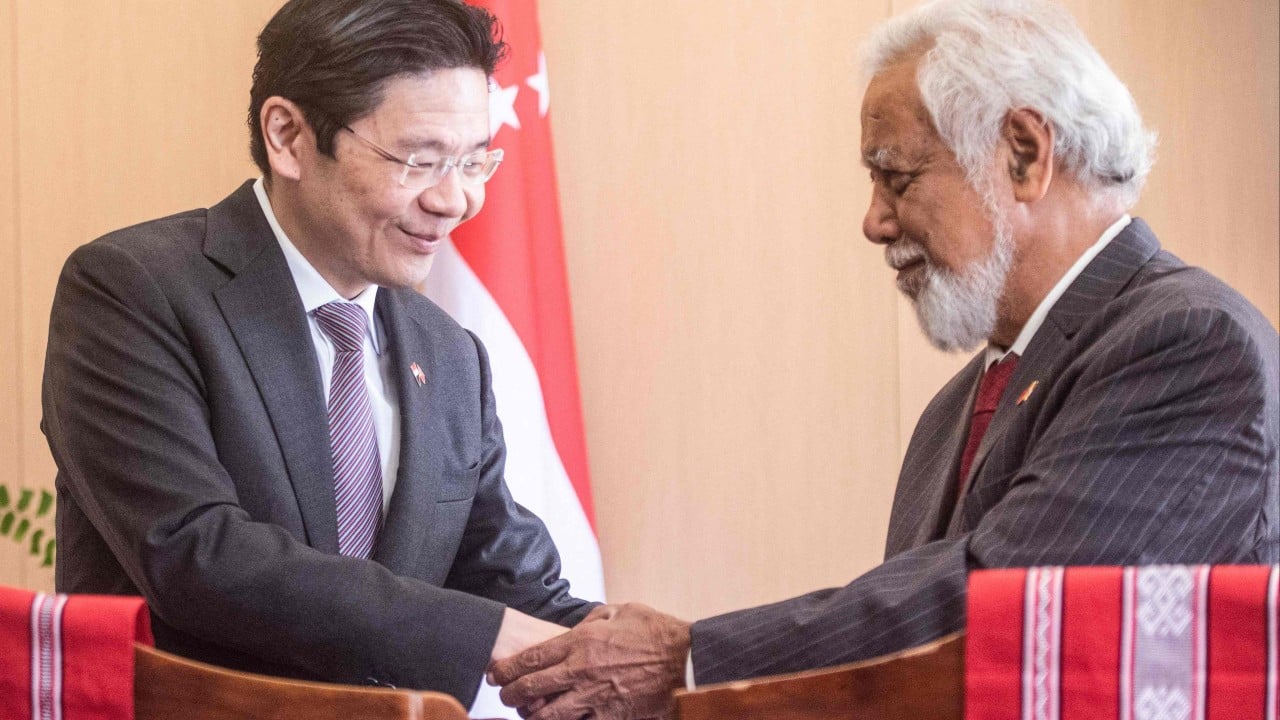
Singapore’s structural dependence on foreign labor requires continuous adjustments to its Non-Traditional Source (NTS) framework to prevent wage-push inflation and mitigate geopolitical concentration risks. The bilateral agreement signed between Singapore Prime Minister Lawrence Wong and Timor-Leste Prime Minister Xanana Gusmão establishes a formalized labor migration pipeline targeting the second half of 2027. By designating Timor-Leste as an approved NTS country, Singapore is executing a calculated geoeconomic arbitrage strategy, matching its high-value capital and infrastructure bottlenecks with Timor-Leste’s surplus low-cost domestic labor.
This framework operates on structural interdependencies that extend far beyond simple labor recruitment. For Singapore, the addition of Timor-Leste stabilizes the supply elasticity of the Work Permit holder pool across capital-intensive, physically demanding industries. For Timor-Leste, the arrangement functions as a macroeconomic stabilizer, generating predictable dollarized liquidity injection mechanisms through worker remittances.
The Structural Mechanics of Labor Source Diversification
The inclusion of Timor-Leste alongside recent NTS additions like Bhutan, Cambodia, and Laos represents an institutional shift in Singapore’s demographic risk management. The Ministry of Manpower optimizes foreign workforce procurement through a strict optimization framework designed to balance economic capacity, infrastructure constraints, and social friction limits.
The NTS Dependency Risk Function
The addition of new labor sources is governed by a fundamental diversification imperative. Relying on a highly concentrated pool of source countries exposes critical domestic sectors to supply shocks driven by foreign policy shifts, regulatory changes, or domestic economic transitions within those source nations. The total risk exposure can be understood as a function of concentration and systemic vulnerability:
$$R_{\text{systemic}} = \sum_{i=1}^{n} (S_i)^2 \cdot \sigma_i$$
Where $S_i$ represents the percentage market share of supply country $i$ within critical infrastructure sectors, and $\sigma_i$ represents the regulatory or political volatility coefficient of that specific jurisdiction. By expanding $n$ to include Timor-Leste, Singapore systematically dilutes the mathematical weight of any single supply nation, decreasing overall systemic volatility across core economic dependencies:
- Construction Sector: Buffers infrastructure project timelines against policy-induced labor contractions from traditional South Asian supply corridors.
- Marine Shipyard Industry: Provides specialized, highly elastic manual labor capable of adjusting to cyclical global maritime manufacturing demands.
- Process Sectors: Ensures a baseline of operational technicians for petrochemical and pharmaceutical processing facilities without driving up marginal wage costs.
Macroeconomic Remittance Dynamics and the Capital Recycling Loop
For Timor-Leste, a lower-middle-income nation with a population of approximately 1.4 million, the labor pact operates as a direct fiscal lever. In 2025, outward worker remittances generated over US$180 million, accounting for roughly 10% of the nation’s gross domestic product.
The introduction of the Singapore pipeline introduces a high-wage premium destination relative to Timor-Leste's existing bilateral corridors with Australia, New Zealand, and South Korea.
[Singapore Capital Inflow] ---> [Infrastructure & Marine Sectors]
                                            |
                                  (Wage Allocation)
                                            v
[Timor-Leste Domestic GDP] <--- [10% Remittance Flow (USD)]
This structural capital recycling loop functions through specific mechanisms:
- Arbitrage Maximization: Timorese laborers operating under Singapore’s regulated Work Permit scheme earn wages that far outstrip domestic purchasing power parity. This optimizes the net cash return per exported unit of labor.
- Sovereign Wealth Buffer: Timor-Leste's state finances remain heavily tied to offshore oil and gas assets within its blue economy, which commands nearly 87% of current GDP. Cultivating a robust human capital remittance pipeline creates an alternative stream of foreign currency, hedging against long-term hydrocarbon depletion and commodity price fluctuations.
- Geopolitical De-risking: By formalizing institutional channels with Singapore, Dili creates economic counterweights to the regional commercial dominance of Jakarta and the resource-extraction monopolies of Canberra.
The Upstream Human Capital Transformation Architecture
The core limitation of basic cross-border labor agreements is the net brain drain suffered by the exporting country. The Singapore-Timor-Leste framework attempts to mitigate this asymmetric value distribution through a cyclical human capital transformation model. The process converts low-skill surplus domestic labor into certified technical assets over a standard multi-year employment cycle.
Phase 1: Skill Acquisition and Operational Standardization
Timorese workers entering Singapore’s construction, marine, and process sectors are integrated into highly standardized, digitally mediated workflows. They are required to clear strict industry safety and skills certification exams administered by the Building and Construction Authority (BCA) or relevant industrial boards.
Phase 2: Knowledge Transference and Remittance Production
During tenure, workers capture immediate economic returns through dollar-denominated wages while mastering operational competencies in advanced logistics, mechanical maintenance, and industrial occupational health standards.
Phase 3: Domestic Capital Reinvestment
Upon the expiration of work permits, the repatriation of these individuals introduces an influx of technically proficient, operationally disciplined human capital into Timor-Leste’s domestic market. These returning workers possess the exact technical competencies required to execute the complex domestic infrastructure projects currently bottlenecked by an absence of local managerial and engineering capabilities.
Multilateral Integration and the 2029 ASEAN Chairmanship Metric
The timing of this bilateral framework directly coincides with institutional milestones inside the Association of Southeast Asian Nations (ASEAN). Timor-Leste achieved full admission as the 11th member state on October 26, 2025. It is scheduled to assume the highly demanding, rotating annual ASEAN chairmanship in 2029.
Singapore’s strategy addresses the acute technical and bureaucratic capacity deficits that threaten Timor-Leste’s ability to govern the bloc effectively. The Enhanced Singapore-Timor-Leste ASEAN Readiness Support (eSTARS) package functions as an institutional scaffolding mechanism.
- Bureaucratic Capacity Escalation: Expanding the eSTARS package embeds tailored technical workshops directly into Dili’s civil service structures. This trains local foreign policy apparatuses in complex multilateral trade negotiations and protocol execution.
- Direct Administrative Attachments: By hosting Timorese officials within Singapore’s active ASEAN chairmanship teams, Singapore creates an immediate operational knowledge transfer loop.
- Systemic Stabilization: Institutional failures during a nation's ASEAN chairmanship weaken the collective bargaining leverage of the entire economic bloc against global superpowers. Ensuring Timor-Leste’s baseline administrative readiness preserves the systemic stability and commercial credibility of ASEAN as a unified market.
Framework Limitations and Structural Friction Points
No geoeconomic strategy operates without friction. The success of the Singapore-Timor-Leste labor pact remains contingent on resolving three distinct operational constraints.
First, the linguistic and vocational baseline deficit poses an immediate challenge. Unlike traditional NTS pools with established English or Mandarin proficiencies, Timor-Leste’s workforce will require intensive initial upskilling to meet Singapore's workplace safety and operational communication thresholds.
Second, asymmetric institutional capacity creates friction. The velocity of Singapore's private sector deployment generally outpaces the regulatory processing capabilities of Dili’s state ministries. This mismatch risks creating administrative backlogs in work visa validation, health screenings, and pre-departure clearings.
Finally, capital expenditure deployment delays present an ongoing risk. While Singaporean enterprises explore investment vectors in wholesale trade, renewable energy, and the blue economy, actual capital deployment remains constrained by Timor-Leste's domestic legal infrastructure. A lack of robust commercial dispute resolution mechanisms and ambiguous land tenure laws continue to suppress foreign direct investment velocity.
The strategic play for enterprise leaders requires moving early to establish direct corporate talent recruitment channels within Dili before the official Go-Live window in the second half of 2027. This will allow firms to secure prime access to the emerging talent pool ahead of broader market competition.