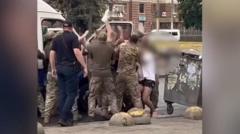
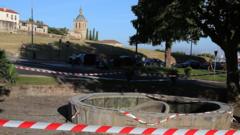
A maritime rescue operation window closes geometrically with every hour that passes after a vessel loses stability. When the MV Barima capsized at approximately 11:00 p.m. near the mouth of the Pomeroon River along Guyana’s North Atlantic coast, it exposed the structural vulnerabilities inherent in regional coastal transit systems. With 116 passengers and crew on board, the initial rescue of 67 individuals—including 15 children—leaves a critical mathematical discrepancy of 49 persons unaccounted for as state and private assets deploy in a high-stakes search-and-rescue operation.
To evaluate this event beyond the baseline tracking of casualties requires an examination of the systemic factors that govern coastal shipping safety: vessel stability mechanics, the operational physics of the Georgetown-to-Port Kaituma transit route, and the logistical constraints of equatorial search-and-rescue infrastructure.
The Physics of Failure: Hydrodynamic Instability and Capsizing Mechanics
A vessel capsizes when its center of gravity moves above its metacenter, destroying the righting lever that allows a ship to correct itself against external forces. For a coastal ferry like the MV Barima operating in the open waters of the North Atlantic coast, this loss of stability typically derives from three compounding variables.
The Free Surface Effect
When liquid or unsecured cargo shifts laterally within a vessel, it alters the center of gravity dynamically. In passenger ferries, this phenomenon is frequently exacerbated by the sudden movement of passengers to one side of the vessel during an initial list, creating a self-reinforcing roll trajectory that overcomes the hull’s natural buoyancy configuration.
Estuary Hydrodynamics and Tidal Intersections
The location of the incident—near the Pomeroon River and Iron Punt—presents complex hydrological challenges. The outflow of river currents colliding with the longshore oceanic currents of the North Atlantic creates highly volatile wave vectors. If a vessel encounters breaking beam seas in these shallow, high-energy coastal zones, the risk of dynamic capsizing increases exponentially, particularly if the vessel is operating near its maximum displacement capacity.
Equipment Deployment Versus Survival Realities
Public Works Minister Juan Edghill confirmed the vessel was outfitted with 250 life jackets, two rigid life rafts, and six inflatable life rafts. While the absolute quantity of safety equipment met statutory requirements for the 116 people on board, the structural configuration of a rapid capsize limits the utility of these assets. In a fast-rolling event:
- Inflatable rafts can become trapped beneath the overturning hull.
- Access to stored life jackets becomes physically impossible due to shifting interior architecture and incoming water pressure.
- Rigid rafts may fail to deploy if the vessel settles at an acute angle, locking launching mechanisms.
The Logistical Bottleneck of Coastal Search and Rescue
The initial notification window determines the spatial boundaries of a maritime search grid. The Timehri Air Traffic Control Tower logged the distress call at 11:01 p.m., indicating that communication architecture functioned as intended during the onset of the emergency. However, the transition from notification to physical extraction reveals the operational limitations of the local infrastructure.
[Distress Call: 11:01 PM] ──> [Spatial Drift Calculation] ──> [Asset Mobilization Delay] ──> [Diminishing Survival Window]
The primary operational constraint is the drift velocity dictated by the Guiana Current, which flows northwestward along the coast. Survivors in the water who did not secure placement on the rigid or inflatable rafts are subject to rapid drift vectors. This expands the required search area quadratically over time, demanding an asset density that challenges regional capabilities.
The deployment of a mixed fleet—comprising the Guyana Defence Force Coast Guard alongside ad-hoc private vessels—introduces critical command-and-control challenges. Private vessels provide rapid, localized scale but lack the standardized thermal imaging, night-vision capabilities, and unified communications hardware required to execute systematic grid searches in pitch-black conditions. This operational asymmetry creates a high probability of search gaps within the initial 12-hour window.
Strategic Protocol for Coastal Transit Systems
Mitigating the systemic risks illuminated by the MV Barima incident requires moving beyond reactive investigation into structural operational reforms. Regulatory bodies managing developing coastal corridors must implement three immediate shifts to insulate their networks against catastrophic failure.
- Mandatory Real-Time Load Cell Integration: Visual passenger counts and static manifest verifications are insufficient. Ferries must utilize automated hull stress and displacement monitoring systems to ensure the distribution of weight does not compromise the transverse metacentric height before clearing port limits.
- Decentralized Survival Asset Placement: Life-saving appliances must be repositioned from centralized interior lockers to external, hydrostatically released racks that deploy automatically when submerged, independent of human intervention or vessel orientation.
- Formalized Private-Public Integration Protocols: Given the structural reliance on private vessels to achieve necessary search scale, maritime authorities must establish localized, pre-registered volunteer fleets equipped with standardized VHF marine radios and basic GPS tracking units to ensure cohesive grid execution during the critical first six hours of an incident.
The survival probability of the remaining 49 individuals hinges entirely on the rapid adaptation of the current search grid to account for oceanographic drift models and the deployment of synchronized aerial and surface assets. Without these structural adjustments to the broader transit framework, coastal corridors will remain fundamentally exposed to identical systemic failures.