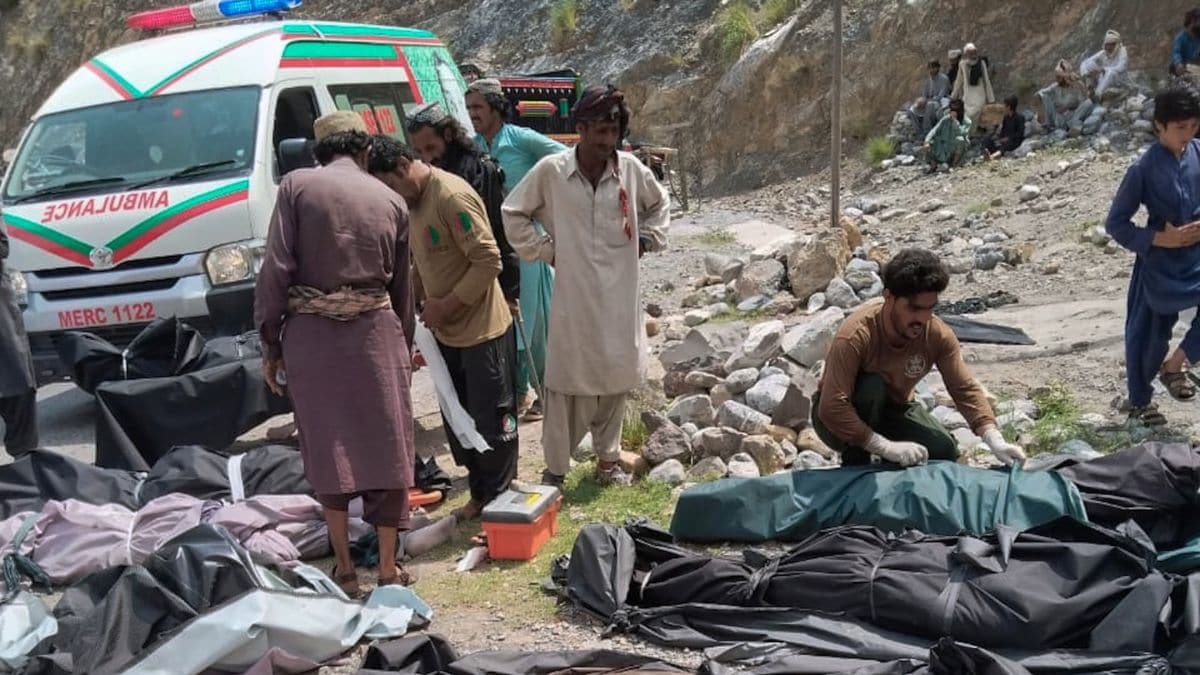
The fatal plunge of a passenger bus into a 70-foot ravine near the Balochistan-Khyber Pakhtunkhwa border, resulting in 40 fatalities and eight critical injuries, is routinely categorized by regional authorities as an isolated tragedy born of mechanical failure. This diagnostic framing is incomplete. An objective analysis of the Dana Sar transit failure reveals that the catastrophe was not an unpredictable anomaly, but rather the deterministic output of an unmitigated operational risk function. When a commercial transport vehicle operating under extreme geographic constraints experiences simultaneous compounding stressors, systemic failure becomes inevitable.
To understand the mechanics of the crash, the incident must be broken down into three compounding operational variables: structural overload, mechanical strain acceleration, and cabin crew destabilization.
The Overload Multiplier: Compounding Kinetic Energy
The vehicle departed Quetta with a baseline manifest of 36 passengers, a volume matching the standard design capacity of a long-haul commercial coach. The critical failure in operational protocol occurred mid-journey. Following the mechanical breakdown of a secondary vehicle en route to Peshawar, the primary coach absorbed the stranded travelers, escalating the total passenger count to 48.
This 33% increase in passenger volume fundamentally altered the vehicle’s physics. In a commercial transport coach, mass distribution dictates the center of gravity and the mechanical stress applied to the braking and suspension systems. The addition of 12 passengers, along with their associated luggage, scales the gross vehicle weight linearly while compounding the kinetic energy ($E_k = \frac{1}{2}mv^2$) that must be dissipated during deceleration.
On a steep, descending mountain pass like the Sherani-Zhob highway, this added mass drastically amplifies the thermal load on the friction-based braking systems. As the vehicle negotiates a continuous sequence of sharp declines, the kinetic energy transforms into heat. The additional mass ensures that the thermal dissipation capacity of the brake drums or discs is exceeded, leading directly to a phenomenon known as brake fade, where the friction material loses its coefficient of friction due to extreme heat.
The Mechanical and Environmental Bottleneck
The geography of the Dhanasar area, where the highway crosses from Balochistan’s Sherani district into Khyber Pakhtunkhwa’s Dera Ismail Khan, acts as an unforgiving environment that leaves zero margin for mechanical error. Mountainous switchbacks require constant, alternating inputs of steering torque and braking force.
Initial technical assessments indicate a catastrophic failure of the braking system as the vehicle approached a high-curvature bend. In a properly regulated transit ecosystem, redundant systems—such as exhaust brakes, retarders, and physical emergency barriers—mitigate the risk of primary brake failure. On this corridor, those redundancies were absent:
- Infrastructure Deficiencies: The hazardous border corridor lacks structural steel guardrails or reinforced concrete barriers capable of absorbing and deflecting the kinetic impact of a heavy commercial vehicle.
- Thermal Runaway: The continuous application of brakes on a heavily laden vehicle navigating descending curves generates a rapid thermal runaway loop. The brakes fail, velocity increases due to gravitational acceleration, and the driver is forced to use steering inputs to scrub speed, overloading the front tires and steering linkages.
Human Factors and Cabin Destabilization
Eyewitness accounts from surviving passengers introduce a critical human-factor variable that disrupted the driver's ability to execute emergency maneuvers. Following the mid-journey absorption of the stranded passengers, a severe altercation erupted within the cabin. Passengers already on board protested the overcrowding, culminating in a physical confrontation where a passenger allegedly grabbed the driver by the neck immediately before the vehicle lost control.
From an operational standpoint, this introducing an acute cognitive and physical distraction at the exact moment the mechanical system reached its critical failure threshold. A driver experiencing physical assault or severe distraction loses the precise motor control required to manage a vehicle undergoing brake failure on a high-curvature descent. The convergence of physical cabin chaos, a failed braking system, and a high-velocity approach to a mountain bend eliminated the possibility of recovery.
Systemic Institutional Deficiencies
The Dana Sar disaster highlights the systemic limitations of regional transport regulation. The primary failure occurs long before the vehicle reaches the mountain pass:
- Enforcement Asymmetry: While long-haul buses are inspected at primary city terminals, there is a total lack of en-route regulatory checkpoints along the Balochistan-KP border capable of detecting and halting overloaded vehicles.
- The Ad-Hoc Interlining Flaw: Commercial operators frequently use informal "interlining"—transferring passengers from a broken-down vehicle to any passing bus—without assessing the residual payload capacity or mechanical health of the receiving vehicle. This lack of centralized fleet dispatch management transforms a localized mechanical delay into a multi-fatality risk.
The rescue operation itself exposed severe infrastructure limitations. Because the vehicle descended 70 to 80 feet into a rugged, undeveloped ravine, specialized extraction equipment had to be deployed over a distance of 75 kilometers from Zhob. The time delay between the impact and the arrival of heavy cutting machinery directly impacts the survival rate of critically injured passengers, defining a clear gap in regional trauma-response distribution.
Tactical Mandates for Corridor Risk Mitigation
To prevent identical failure cascades along the high-risk corridors connecting Balochistan and Khyber Pakhtunkhwa, regulatory authorities must shift from reactive post-incident investigations to structural enforcement.
First, transport authorities must mandate the installation of digital passenger-counting sensors integrated with GPS tracking on all inter-provincial commercial routes. Any variance between the initial terminal manifest and the mid-route passenger load must trigger an automatic operational halt order at the next provincial checkpoint.
Second, the National Highway Authority must prioritize the installation of runaway truck ramps (gravity-based escape lanes) and high-containment concrete barriers at critical high-curvature zones across the Dana Sar range. Relying on driver skill to manage thermal brake failure on unshielded mountain drops is an unviable safety strategy.
Finally, the informal practice of ad-hoc passenger transfers between independent commercial operators must be legally banned; broken-down vehicles must await designated, verified relief coaches equipped to handle the specific passenger volume.


