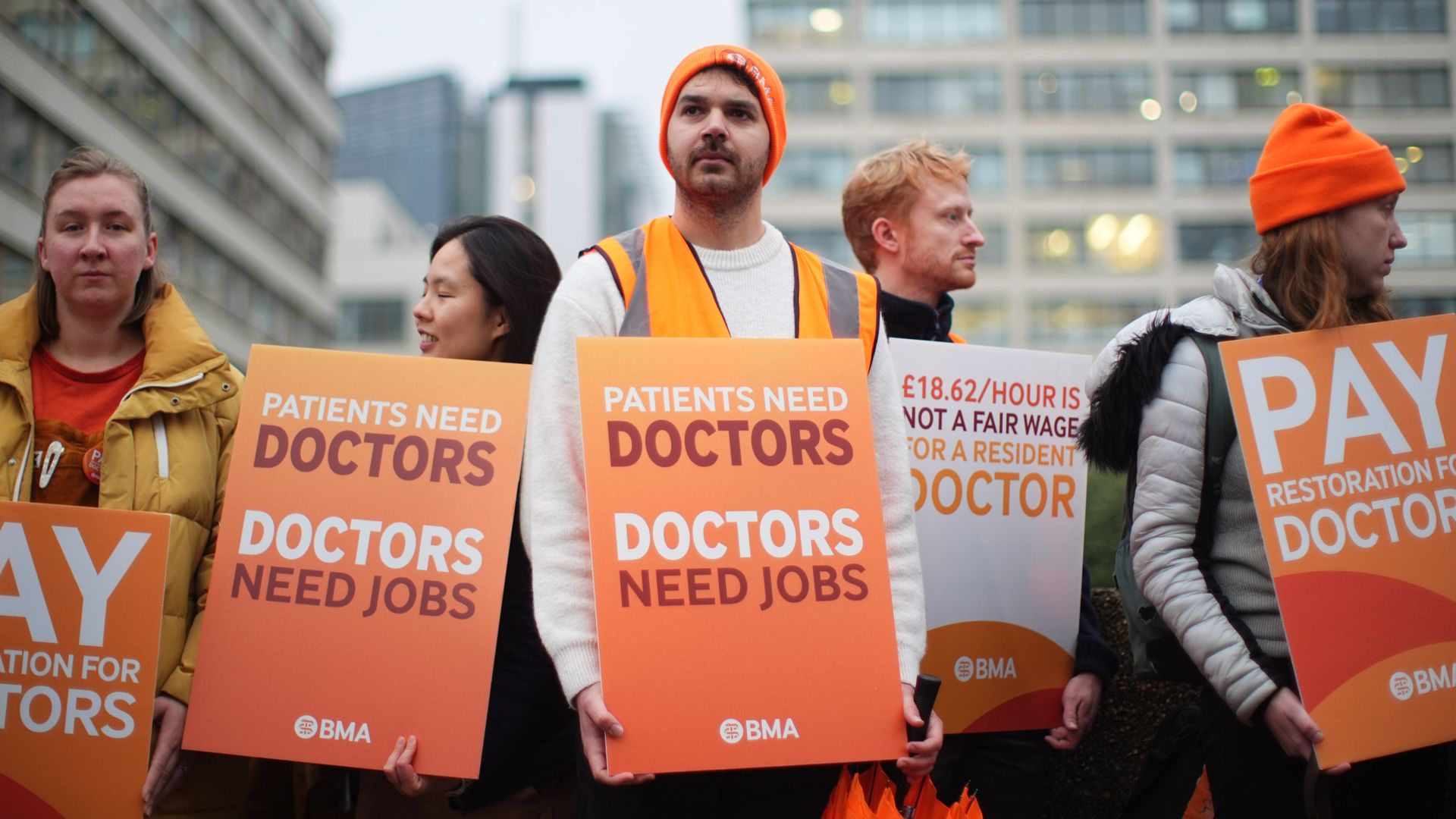
The British Medical Association (BMA) resident doctors committee in England has accepted a government pay and structural reform package, concluding a disruptive cycle of industrial action that generated 21 strike days since July 2025. A narrow 52.9% majority voted in favor of the deal on a 57.3% turnout, highlighting deep structural polarization within the medical workforce. This settlement increases average resident doctor pay by 35.2% compared to four years prior, incorporating localized pay scale modifications alongside broader structural adjustments to training and working conditions. Behind the immediate headline figures lies a complex intersection of fiscal constraints, workforce supply bottlenecks, and long-term retention dynamics within the National Health Service (NHS).
To comprehend the full economic and operational impact of this agreement, the settlement must be analyzed through three operational frameworks: the mechanics of the wage restructuring, the mitigation of career infrastructure constraints, and the macroeconomic trade-offs governing public sector labor disputes. Learn more on a connected issue: this related article.
The Tri-Component Value Structure of the 2026 Agreement
The newly accepted package does not rely on a simple flat-rate salary increase. Instead, it alters the economic profile of a resident doctor's career trajectory by combining direct wage uplifts, structural compression of the pay scale, and the absorption of professional overhead costs by the employer.
1. Direct Base Compensation Adjustments
The agreement delivers a 6.6% average pay uplift across a ten-month implementation window, building directly upon previous pay awards. This increment includes a 3.5% uplift from the 2026 Review Body on Doctors' and Dentists' Remuneration (DDRB) award, backdated to April 2026, supplemented by an immediate 3.1% average structural injection. Lower-tier tranches—specifically first- and second-year foundation doctors—receive targeted adjustments of 6.2% and 7.1% respectively, reflecting an operational intent to minimize early-career attrition. Further journalism by Medical News Today explores similar perspectives on the subject.
2. Structural Pay Scale Reform
The settlement accelerates long-overdue pay scale modifications designed to link remuneration directly to the acquisition of clinical competencies rather than arbitrary time-served benchmarks. By compressing the intervals between increments, the net lifetime earnings curve of an NHS medical career shifts forward. This adjustment reduces the historical wage stagnation that occurred when trainees remained trapped at specific nodal points due to systemic delays in specialty training progression.
3. Professional Overhead Absorption
A highly critical yet non-headline component of the deal is the mandatory reimbursement of professional friction costs. The state will now fund the first two attempts of each required Royal College examination, alongside full coverage of portfolio and membership fees from April 2027. For an individual practitioner, these mandatory fees frequently total thousands of pounds out of post-tax income, acting as an implicit structural tax on training progression. Eliminating this burden represents an immediate improvement in net disposable income without directly increasing the pensionable gross base wage, a tactical victory for treasury cost control.
Training Bottlenecks and the Workforce Supply Chain
Wage increases alone cannot resolve the compounding operational crises within the NHS if the underlying labor supply chain remains restricted. The BMA leveraged this dispute to extract significant structural concessions regarding training capacity and employment contracts.
A severe operational mismatch exists between the number of foundational resident doctors and the availability of higher specialty training posts. This discrepancy creates an artificial career ceiling where fully qualified junior clinicians are unable to progress into consultant tracks, forcing them into short-term, insecure Locally Employed Doctor (LED) contracts.
The agreement addresses this workforce friction through two distinct mechanisms:
- Training Post Expansion: The government has committed to funding and establishing between 4,000 and 4,500 new specialty training positions over a three-year horizon. The initial allocation will deploy 1,000 posts within the next fiscal year, including 250 positions commencing in February 2027. Crucially for broader healthcare planning, the deal explicitly stipulates that none of these positions will be allocated to general practice, focusing resources strictly on acute and secondary care specialties where waiting lists are most acute.
- Contractual Stabilization for Locally Employed Doctors: Starting August 2026, employers are mandated to transition LEDs from unstable, short-term fixed contracts to substantive, permanent contracts, barring specific legal exemptions such as maternity or long-term sickness cover. Furthermore, terms for these clinicians will be aligned with the national 2016 contract framework, eliminating localized downward variations in employment terms.
The Cost Function of Industrial Action
The fiscal logic behind the government’s willingness to execute this settlement is rooted in the soaring direct and indirect costs of protracted workplace disruption. Every single day of strike action by resident doctors imposed an estimated £50 million operational penalty on the NHS. This cost function is driven by the necessity of hiring external agency staff at highly inflated locum rates to maintain legal baseline safety thresholds in emergency departments and intensive care units, alongside the administrative losses associated with canceled elective care.
Beyond immediate cash expenditures, the cumulative impact of 21 strike days since mid-2025 severely degraded the operational performance metrics of the healthcare system. The postponement of hundreds of thousands of elective procedures and outpatient consultations extended waiting times, directly undermining political objectives to reduce the backlog. Settling the dispute halts this immediate financial drain and allows hospital trusts to stabilize scheduling, though the accumulated care deficit will require years of elevated capital expenditure to clear.
Critical Vulnerabilities and the Post-Settlement Horizon
Despite the termination of the immediate trade dispute, the slim 53% acceptance margin indicates a fragile consensus. The underlying labor dynamics remain highly volatile due to fundamental limitations inherent to the package.
The BMA Resident Doctor Committee has explicitly stated that this agreement is a tactical checkpoint rather than the final destination. The long-term strategic objective remains full "pay restoration" to match the real-world purchasing power of 2008 wages. Current projections indicate that even after the total implementation of this 35.2% four-year compounded increase, resident doctor salaries lag nearly 20% behind their 2008 inflation-adjusted equivalents.
This gap presents a continuing risk of future labor friction. The independent DDRB process is effectively on notice; if subsequent annual pay recommendations fail to consistently match or exceed inflation, the union retains the organizational infrastructure to re-ballot for industrial action.
Furthermore, a significant structural bottleneck remains. Expanding specialty training slots by up to 4,500 places requires a parallel expansion of senior consultant supervisory capacity and physical clinical infrastructure. Without rapid capital investment into physical hospital environments and dedicated clinical education time for senior staff, this rapid influx of trainees risks degrading training quality or generating local operational inefficiencies.
The final systemic vulnerability is the inevitable contagion effect across other public sector workforces. The NHS Staff Council has already received a mandate to negotiate modifications to the Agenda for Change pay structure, which governs nurses, midwives, and paramedics. Having demonstrated that persistent, coordinated industrial action can force structural concessions and above-average funding injections from the Treasury, the resident doctors have provided a clear playbook for neighboring healthcare unions.
Hospital executives and government planners must anticipate a sequence of compounding pay demands from non-medical clinical staff, meaning the financial cost of this settlement represents only the initial installment of a much larger structural re-pricing of public sector healthcare labor.
Strategic Forecast
The immediate operational priority for healthcare leaders must transition from crisis management to aggressive capacity utilization. Over the next 24 months, the stabilization of the medical workforce will allow hospital trusts to maximize theater utilization and reduce reliance on expensive short-term locum cover. However, the true test of this settlement lies in the upcoming DDRB pay rounds. If inflation outpaces baseline adjustments or if the implementation of the 4,500 specialty training positions is delayed by bureaucratic friction, the narrow 53% majority that accepted this deal will quickly dissolve, returning the NHS to a state of active industrial dispute by 2028. Government strategy must therefore treat this pay scale compression not as a finished negotiation, but as the baseline foundation for a permanent, structurally indexed funding model for medical labor.