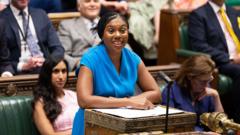
The confrontation between Conservative Leader Kemi Badenoch and the Labour frontbench during Prime Minister’s Questions (PMQs) provides a clear model of calculated rhetorical non-compliance. When the Speaker of the House, Sir Lindsay Hoyle, intervened to request that the Opposition Leader moderate her language—specifically targeting her assertion that Labour MPs had "400 knives" in Keir Starmer's back—Badenoch’s subsequent refusal to issue an apology was not an emotional lapse. It was an explicit execution of adversarial political strategy designed to maximize internal party consolidation at the expense of broad institutional consensus.
Mainstream commentary often evaluates these exchanges through a purely moral or decorum-based lens, categorizing the behavior as a breach of parliamentary etiquette. This analysis misses the underlying operational rationale. In highly polarized legislative environments, rhetorical aggression serves as a signaling mechanism. By dismantling the strategic layers of this specific exchange, we can isolate the mechanics of asymmetric opposition branding, the tactical utility of the refusal to apologize, and the structural trade-offs inherent in this level of friction.
The Strategy of Asymmetric Opposition Branding
An opposition party facing a dominant legislative majority cannot rely on standard legislative blocking mechanisms. Instead, it must deploy an asymmetric communication strategy designed to de-legitimize the governing party’s internal cohesion. During this session, the rhetorical positioning operated on two distinct lines of attack:
- The Internal Betrayal Narrative: By describing the transition of power within the Labour Party through the imagery of "400 knives," the opposition attempts to shift the public and media narrative from a organized political transition to an unstable internal coup. This framework lowers the perceived stability of the government.
- Categorical Ideological Labeling: Characterizing Education Secretary Bridget Phillipson as a "spiteful class warrior" and defining dissenting backbenchers not as legislative representatives but as "welfare MPs" serves to narrow the political identity of the opponent. This reduces complex policy debates to stark ideological archetypes.
This approach exploits a fundamental vulnerability in broad-tent governing coalitions. By painting the government not as a moderate, unified front but as a collection of factional actors driven by self-interest and ideological extremes, the opposition creates friction points that the governing party must spend political capital to smooth over.
The Operational Mechanics of the Non-Apology
The core structural inflection point of the session occurred when the Speaker intervened, citing the need for institutional respect and the historical weight of political violence. In standard media analysis, a refusal to apologize under these conditions is treated as a tactical error that invites negative press cycles. In a structured political strategy, however, the non-apology functions as a deliberate commitment device.
A formal apology in the House of Commons carries specific institutional costs. It signals a retreat, validates the Speaker's reprimand, and temporarily cedes control of the narrative to the government. Conversely, a flat refusal—subsequently reinforced by official communications stating that the leader would "absolutely not" apologize—functions as an optimization play targeted at a highly specific audience segment.
                    [Speaker Intervention / Reprimand]
                                    |
                    +---------------+---------------+
                    |                               |
          [Option A: Apologize]           [Option B: Refuse Apology]
                    |                               |
         - Signals retreat               - Validates "anti-establishment" brand
         - Cedes narrative control       - Consolidates core partisan base
         - Minimizes short-term press    - Accepts institutional friction
The trade-offs of this optimization play are strictly defined:
- The Primary Gain: It reinforces an authentic, unyielding, and anti-establishment brand identity to the core partisan base and right-aligned media ecosystem. For an opposition leader consolidating power within their own ranks, demonstrating a refusal to back down under institutional pressure establishes a reputation for resilience.
- The Secondary Cost: It increases alienation among unaligned, moderate swing voters who prioritize institutional decorum and stability. It also diminishes the leader's long-term legislative leverage with the Speaker's office, which controls the selection of amendments and the allocation of speaking time in subsequent sessions.
By choosing the path of maximum resistance, the opposition explicitly gambles that near-term base consolidation is more valuable than long-term cross-bench appeal.
Structural Bottlenecks in Parliamentary Decorum Metrics
The escalation during this session highlights a growing structural mismatch between ancient parliamentary rules of decorum and modern digital media incentives. The House of Commons operates on a legacy framework designed around the concept of "Good Temper and Moderation." This framework assumes that peer-to-peer shaming and interventions from the Chair are sufficient costs to deter hyper-adversarial language.
This assumption fails when external digital incentives alter the cost-benefit equation for individual politicians. A highly charged, controversial snippet from a parliamentary exchange generates immediate, high-velocity distribution across digital video networks and social platforms. The institutional penalty imposed by a Speaker's verbal reprimand is heavily outweighed by the return on attention, fundraising potential, and base activation generated by the viral media asset.
The system encounters a structural bottleneck: the penalties are institutional and localized, while the rewards are public and distributed. Consequently, the threshold for what constitutes acceptable language will continuously drift toward higher levels of provocation, as traditional enforcement mechanisms lack the leverage to counteract modern attention-economy incentives.
Strategic Forecast
The refusal to apologize for aggressive rhetoric in the chamber signals a permanent shift toward high-friction opposition politics. The governing party will likely counter this by attempting to systematically link the opposition leader’s vocabulary to broader themes of instability and unfitness for governance, banking on the assumption that the suburban electorate will reject persistent hostility.
The immediate tactical play for the opposition is to maintain this friction. As the government attempts to pass complex structural reforms, the opposition will likely bypass granular policy critique in favor of high-impact, narrative-driven disruptions designed to frame every legislative debate as an ideological battleground. This strategy risks institutional marginalization within Westminster, but it remains the most direct path for an under-resourced opposition to maintain a distinct, high-visibility identity in the wider political arena.