The physical seizure of the oil tanker Smyrtos in the English Channel by British Royal Marine Commandos and the National Crime Agency marks a structural shift in Western sanction enforcement. While political rhetoric frames this as an isolated blow to Moscow's war chest, an objective analysis reveals a highly calculated exploitation of maritime law and registration bottlenecks. This operation moves enforcement from passive financial restrictions to active tactical interdiction, rewriting the risk calculus for asymmetric maritime trade.
Understanding this shift requires moving past political talking points and analyzing the precise legal, operational, and economic frameworks that governed the seizure, and how this alters the global energy supply chain.
The Structural Mechanics of Statelessness
The primary vulnerability that enabled the boarding of the Smyrtos was not its ownership structure or its cargo destination, but its sudden lack of a sovereign flag. Under the United Nations Convention on the Law of the Sea (UNCLOS), the principle of exclusive flag state jurisdiction generally prohibits states from boarding or stopping foreign-flagged vessels on the high seas or within international straits unless there are clear grounds to suspect specific violations, such as piracy or a complete absence of nationality.
The breakdown of the vessel's legal defense occurred through a multi-step sequence:
[Regulatory Pressure on Flag State] ➔ [Cameroon Registry Expels Smyrtos] ➔ [Vessel Rendered Legally Stateless] ➔ [Removal of UNCLOS Flag State Protection] ➔ [UK/French Joint Tactical Interdiction]
The Smyrtos had been operating under the flag of Cameroon, a jurisdiction increasingly utilized by the Russian shadow fleet to bypass Western maritime services. Days prior to the interdiction, under sustained diplomatic and regulatory pressure from Ukraine’s allies, Cameroon executed a targeted purge of its shipping registry, expelling 36 vessels, including the Smyrtos.
This administrative action transformed the tanker from a sovereign-protected entity into a legally stateless vessel while transit was actively occurring. Under international law, a stateless vessel lacks the shield of exclusive jurisdiction, exposing it directly to the legal processes and physical boarding of nearby coastal states. The UK government maximized this narrow window of legal exposure, executing an operation that would have otherwise triggered a severe diplomatic or legal crisis had the vessel remained registered under a cooperative flag.
The Cost Function of Asymmetric Maritime Transit
The interdiction of the Smyrtos exposes the operational bottlenecks faced by the Russian shadow fleet, which carries an estimated 75 percent of Russia’s sanctioned oil exports. This fleet relies on avoiding Western maritime infrastructure, specifically Protection and Indemnity (P&I) insurance clubs and Tier-1 financing, to bypass the G7 price cap mechanism.
The economic viability of this shadow network depends entirely on minimizing transaction and transit costs to offset the steep discounts at which Russian crude must be sold to Asian markets. The English Channel represents the most optimal, lowest-cost maritime highway for vessels moving from Baltic ports like Ust-Luga to destinations in Asia and North Africa.
By executing a high-profile physical seizure in this narrow choke point, the UK and France have systematically altered the cost function of shadow transit through three distinct pressures.
Route Deviation and Fuel Penalties
The immediate operational reaction to the seizure demonstrates its deterrent scale. Tracking data indicated that sister vessels under similar ownership structures, including the Maini, the Lion I, and the Sona, instantly abandoned their trajectories toward the Dover Strait, reversing course or diverting around the western coast of Ireland and the northern tip of Scotland. This geographical detour introduces massive inefficiencies. Bypassing the English Channel adds roughly 600 to 800 nautical miles to a standard Baltic-to-India transit, increasing voyage duration by several days and compounding fuel consumption costs, which erodes the netback margin of the crude cargo.
The Escort Cost Penalty
Historically, states have avoided boarding shadow fleet vessels due to the risk of escalation or the sheer volume of traffic. The realization that Western military assets will actively board stateless or sanctioned tankers forces a choice between two costly options. Shippers must either accept the risk of complete asset forfeiture or demand sovereign military protection.
Deploying Russian naval warships to escort civilian tankers through international straits like the English Channel strains naval capacity, consumes high-value military resources, and escalates the risk of direct kinetic friction with NATO forces.
Flag and Insurance Risk Premium
As registries like Cameroon yield to Western pressure, the remaining pool of flag-of-convenience states will demand significantly higher registration fees to compensate for the threat of secondary sanctions. Simultaneously, the lack of legitimate P&I insurance means that any environmental incident or structural failure must be absorbed entirely by the cargo owners or hidden operators. The threat of physical seizure dramatically inflates the capital risk premium for the shell companies managing these assets.
The Operational Blueprint of the Interdiction
The execution of the six-hour operation off the Dorset coast reveals a highly coordinated, multi-domain military and law enforcement framework designed to neutralize non-compliance rapidly while mitigating the risk of an environmental disaster.
The tactical layout deployed by the Ministry of Defence highlights the complexity required to secure an uncooperative 100,000-tonne crude carrier:
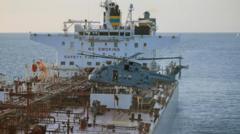
- Air Insertion and Surveillance: Personnel from the Royal Marine Commandos executed a midnight boarding by fast-roping from CH-47 Chinook helicopters, supported by Merlin Mk4 and Wildcat aircraft from the Maritime Air Group. A Royal Air Force P-8 Poseidon maritime patrol aircraft provided wide-area sensor coverage to monitor for any approaching surface or subsurface threats.
- Surface Containment: The Type 23 frigate HMS Sutherland and the Hunt-class minehunter HMS Ledbury provided surface containment, establishing a kinetic perimeter to prevent intervention and manage local maritime traffic.
- Tactical Integration: While military forces secured physical control of the ship and its 25 crew members without resistance, specialized law enforcement officers from the National Crime Agency simultaneously boarded to execute searches under domestic sanctions legislation, securing physical manifestos, digital logs, and corporate documentation to map the underlying network of shell companies.
The choice of anchorage off Weymouth for the detained vessel highlights a critical limitation of maritime interdiction. A fully laden oil tanker carrying roughly 700,000 barrels of crude cannot simply be tied up at a standard commercial dock. It requires specialized deep-water anchorage, continuous environmental monitoring to prevent catastrophic spills, and constant security to prevent asset reclamation. The operational tail of a successful seizure demands substantial, ongoing domestic maritime infrastructure.
Tactical Divergence and Policy Limitations
While the seizure proves the tactical viability of physical interdiction under specific legal conditions, scaling this mechanism into a systemic blockade faces severe operational and geopolitical limits. Western nations cannot treat this operation as a repeatable blueprint for every shadow vessel due to three core structural bottlenecks.
The first limitation is legal dependency. The seizure of the Smyrtos succeeded primarily because the vessel was stripped of its flag immediately prior to transit, rendering it stateless under UNCLOS Article 110. If Russia shifts its shadow fleet to alternative registries that refuse to cooperate with Western diplomatic pressure, or if it utilizes sovereign state-owned flags, the legal basis for non-consensual boarding in international waters evaporates. Forcing a boarding on a validly flagged vessel constitutes an act of aggression under international maritime law, a threshold Western allies are highly unlikely to cross.
The second bottleneck involves physical capacity and legal processing. Holding a single tanker requires dedicated naval assets, coast guard supervision, environmental tracking, and an extensive legal framework to process arrested individuals, such as the Indian national detained by the NCA. With the global shadow fleet estimated at over 700 vessels, attempting to scale physical seizures would rapidly overwhelm the naval and judicial infrastructure of coastal European states. Interdiction remains an exceptional tool for high-value signaling rather than a comprehensive replacement for financial sanctions.
This reality creates an operational bottleneck:
[700+ Global Shadow Tankers] ➔ [High Resource Cost Per Seizure] ➔ [Saturated Naval/Legal Infrastructure] ➔ [Enforcement Restricted to High-Value Signaling Only]
The third risk is environmental and retaliatory escalation. Forcing a confrontation on a fully loaded, poorly maintained tanker inside a highly congested shipping lane like the English Channel carries a permanent risk of collision or structural failure, which could trigger an environmental emergency on the UK or French coastline. Furthermore, a permanent policy of physical disruption invites asymmetric retaliation from adversarial states against Western commercial shipping transiting critical choke points globally, such as the Strait of Hormuz or the Bab al-Mandab.
The Strategic Path Forward
The interdiction of the Smyrtos confirms that passive financial restrictions have hit a point of diminishing returns, forcing a shift toward targeted physical and administrative disruption. To turn this tactical success into a sustainable strategic advantage, enforcement must pivot away from high-risk mid-transit military boardings and focus heavily on the administrative choke points that occur before a vessel ever leaves port.
The most effective lever is the systematic weaponization of flag registry compliance. Western nations must establish an automated, real-time diplomatic mechanism that applies immediate secondary sanctions to any flag state registry failing to vet its fleet for hidden Russian ownership or deceptive maritime practices, such as disabling Automatic Identification System (AIS) transponders. By forcing smaller registries to choose between maintaining access to global financial markets or hosting shadow vessels, allies can systematically replicate the statelessness vulnerability that compromised the Smyrtos.
Simultaneously, coastal nations must transition from individual ship targeting to a strict choke-point denial framework. Rather than deploying elite military units for resource-heavy boarding operations, nations bordering restricted waterways must implement rigorous mandatory environmental and safety inspections for any vessel lacking top-tier P&I insurance before granting transit rights through territorial waters.
Failure to comply or provide verifiable proof of sovereign financial liability should result in an immediate denial of entry, forcing the shadow fleet into lengthy, economically unsustainable alternative routes. This shifts the burden of risk and cost entirely onto the illicit supply chain, degrading its financial viability without requiring continuous kinetic intervention.