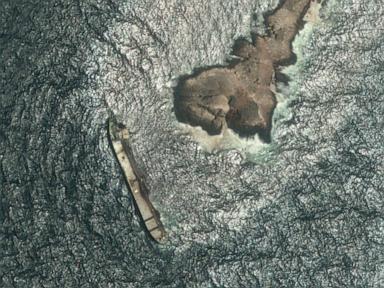
Maritime environmental crises follow distinct structural failure curves. When the Suezmax tanker Caroline Bezengi ran aground near the Hallaniyat Islands off the coast of Oman, it exposed the fragile mechanics governing the contemporary movement of restricted energy commodities. Carrying close to one million barrels of crude originating from Russian ports, the vessel experienced an onboard explosion prior to its grounding, setting off a slow-motion ecological and logistical breakdown.
Evaluating this event requires stripping away standard news narratives to examine the structural vulnerabilities of the dark fleet, the cost function of maritime insurance avoidance, and the kinetic physics of oil dispersion in protected marine environments.
The Structural Anatomy of the Shadow Fleet Risk Matrix
The grounding of the Caroline Bezengi is not an isolated navigational error. It is the predictable outcome of a parallel maritime economy operating outside conventional oversight. To understand why this incident escalated from an initial propulsion difficulty into a multi-hundred-square-kilometer slick, analysts must evaluate three core variables: structural age, regulatory arbitrage, and capital opacity.
- Asset Age and Fatigue: Built in 2001, the vessel operates well past the prime commercial threshold of modern single-hull or early double-hull designs requiring rigorous class renewals. Aging steel subjected to corrosive crude grades experiences micro-fractures accelerated by minimal preventative maintenance cycles.
- Jurisdictional Fragmentation: The vessel has rotated through multiple flags of convenience—including recent de-listing from the Cameroon registry—to evade Western sanctions. This creates a legal vacuum where no primary state actor exercises active operational control or possesses financial incentive to fund immediate salvage.
- Insurance Nullification: Operating without standard P&I (Protection and Indemnity) club coverage from Western maritime syndicates means there is no pre-funded capital pool dedicated to rapid emergency lightering or immediate containment contracting.
When an uninsured or under-insured vessel encounters structural failure, the absence of an immediate financial backstop creates a response delay. In environmental containment, response delay is the primary multiplier of total remediation cost.
The Environmental Cost Function and Dispersion Mechanics
Oman's Environment Authority formally acknowledged that the resulting slick spans approximately 390 square kilometers, while independent satellite monitoring groups such as Greenpeace and PAX place expanded sheens and trajectories across significantly larger radiuses. The mathematical progression of this spill is dictated by local hydrodynamics, specifically the peak monsoon conditions of July and August.
The physics of the spill involve two distinct phases:
- Offshore Sheen Migration: High winds and surface currents drive lighter volatile fractions across the open waters of the Arabian Sea reserve. While thin sheens evaporate or disperse partially, they disrupt surface-dependent marine life, including the endangered Arabian Sea humpback whale population and local seabird colonies.
- Nearshore Heavy Fraction Deposition: As the vessel sinks deeper into the rocky substrate off Qibliyah Island, heavier black oil separates and coats intertidal zones, southern coastlines, and mainland Omani beaches.
Once heavy crude contacts shallow coral ecosystems or rocky shorelines, the persistence vector changes entirely. Residual hydrocarbons bind to benthic sediments, echoing historical contamination models where remnants remain detectable decades after the initial event.
The Governance and Response Vacuum
Why did a crippled tanker carrying nearly a million barrels of oil sit stranded for over two months without active stabilization or lightering? The answer lies in the structural paralysis of international maritime governance.
Conventional maritime accidents trigger an immediate deployment of salvage tugs financed by hull underwriters and liability insurers. In the case of shadow operations, the true beneficial owners are shielded behind opaque corporate shells—such as the Shanghai-linked management entities associated with the Caroline Bezengi. These entities prioritize capital preservation over salvage execution, calculating that the cost of abandoning a detained or stranded hull is lower than financing a complex offshore recovery operation in a sanctioned corridor.
Consequently, regional authorities bear the fiscal and operational burden. While Oman deployed monitoring frameworks, satellite tracking, and predictive models, containment of a deep-sea, high-capacity leak requires specialized assets: heavy-lift salvage vessels, aircraft-mounted dispersant payloads, and offshore booming arrays. Without a pre-existing liability mechanism, these resources face severe deployment friction.
Strategic Forecast for High-Risk Maritime Corridors
The containment failure at the Hallaniyat Islands establishes a precedent for how environmental hazards will be handled in contested trade lanes. As long as regulatory pressure forces a growing share of global crude into aging, uninsurable tonnage, the frequency of unmitigated maritime spills will scale upward.
Future risk mitigation cannot rely on retroactive sanctions enforcement alone. Because shadow fleet operators systematically bypass traditional ports of refuge and standard financial guarantees, coastal states bordering critical chokepoints must implement pre-emptive bonding requirements or establish regional emergency response funds financed by transit levies. Without structural interventions that internalize the true cost of maritime failure, littoral ecosystems will continue to absorb the externalities of shadow trade.


