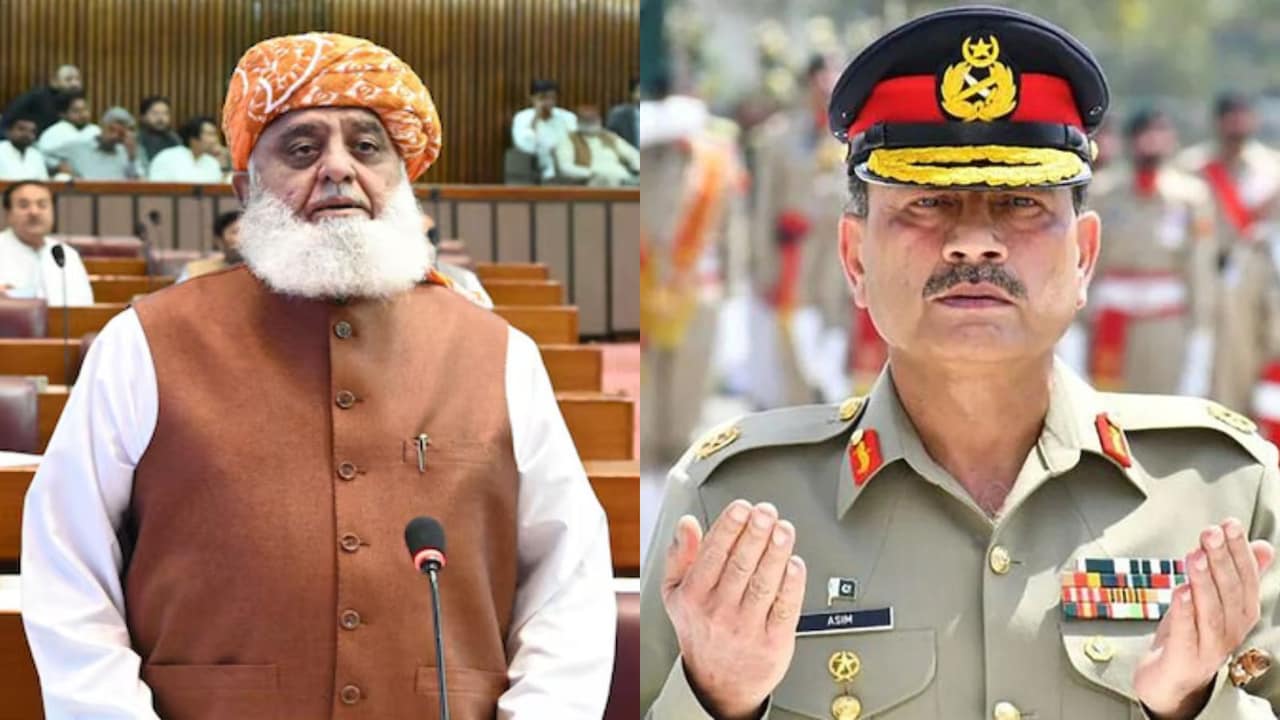
The traditional model of Pakistani governance—often conceptualized as a "hybrid regime" where a civilian facade masks an underlying military guardianship—has collapsed under its own weight. It has been replaced by a system of formalized institutional overreach. When Jamiat Ulema-e-Islam (Fazl) chief Maulana Fazlur Rehman publicly challenged Field Marshal Asim Munir to "take off the uniform" and contest elections, he was not merely engaging in standard political theater. He was exposing the critical structural failure of a state where the armed forces have transitioned from covert political arbiters to overt, constitutionally insulated administrators.
This transition undermines the fundamental division of labor required for state survival. When military institutions expand their remit to civilian domains while simultaneously attempting to delegate combat operations to local populations, the state forfeits its primary source of legitimacy: the monopoly on the legitimate use of physical force.
The Strategic Expansion of the Military Apparatus
The current Pakistani power structure is defined by a rapid expansion of the military's administrative footprint. The inclusion of Field Marshal Asim Munir on a high-level committee tasked with managing national population growth illustrates how thoroughly civilian policy-making has been outsourced.
This institutional expansion is structurally reinforced by the 27th Amendment to Pakistan's Constitution. The amendment does not merely tweak the balance of power; it fundamentally reengineers the state architecture through several mechanisms:
- Permanent Uniformity: By elevating the Chief of Army Staff to a five-star Field Marshal rank with lifelong tenure in uniform—removable only via an impeachment-like process—the state has legally eliminated the distinction between temporary command and permanent political tenure.
- The Sovereign Immunity Loophole: Granting lifelong immunity from criminal proceedings to five-star officers removes the legal feedback loops that theoretically hold public officials accountable to the judiciary or the legislature.
- Centralized Resource Command: Consolidating command of the Army, Navy, Air Force, and strategic nuclear assets under a single, military-nominated authority strips civilian prime ministers of their constitutional role as the ultimate commanders of national defense.
This formalization alters the incentives of the ruling elite. Civilian leaders, operating under the constant threat of selective accountability, are reduced to administrative proxies. The military, meanwhile, assumes the responsibilities of governance without the electoral feedback mechanisms that force civilian administrations to correct policy failures.
The Economics of Outsourcing Violence
The security crisis in Pakistan's peripheral regions—specifically Khyber Pakhtunkhwa and Balochistan—reveals a dangerous structural paradox. While the military centralizes political authority in Islamabad, it has simultaneously attempted to decentralize the burden of physical defense by encouraging local populations to raise civilian militias to combat insurgencies.
From a state-theory perspective, this is a highly volatile strategy. The social contract of a modern state relies on a specific transaction: citizens yield their individual right to violence and pay taxes, and in return, the state provides physical security through a professionalized standing army.
[Citizen Taxes & Yield of Violence Rights] ----> [State Treasury & Mandate]
                                                        |
                                                        v
[Localized Blood Vendettas & Chaos] <---- [Attempts to Arm Civilian Militias]
When a state apparatus attempts to arm civilian militias, it triggers three immediate structural failures:
- Forfeiture of the Monopoly on Violence: Legitimizing non-state armed groups, even those aligned with the government, fractures the chain of command. It guarantees that any future stabilization effort will require disarming the very groups the state created.
- Generation of Long-Term Blood Feuds: In tribal and highly segmented societies, deputizing specific clans or communities to fight insurgents transforms a national counter-terrorism campaign into localized, multi-generational vendettas.
- The Financial Misallocation Loop: Tax revenue is extracted from the civilian economy under the premise of funding a professional defense force. Delegating physical combat to unpaid civilians while continuing to fund an expanding military budget creates severe fiscal friction, driving down public compliance and further eroding state legitimacy.
The Territorial Shrinkage of State Writ
The failure of this hybrid model is most visible in the geography of the periphery. Large tracts of Balochistan and the Pashtun belt are operating outside the functional control of the federal government. When the state’s presence is reduced to fortified garrisons, the "writ of the state" becomes an illusion.
+-----------------------------------------------------------------------+
|                    TERRITORIAL CONTROL SPECTRUM                      |
+------------------------------------+----------------------------------+
|          Core Regions              |         Peripheral Regions       |
|  (Punjab, Urban Sindh, Islamabad)   |   (Balochistan, Pashtun Belt)    |
+------------------------------------+----------------------------------+
| - Complete tax extraction          | - Zero tax collection            |
| - Intact civil administration      | - Parallel Taliban/Baloch courts |
| - Monopolized physical security    | - Fractured local militias       |
| - Functional judicial system       | - Garrison-only state presence   |
+------------------------------------+----------------------------------+
This territorial decay is not merely a security failure; it is an administrative choice. Resources that should be deployed toward establishing local police presence, judicial infrastructure, and basic economic integration are instead diverted to maintain political control at the center. The result is a highly unequal state: a highly securitized core that extracts resources, and a neglected periphery where the local population must navigate the competing authority of insurgents, state-sponsored militias, and absent military officers.
The Ultimate Strategic Choice
Pakistan's institutional arrangement has reached a point of diminishing returns. The military cannot continue to manage population control, execute economic policy, and engineer electoral outcomes while simultaneously maintaining its primary operational readiness and delegating domestic combat duties to local militias.
The path toward structural stability requires a systematic contraction of the military's domestic administrative footprint. Security cannot be outsourced to civilian militias, nor can governance be permanently outsourced to five-star generals. For Pakistan to avoid systemic insolvency and territorial fragmentation, the state must re-establish a clear division of labor: a civilian executive held accountable by genuine elections, and a military confined strictly to national defense and paid for by a transparent public treasury. Any attempt to maintain the current, over-extended constitutional structure will only accelerate the erosion of the state's authority.


