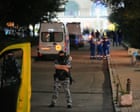
An improvised explosive device detonated outside the Balzi Rossi restaurant on Kudrinskaya Square in central Moscow, resulting in three fatalities and twenty-one injuries. The mechanical sequence of the event—featuring an intercepted courier, a premature threshold detonation, and a high-density urban target vector—provides a clear case study in asymmetric urban violence and physical security response dynamics. Deconstructing the incident requires examining the operational vectors, structural failure points, and tactical implications for high-value venue protection within high-risk urban environments.
The Physical Vector and Architectural Vulnerability
The selection of the venue dictates the baseline risk profile. Balzi Rossi occupies the ground floor of one of Moscow's iconic Seven Sisters Stalin-era skyscrapers, specifically the residential tower on Kudrinskaya Square. These historic structures present unique architectural configurations. They feature heavy masonry, restricted internal choke points, and prominent perimeter facades that face dense municipal corridors like the Garden Ring.
On the evening of the blast, the establishment was closed to the general public to accommodate a private function on its outdoor summer terrace. This operational status altered the venue's security baseline. Private events inherently concentrate high-value targets, specific demographic profiles, or military-associated personnel behind semi-permeable perimeters.
The physical geometry of the site created a specific kinetic envelope. An explosive yield equivalent to roughly one kilogram of TNT, packed with fragmentation media such as metal ball bearings, produces a devastating overpressure wave and high-velocity shrapnel field. Because the detonation occurred at the entrance threshold rather than deep within the interior seating matrix, the masonry and structural bulk of the Stalinist skyscraper acted as a partial blast baffle. This architectural containment absorbed a portion of the radial energy, yet the proximity to the outdoor terrace ensured that the thermal and kinetic shockwaves still inflicted twenty-one secondary casualties of varying severity.
The Interception Mechanics and Human Error Variables
According to assessments released by Russia's National Anti-Terrorism Committee and investigative reports from domestic media outlets, an unidentified female carrier attempted to enter the premises carrying an improvised explosive device disguised or presented as a delivery or gift box. The kinetic outcome was determined by a single tactical friction point: the venue security guard.
The guard identified an anomaly in the courier's presentation or authorization status, denied entry, and initiated a physical interdiction at the threshold. This intervention altered the intended target location. Strategic analysis of urban bombings indicates that closed-circuit or remote detonations rely heavily on target synchronization. When a courier or proxy is intercepted short of the designated interior zone, the operational timeline collapses.
Two primary hypotheses define the forensic investigation into the detonation mechanism. The first posits that the device was triggered intentionally by the carrier upon encountering resistance. The second, more complex hypothesis supported by investigative leaks in outlets such as Kommersant, suggests the device was detonated remotely by an external handler who observed the interception. Under this dual-key or remote-override scenario, the carrier may have been an unwitting human transport vector, carrying a payload configured with a remote receiver without possessing definitive operational awareness of the explosive contents.
The physical consequence of the threshold intervention was absolute. The carrier, the security guard, and a nearby customer absorbed the primary concussive force and high-density fragmentation pattern, resulting in three immediate fatalities. While the intervention failed to prevent the blast entirely, compressing the blast radius to the exterior threshold likely prevented a catastrophic mass casualty event among the guests seated on the enclosed terrace.
The Macro Security Environment and Asymmetric Warfare Patterns
The incident occurs within a volatile geopolitical and domestic security matrix, more than four years into the ongoing war with Ukraine. Over the preceding years, the operational profile of asymmetric threats within the Russian Federation has shifted from traditional infrastructure sabotage to targeted kinetic strikes against prominent military figures, nationalist ideologues, and pro-conflict public figures. Previous high-profile incidents—such as the car bombings targeting Daria Dugina and General Igor Kirillov, or the cafe bombing that killed military blogger Vladlen Tatarsky—demonstrated a persistent methodology of utilizing domestic proxies, unwitting couriers, or localized operatives to bypass soft perimeter controls.
Following these prior attacks, the Federal Security Service announced heightened protection protocols for senior military and state officials. However, the Balzi Rossi incident highlights the inherent vulnerability of the hospitality sector. Upscale dining venues and private banquets function as semi-public spaces where total access control is commercially and practically unviable. Private venues rely on hospitality-grade vetting rather than military-grade screening protocols.
When asymmetric actors exploit this gap, security systems are forced to rely on the situational awareness and tactical intuition of single frontline personnel. The guard at Kudrinskaya Square executed a high-cost interception that mitigated total asset destruction at the expense of his own life. This highlights a fundamental law of asymmetric defense: perimeter hardening shifts the failure point from architectural integrity to human vigilance.
Tactical Takeaways for Urban Venue Protection
The Moscow restaurant bombing reinforces three baseline principles for asset hardening in high-threat environments:
First, the threshold is the primary point of failure. If an explosive device is detected or intercepted at the door rather than the perimeter fence, the defensive margin is razor-thin. True defense requires an outer cordon that prevents anomalous packages from reaching pedestrian choke points.
Second, human proxies represent an unpredictable variable in remote-detonation logistics. Whether the carrier is a voluntary operative or an unwitting mule manipulated by a secondary handler, reliance on visual behavioral profiling at the entrance remains an imperfect filter.
Third, high-density gatherings in historic urban structures are uniquely susceptible to collateral amplification. The combination of enclosed masonry terraces and concentrated high-profile attendance creates an asymmetric return on investment for threat actors, requiring structural risk assessments that extend far beyond standard private event management.
The forensic reconstruction of the Kudrinskaya Square explosion demonstrates that while tactical intervention at the threshold can successfully deflect a primary target vector, it cannot eliminate the shockwave radius of an active improvised device. Future risk mitigation in urban hospitality sectors will necessitate the integration of automated electronic scanning and standardized standoff distances to neutralize proxy delivery vectors before physical contact with venue staff can occur.