The Weight of the Clipboard
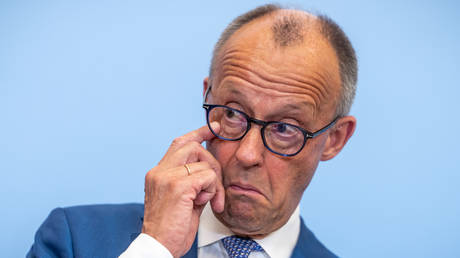
The fluorescence of a television studio at midnight does not feel like power. It feels like an interrogation. Friedrich Merz sits beneath the harsh LEDs, his long frame folded into a leather chair that suddenly feels much too large for him. Outside the soundproof glass, Berlin is quiet, but inside, the air is thick with the smell of stale coffee and the sharp, metallic tang of anxiety.
On the monitors across the room, the numbers are flashing. They are not just digits; they are the architectural blueprints of a political collapse.
A standard news report will tell you that the approval ratings for Germany’s opposition leader have plummeted to an all-time low. It will cite the percentages, compare them to the previous quarter, and quote a couple of tight-lipped political scientists from the Free University of Berlin. But numbers are bloodless things. They hide the human friction of leadership—the precise moment a politician stops looking like a savior and begins to look like a relic.
Consider a hypothetical voter named Andreas. He lives in Essen, works at a medium-sized logistics firm, and has voted for the Christian Democratic Union (CDU) for most of his adult life. He does not hate Merz. Hate requires energy. What Andreas feels is a profound, exhausting indifference. When Andreas looks at the screen, he does not see a future chancellor. He sees a corporate lawyer who stumbled into a cultural storm without an umbrella.
That is the true nature of a polling crisis. It is not an explosion. It is a slow, leaking tire on a dark stretch of the Autobahn.
The Illusion of the Default Option
For months, the math seemed simple. The ruling coalition government under Olaf Scholz was fracturing under the weight of economic stagnation and endless internal bickering. By the laws of political gravity, the main opposition party should have been soaring. The public, tired of the current management, was supposed to hand the keys back to the traditional guardians of the German state.
Instead, the floor gave way.
The latest data from the infratest dimap poll reveals a terrifying reality for the CDU leadership. Merz’s personal popularity has dropped significantly below even the deeply unpopular sitting chancellor. When voters are asked who they would prefer in a direct election, the line for Merz plunges toward the bottom of the graph.
Why? Because anger does not automatically convert into trust.
Imagine walking into a bakery because the supermarket down the street ran out of bread, only to find that the bakery is only selling stale rolls from three days ago. You do not buy the stale rolls just because you are hungry; you go home and look for another option entirely. In Germany, that other option is increasingly found on the fringes, where the rhetoric is louder and the promises are simpler. Merz is discovering that being the default choice is a terrible strategy when people are desperate for a different world.
The Sound of an Empty Room
The problem is one of language. Watch Merz when he speaks about the economy. His posture stiffens. His voice adopts the precise, patronizing cadence of a boardroom presentation. He talks about fiscal discipline, structural reforms, and competitiveness.
These are important words. But they do not keep the heat on in a two-bedroom apartment in Dortmund.
During a recent rally in Saxony, the disconnect was palpable. The stage was set with the traditional black, red, and gold banners. The crowd was there, but they were quiet. Not a respectful quiet, but a hollow one. Merz spoke for forty minutes about corporate tax structures. He used a metaphor about a ship navigating rough seas, a classic trope that has been used by every German politician since Bismarck.
A woman in the third row, holding a grocery bag, simply checked her watch.
The political apparatus assumes that voters are rational actors analyzing policy white papers. They are not. They are tired human beings looking for a sense of safety. When a leader fails to provide that emotional anchor, his policy proposals sound less like solutions and more like a lecture from a distant uncle.
The Shadow of the Past
To understand how Merz arrived at this nadir, one must understand his history. He is a man who waited two decades for his turn. After being pushed aside by Angela Merkel in the early 2000s, he retreated to the private sector, accumulating wealth and influence in the upper echelons of global finance. He returned to the political arena as the anti-Merkel—a man of clear convictions, conservative economic principles, and a refusal to compromise with modern progressive trends.
It was a compelling narrative for a party that felt it had lost its soul during the long, centrist years of the Merkel era.
But the Germany Merz returned to was not the Germany he left. The geopolitical reality had shifted. The economic model that relied on cheap energy and open global markets was cracking. The voters were younger, more anxious, and deeply divided.
The very traits that made Merz attractive to the party faithful—his stubborn adherence to old-school economic orthodoxy and his combative style—became liabilities to the broader electorate. He looks like a man trying to operate a smartphone with a dial-tone mentality. The public caught on.
The Ghost in the Machine
The numbers are a symptom, not the disease. The disease is a profound lack of empathy.
In political polling, there is a specific metric known as "sympathy values." It measures how much the average person actually likes the candidate as a human being. This is where the collapse is most acute. Merz has never been a warm figure, but his recent media appearances have exacerbated the perception of coldness.
When questioned about rising social inequality, his responses often border on irritation. He treats the question as an intellectual error rather than a human crisis.
This brings us back to the studio lights. The interview ends. The cameras click off. The handlers rush forward with coats and schedules, talking about the next media appearance, the next press release, the next strategy meeting. They treat the poll numbers as a tactical problem to be solved with better messaging or a sharper PR campaign.
They are wrong.
You cannot market your way out of a fundamental lack of connection. A country cannot be managed like a distressed asset portfolio. As the black sedan carries the opposition leader away into the Berlin night, past the dark windows of apartments filled with people who no longer care what he has to say, the silence is deafening. It is the sound of an entire nation turning its back, not out of anger, but out of a quiet, definitive exhaustion.


