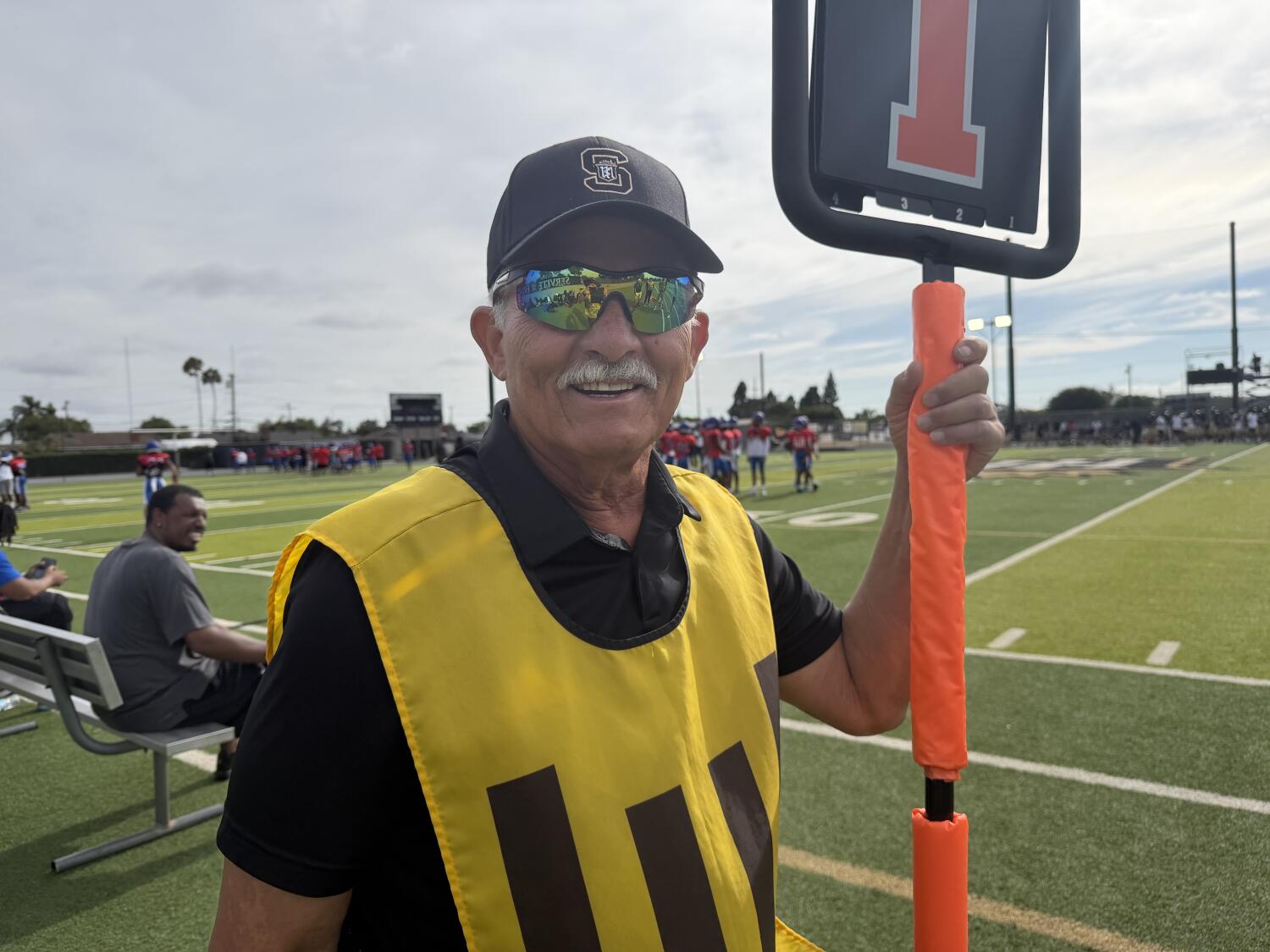
High-performance athletic infrastructure depends entirely on redundant, low-visibility support systems operating without failure across extended time horizons. While media analysis focuses almost exclusively on roster composition, coaching schemes, and direct capital investment, the institutional stability of high school athletics rests on auxiliary operational continuity. Val Moreno entering his thirty-third consecutive year managing the sideline chain crew for Servite High School home football games offers an empirical case study in organizational tenure, human reliability, and institutional memory within amateur athletic ecosystems.
Evaluating this longevity requires moving past sentimental narratives about community service to examine the mechanics of long-term operational engagement. Institutional retention in volunteer roles usually degrades rapidly due to burnout, shifting personal priorities, and the absence of clear feedback loops. Mitigating these systemic decay factors demands an explicit structural framework.
The Operational Anatomy of Sideline Management
Managing down-and-distance markers for competitive football is frequently mischaracterized as a passive or purely mechanical task. In practice, the chain crew functions as an extension of the officiating crew, operating under severe time constraints, ambient environmental pressure, and high cognitive load.
The primary responsibilities involve maintaining absolute spatial accuracy across a 100-yard field under variable weather conditions while reacting instantaneously to whistle blows, line-of-sight obstructions, and dynamic player movement along the boundary. The cost of failure is high: a minor measurement error directly alters game state, shifts win probability matrices, and introduces legal or reputational liabilities for the hosting institution.
Sustaining high performance in this environment across three decades requires a specific operational model built upon three core pillars:
- Error Minimization Protocols: Eliminating variance through rigid procedural consistency, standardizing hand signals with line judges, and maintaining strict physical alignment with the yardage lines.
- Environmental Adaptation: Managing physical endurance, cognitive fatigue, and distraction during high-stakes game situations where crowd noise and intense player collisions occur inches from the sideline.
- Succession and Mentorship: Cultivating shared operational knowledge by onboarding, training, and synchronizing new crew members to ensure systemic resilience against individual attrition.
The Economics of Volunteer Retention
In organizational theory, volunteer retention is governed by the ratio of perceived contribution to personal opportunity cost. Over a thirty-three-year timeline, this ratio faces continuous pressure. Traditional volunteer models rely heavily on extrinsic motivation, such as public recognition or compensation, neither of which applies to high school chain crews who typically donate their time on Friday nights.
Servite’s ability to retain personnel across decades indicates a structural alignment between the individual's intrinsic reward mechanisms and the institution's operational requirements. The role provides high structural clarity, immediate task completion feedback, and deep integration into a high-prestige athletic subculture. When a role combines unambiguous metrics of success with strong social affiliation, the psychological switching cost of leaving increases exponentially.
This creates a self-reinforcing loop of tenure. As operational experience accumulates, the marginal cognitive effort required to execute the task decreases, while the individual's value to the institutional network increases. Experienced chain crew members develop predictive intuition regarding play development, allowing them to anticipate boundary movements and position the chains preemptively, thereby reducing physical strain and minimizing error rates.
Institutional Memory and Risk Mitigation
High school athletic programs experience high annual turnover in student-athletes, coaching staff, and athletic administration. This structural transience creates institutional amnesia, where standard operating procedures are regularly forgotten or poorly executed.
Auxiliary volunteers who maintain multi-decade continuity serve as human repositories of institutional memory. They stabilize the operational environment by enforcing unwritten standards of professionalism, maintaining historical continuity with league officials, and preserving institutional norms across generations of leadership. When officials, coaches, and administrators change every few years, a stable chain crew provides an invariant baseline that protects the integrity of the competition.
Organizations that fail to cultivate or retain this level of veteran support suffer from elevated error rates during game days, increased friction with officiating crews, and administrative churn. Treating auxiliary roles as interchangeable commodities rather than critical nodes of institutional infrastructure leads directly to operational degradation.
Strategic Operational Optimization for Athletic Programs
To replicate the stability exemplified by multi-decade sideline stewardship, athletic departments must shift their management approach from transactional recruitment to long-term asset retention.
Programs should implement structured onboarding pipelines that pair incoming volunteers with veteran practitioners, ensuring that tacit knowledge is successfully transferred rather than lost upon departure. Furthermore, institutions must formalize recognition pathways that validate the specialized expertise required for auxiliary roles, reinforcing the psychological contract between the volunteer and the organization.
Elevating the status of foundational operational roles from background necessities to core components of institutional governance safeguards competitive integrity and organizational resilience over decades of play.