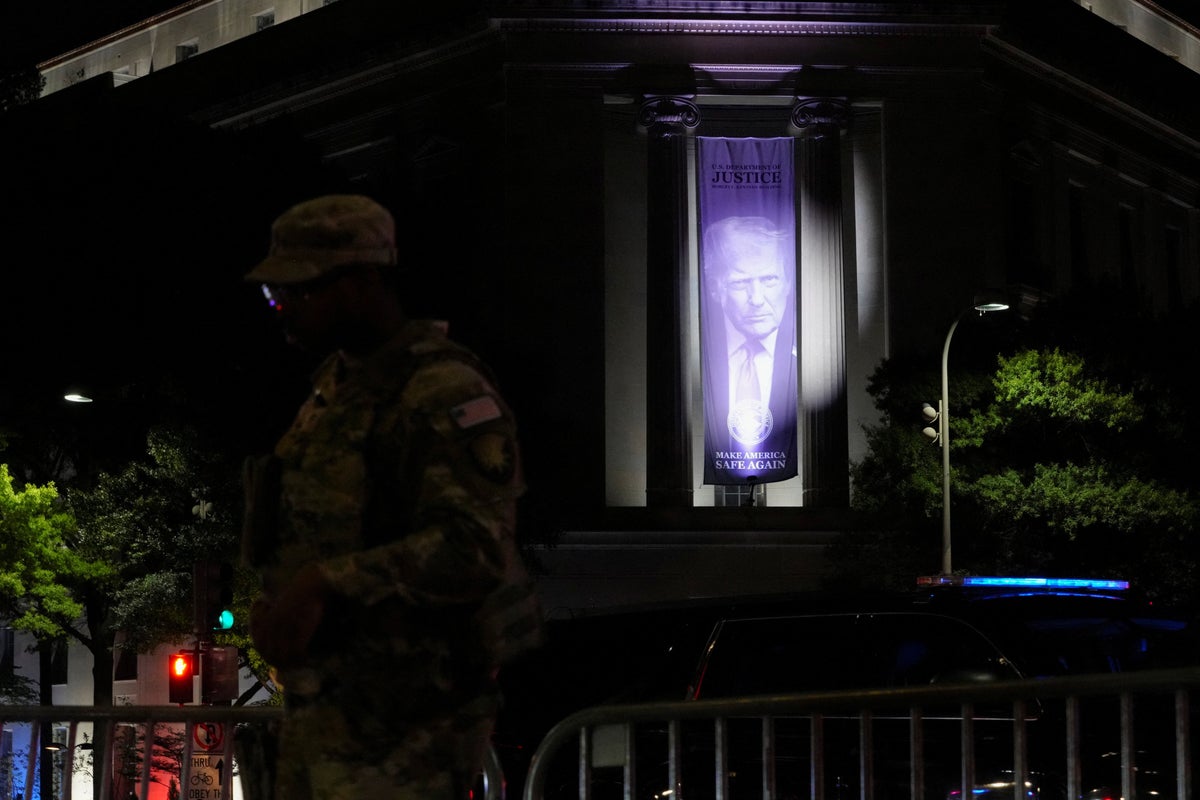
The recent deployment of capital toward the physical rebranding of federal infrastructure, specifically exemplified by the installation of large-scale executive imagery and structural refurbishments at the United States Department of Justice, offers a clear case study in institutional messaging and asset allocation. When evaluating public sector procurement tied to symbolic display, analysts must move past superficial political commentary and instead deconstruct the financial vectors, operational mechanisms, and institutional signalling driving these expenditures.
The Cost Function of State Signage
Public procurement initiatives involving architectural modifications and external building banners operate under distinct economic and administrative constraints compared to private sector marketing campaigns. To understand the nearly one-million-dollar expenditure reported on federal structural updates and display installations, one must evaluate the cost function of government procurement:
$$Total Cost = Direct Material + Labor + Specialized Deployment + Compliance & Contingency$$
- Direct Material: High-durability, weather-resistant polymers and heavy-gauge fabric assemblies designed to withstand environmental degradation on monumental facades.
- Labor & Engineering: Union-compliant rigging crews, structural safety engineers, and crane operation syndicates required for urban installation in secure federal zones.
- Compliance & Permitting: Internal risk assessments, historical preservation reviews where applicable, and inter-agency coordination.
Rather than viewing these line items as standard operational overhead, institutional analysts categorize them under sovereign branding allocation. The primary objective of such expenditures is not commercial conversion, but rather the establishment of visible authority over physical federal real estate.
The Three Pillars of Executive Imposition
The systematic integration of executive branding across Washington infrastructure follows a rigorous, predictable methodology. This framework relies on three distinct operational pillars designed to shift the perceived locus of power within federal agencies.
1. Spatial Dominance of Neutral Architecture
Federal administrative architecture—historically designed using neoclassical motifs to project timeless institutional permanence—is intentionally repurposed. By affixing high-contrast executive iconography to neutral stone facades, the administration disrupts the architectural neutrality traditionally associated with independent investigative bodies. This creates a visual hierarchy where individual executive identity supersedes institutional anonymity.
2. Slogan-Driven Policy Anchoring
The inclusion of declarative text alongside executive imagery functions as a compressed policy directive. Phrases such as "Make America Safe Again" serve dual purposes: they act as public-facing justification for specific operational priorities—such as immigration enforcement and urban crime reduction—while simultaneously binding the agency's public output directly to the sitting executive's political brand.
3. Administrative Fealty Signalling
At the operational layer, agency leadership executes compliance not merely through policy implementation, but through physical compliance. When cabinet-level departments adopt visual markers requested or endorsed by the executive office, it signals internal alignment and dissolves the traditional "arms-length" doctrine that separates law enforcement execution from political oversight.
Cause and Effect Mechanics within Institutional Rebranding
The introduction of overtly personalized administrative markers on neutral state assets triggers distinct feedback loops across both public sentiment and internal bureaucratic behavior.
[Executive Mandate] ---> [Capital Allocation & Procurement] ---> [Architectural Alteration] ---> [Institutional Signal Disruption] ---> [External & Internal Feedback Loops]
When an agency like the Department of Justice alters its physical presentation, two primary systemic reactions occur:
- The External Legitimacy Friction: Watchdog organizations and opposition groups immediately challenge the action, framing it as an erosion of institutional independence. This creates a public relations battleground where the administration defends the expenditure as a celebration of national milestones, while critics map it as a symptom of democratic erosion.
- The Internal Compliance Vector: Bureaucrats and career civil servants navigate an altered incentive structure. When physical symbols of executive authority loom over daily operations, the perceived cost of dissent or independent internal friction increases, subtly altering institutional risk tolerance.
Limitations and Operational Realities
While the deployment of high-cost executive banners generates significant media focus, structural analysts must recognize the tactical limitations of these initiatives. Physical signage is a lagging indicator of power, not its source. Banners and building refurbishments do not inherently alter statutory authority, judicial precedents, or budgetary appropriations managed by Congress.
Furthermore, relying on centralized executive branding introduces vulnerability to future administrative reversions. Assets optimized exclusively for temporary political messaging carry high replacement or removal costs when political control shifts, making them inefficient long-term capital deployments from a purely fiscal standpoint.
Strategic Outlook
To evaluate similar federal expenditures moving forward, analysts should abandon moralized interpretations and focus strictly on procurement tracking, vendor contract transparency, and the correlation between physical asset rebranding and concurrent shifts in agency enforcement priorities. The primary metric of success for these campaigns is not public approval, but the permanent alteration of the visual baseline in the nation's capital. Future institutional strategies will likely continue testing the threshold where public real estate intersects with personalized executive authority, setting new benchmarks for how state power is communicated to the citizenry.


/i.s3.glbimg.com/v1/AUTH_1f551ea7087a47f39ead75f64041559a/internal_photos/bs/2025/P/p/LLF10DRp2WoUISXryrUQ/whatsapp-image-2025-12-02-at-20.06.57.jpeg)