Lose a football match. Demand a stronger navy.
It sounds like a bad parody of British post-empire angst, but it's exactly what happened in July 2026 after England fell 2-1 to Argentina in a brutal, late-drama World Cup semi-final. After the final whistle blew in Atlanta, the pitch became a geopolitical battleground. For a different view, see: this related article.
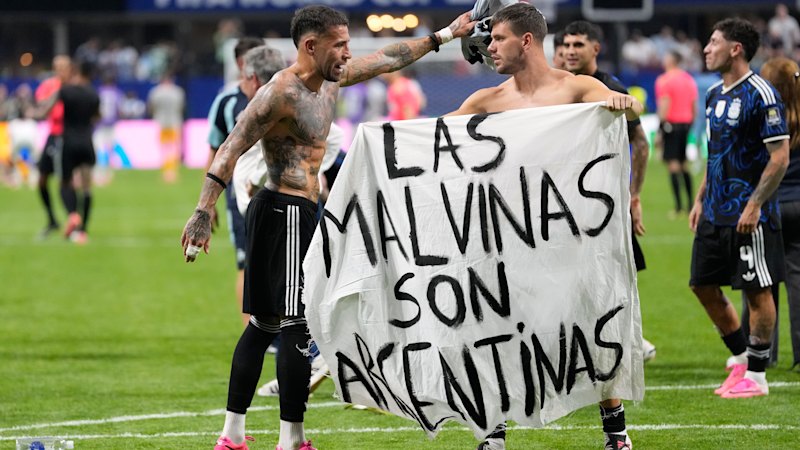
Argentine players, including superstar Lionel Messi, paraded in front of their screaming fans holding a banner. It read: “Las Malvinas son Argentinas”—The Falklands are Argentine.
Within hours, the British political class lost its collective mind. While some politicians called for immediate FIFA bans, others bypassed football entirely. They pointed directly at the UK's shrinking fleet of warships. It is a bizarre crossover of elite sports, historical trauma, and modern defense panic. Further analysis on this trend has been provided by The Washington Post.
The Pitchside Provocation That Sparked the Row
The match itself was tense. Anthony Gordon put England ahead in the 55th minute. Then, the wheels came off. Argentina struck twice in the dying minutes—Enzo Fernández equalizing in the 85th and Lautaro Martínez stabbing home the winner in stoppage time.
But the real crisis kicked off during the celebrations.
The Argentine squad unfurled a white sheet bearing the sovereignty claim over the South Atlantic archipelago. This wasn't a spontaneous fan stunt. It was held by the players themselves on the world’s biggest stage.
Back in Buenos Aires, Argentine Vice-President Victoria Villarruel poured fuel on the fire. She posted a photo of the team on X, writing: "The Falklands are Argentine! They banned bringing them to the stadium and forgot that we carry them in our blood and our hearts."
Westminster Demands Bans While Farage Eyes the Fleet
British reaction was swift, loud, and deeply divided on how to actually respond.
UK Business Secretary Peter Kyle went straight to the rulebook. He called the display "entirely inappropriate" and demanded that FIFA launch a full investigation. FIFA’s code of conduct is famously strict about political messaging, explicitly banning political, ideological, or religious propaganda on the pitch.
Liberal Democrat leader Ed Davey went even further, demanding the players involved be banned from the World Cup final.
Then came Nigel Farage.
The Reform UK leader dismissed the football bureaucracy entirely, choosing to look at the big picture. On X, he wrote:
"Whilst I am disgusted at the behaviour of some Argentinian players last night, the most important thing to do is build up the Royal Navy quickly."
It seemed like a wild leap from a conceded goal in Georgia to naval procurement. But Farage hit a raw nerve. The taunt from the Argentine squad exposed a vulnerability that British defense hawks have been warning about for a decade: the hollowed-out state of the Royal Navy.
How Weak is the Royal Navy Right Now
To understand why a football banner turned into a debate about frigates, you have to look at the numbers.
When Britain fought the Falklands War in 1982, it dispatched a massive task force of over 100 ships, including two aircraft carriers and dozens of frigates and destroyers. Today, the Royal Navy's active surface escort fleet has shrivelled to around 12 destroyers and frigates.
- Maintenance Nightmares: The Type 23 frigates are being run far past their intended lifespans. They spend months, sometimes years, stuck in dry dock due to a lack of spare parts and skilled engineers.
- Recruitment Crisis: The navy simply doesn't have the personnel to crew the ships it does have.
- Funding Black Hole: Former Defence Secretary John Healey’s recent resignation letter warned that the UK’s planned defense spending is dangerously inadequate for the rising global threats.
If Argentina decided to test British resolve tomorrow, the UK would struggle to assemble even a fraction of the fleet that sailed south in 1982.
Why an Invasion Remains a Paper Tiger
Despite the panic in London newsrooms, there is an obvious flip side to this drama. Argentina’s military is in no position to pull off a repeat of 1982.
Decades of economic crises have left the Argentine armed forces severely underfunded, lacking modern fighter jets, functional submarines, or amphibious landing capabilities. The country uses the Falklands issue primarily as a domestic distraction. Whenever inflation spikes or governments face pressure, politicians pull the "Malvinas" lever to unite the public.
Furthermore, the defense of the Falklands doesn't rely solely on a floating navy anymore. The islands are heavily fortified. Mount Pleasant complex hosts a permanent garrison of British infantry, state-of-the-art radar tracking, and Eurofighter Typhoon jets.
As defense analysts on platforms like Reddit pointed out, any modern attempt to approach the islands would face immediate air defense and potentially devastating drone deployments. The days of needing a massive battleship fleet just to keep the peace are long gone.
What Happens Next
The immediate ball is in FIFA's court. The governing body has previously fined associations and banned players for political gestures, but whether they will have the stomach to punish Lionel Messi and the finalists ahead of the World Cup showpiece is another matter entirely.
For the UK, the real work lies at home. If the British government wants to stop being humiliated on the global stage, complaining to FIFA won't cut it. The administration needs to address the defense spending gap.
Boosting naval recruitment and speeding up the delivery of Type 26 and Type 31 frigates is the only real way to project strength. Until Britain fixes its fleet, its geopolitical rivals will continue to use sport as a weapon, knowing exactly where the UK's armor is thinnest.