The air inside the Le Mans manufacturing plant smells of stamped steel, industrial lubricants, and cold morning coffee. For decades, the rhythm here was entirely predictable. A worker named Jean-Pierre—hypothetically speaking, though he represents three generations of actual metalworkers in this valley—knew exactly what his hands would build when he clocked in at dawn. He built the subframes for family hatchbacks. He pressed the door panels for commuter cars that would eventually carry children to football practice and groceries home from the supermarket. His labor was stitched into the mundane, peaceful fabric of European civilian life.
But look closer at the conveyor belts today. The jigs are changing. The tolerances are tightening in ways that have nothing to do with fuel efficiency or passenger legroom.
The French Ministry of the Armed Forces quietly knocked on the historic carmaker's door with a stark, unsettling proposition. They did not want more staff cars or transport trucks. They wanted Renault to build weapons. Specifically, they wanted the factory floor to pivot toward the production of loitering munitions—a clinical, sterile term for what the rest of the world calls explosive kamikaze drones.
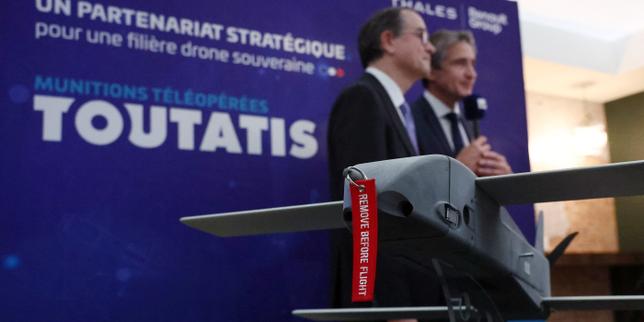
By next year, this factory and its sister facilities are slated to churn out 1,000 of these lethal, flying wings every single month under a newly unveiled partnership with defense giant Thales. The project is called Toutatis. It represents an unprecedented, uncomfortable collision between consumer capitalism and the relentless mechanics of modern warfare.
The Machine in the Mirror
To understand how a company synonymous with quirky city cars ended up manufacturing flying bombs, you have to look at the brutal geometry of modern combat. The war in Ukraine exposed a terrifying vulnerability in Western military doctrine. High-tech, multi-million-euro missile systems are magnificent until you run out of them. And in a high-intensity conflict, you run out of them in weeks.
The battlefield now demands mass. It demands disposable attrition.
Consider the hypothetical math confronting a modern logistics officer: if an adversary deploys thousands of cheap, commercial-grade drones to swarm your positions, defending yourself with traditional air-defense missiles costing half a million euros a pop is a mathematically guaranteed way to bankrupt your nation before the first month of fighting ends. You need something cheap. You need something automated. Most importantly, you need it by the truckload.
Defense contractors are brilliant at building exquisite, boutique machinery over the course of decades. They are profoundly terrible at mass production. They do not know how to build 1,000 of anything in thirty days without the price tag spiraling into the stratosphere.
Renault does.
For over a century, the automotive industry optimized the art of shaving fractions of a cent off a plastic clip and squeezing seconds out of an assembly line. They know how to source raw steel, stamp it, wire it, test it, and roll it out of a bay door every few minutes with terrifyingly low failure rates.
The Toutatis drone is the physical manifestation of this logic. It is a short-range, turbojet-powered flying wing designed to be carried in a soldier’s backpack or launched from the back of a tactical vehicle. It flies at 400 kilometers per hour, ignores electronic jamming, and possesses a mission-configurable warhead designed to punch through heavy armor. It can hunt in swarms. It is built to die.
But the real friction isn't mechanical. It is cultural.
"We are a business-to-consumer company," a company insider recently whispered to reporters, capturing the deep unease rippling through the executive suites. "We are not really set up to be talking to military procurement agencies for weeks over specifications."
There is a profound institutional vertigo when a brand that spends billions of euros trying to project an image of safety, sustainability, and family values suddenly finds itself calculating the kill radius of a nose-cone payload. To keep the ghost out of the corporate machine, Renault leadership quietly enacted an informal rule: defense revenues must be strictly capped at 5 percent of the group's total turnover.
It is a financial firewall. It allows the company to fulfill what it calls its "duty as a French citizen" during a geopolitical crisis while preventing the brand from being reclassified by ethical investment funds as a merchant of death. They want to help defend the republic, but they do not want to lose their soul—or their ESG lending guidelines—in the process.
Yet the tide is incredibly difficult to resist. The automotive market in Europe is bruising. Consumer demand is soft, and the electric vehicle transition is a meat grinder of shifting regulations and aggressive foreign competition. Factories have spare capacity. Workers need jobs.
Beside the Toutatis project with Thales, Renault signed another deal with Turgis Gaillard to assemble the Chorus—a massive, long-range strike drone capable of carrying a 500-kilogram warhead over 3,000 kilometers. There are even quiet talks with Belgian firm John Cockerill to turn the rugged, budget-friendly Dacia car platform into autonomous land drones.
Step by step, the carmaker is wading deeper into the rubicon.
The Human at the End of the Wire
We often treat these industrial shifts as abstract corporate chess. We read the press releases from the Eurosatory defense fair and analyze the stock price fluctuations. But the true weight of this transition lands squarely on the shoulders of the people who have to pull the levers.
Picture the assembly line at Le Mans a year from now. Jean-Pierre stands at his station. The component that glides down the track toward him is no longer an aluminum steering knuckle. It is the fuselage casing for a loitering munition. He checks the seals. He routes the wiring harness. He hooks up the optical sensor package.
He knows that, unlike a car, this object is designed to function exactly once. Its engineering triumph is its total destruction.
There is a distinct psychological weight to that realization. In the old days, a factory worker could spot a vehicle on the highway years later and feel a quiet spark of ownership. I built that. It carried a family safely through a rainstorm. The new products offer no such long-term residency in the world. They exist to vanish in a flash of heat and fragmented steel somewhere on the eastern fringes of the continent.
The defense architects assure us that humans remain securely in the decision-making loop. The Toutatis drone will fly itself, navigate through electromagnetic chaos, and identify potential targets using onboard algorithms, but it will still wait for a flesh-and-blood operator to click a mouse or press a button before committing to its final, fatal dive.
But as the manufacturing capacity scales to thousands of units per month, the line between human intention and automated slaughter thins to the width of a razor blade. The machinery of mass production possesses a momentum all its own. Once you build the capability to flood the skies with disposable capital, the world inevitably finds a reason to let them fly.
Jean-Pierre finishes his shift. He clocks out, walks across the asphalt parking lot, and climbs into his own diesel hatchback. He turns the key, the engine coughs to life, and he drives home along the quiet, tree-lined roads of western France. He leaves behind a floor that is quietly preparing for a completely different kind of future—one where the excellence of European engineering is measured not by how long a machine can run, but by how efficiently it can explode.