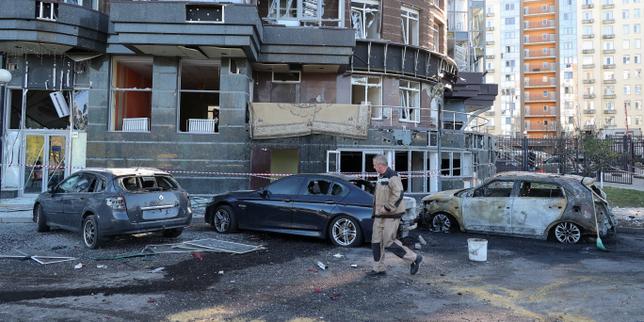
Cross-border unmanned aerial vehicle (UAV) strikes against Russian border oblasts have shifted from isolated tactical distractions into a persistent operational theater that forces Moscow to choose between frontline offensive density and domestic air defense saturation. When four civilians are killed across a regional capital like Belgorod and its surrounding rural settlements in a single wave of drone strikes, the kinetic event itself represents only a fraction of the strategic equation. Standard breaking-news reporting treats these incidents as isolated casualty tallies. A rigorous operational analysis reveals a deliberate campaign of geographic dispersion, air defense exhaustion, and economic friction designed to degrade the Russian war effort from within its own logistical staging ground.
The Structural Logic of the Belgorod Theater
Belgorod Oblast is not merely a border province; it is the primary logistical nervous system for Russian ground operations in northeastern Ukraine, specifically supporting the Kharkiv and Donbas axes. Understanding why drone strikes concentrate simultaneously on the urban core of Belgorod city and dispersed rural villages requires mapping the operational geometry of the region. In similar developments, read about: Asymmetric Backchannels and Nordic Deterrence in Modern Conflict Resolution.
Urban Centers Versus Peripheral Settlements
Targeting both an urban administrative hub and peripheral villages within the same strike window exploits two distinct vulnerabilities in territorial defense:
- Urban Density and Psychological Friction: Belgorod city sits roughly 40 kilometers from the Ukrainian border. At this range, flight times for one-way attack drones and modified commercial quadcopters compress to under twenty minutes. Strikes hitting urban infrastructure or residential zones immediately disrupt municipal administration, strain emergency medical networks, and erode the domestic political contract that insulates Russian civilians from the consequences of the war.
- Rural Dispersion and Defensive Gaps: Villages scattered across the oblast lack dedicated point-defense systems. Protecting hundreds of small settlements with short-range air defense (SHORAD) assets is mathematically impossible without stripping frontline brigades of vital protection. Attacking rural nodes forces Russian commanders to either leave border communities exposed or dilute their defensive coverage across a wide, low-density perimeter.
Known Facts Versus Operational Hypotheses
In analyzing cross-border incidents where independent verification is constrained by wartime censorship, strict separation between confirmed telemetry and strategic inference is mandatory: BBC News has analyzed this critical subject in extensive detail.
- Confirmed Operational Realities: Four fatalities occurred across two distinct target profiles—two within the urban boundaries of Belgorod and two in surrounding oblast villages—resulting from unmanned aerial platforms. Russian regional authorities consistently report these events through casualty figures and localized infrastructure damage while withholding data on military logistics hits or air defense expenditure rates.
- Analytical Hypotheses on Targeting: While civilian casualties are the visible outcome reported in public dispatches, operational doctrine suggests two primary drivers behind mixed urban-rural strikes. The first is collateral degradation resulting from electronic warfare (EW) jamming, which knocks drones off military trajectories and causes them to crash into residential areas. The second is deliberate infrastructural pressure aimed at forcing the evacuation of border zones, thereby clearing the civilian human shield that complicates Ukrainian reconnaissance and strike operations.
The Cost-Exchange Asymmetry of Drone Saturation
Traditional warfare relies on parity of force; modern drone attrition relies on economic asymmetry. The core mechanism driving the Belgorod strikes is the inverted cost-exchange ratio between offensive unmanned platforms and defensive surface-to-air interceptors.
An expendable one-way attack drone or heavy multi-rotor bomber costs between $1,500 and $30,000 to manufacture and deploy, depending on payload capacity and guidance autonomy. Conversely, a single interceptor missile fired from a Russian Pantsir-S1 or Tor-M2 air defense system costs between $500,000 and $1.5 million. Even when Russian air defenses achieve an interception rate exceeding 80 percent, the defender loses the war of attrition through sheer resource depletion.
This economic imbalance creates three cascading bottlenecks for Russian military planners:
- Interceptor Inventory Depletion: Every missile expended over a village in Belgorod Oblast is one fewer interceptor available to protect high-value command posts, ammunition depots, or armored columns in occupied Ukrainian territory.
- Radar Fatigue and Emission Exposure: Keeping search and tracking radars active continuously to detect low-altitude, slow-moving drones exposes air defense batteries to anti-radiation missiles and signals intelligence (SIGINT) triangulation.
- Maintenance and Crew Burnout: High-tempo alert cycles degrade the mechanical readiness of mobile air defense chassis and exhaust specialized operator crews who cannot be rapidly replaced.
Air Defense Saturation and the Low-Altitude Blind Spot
The physical environment of Belgorod Oblast presents severe technical challenges for conventional radar networks. Modern air defense architectures were engineered during the Cold War to detect high-speed, high-altitude fixed-wing aircraft and ballistic trajectories. Small unmanned systems exploit the blind spots inherent in those legacy designs.
Terrain Masking and Radar Horizon
Drones operating at altitudes between 30 and 150 meters utilize terrain masking—flying below the radar horizon created by the curvature of the earth and local topographical variations. By the time a ground-based radar acquires a target skimming treetops or following river valleys into Belgorod, the engagement window has narrowed to seconds.
The Electronic Warfare Paradox
To compensate for kinetic interception limits, Russian forces rely heavily on localized electronic warfare networks designed to jam satellite navigation (GNSS) and sever command-and-control (C2) radio links. However, EW introduces an operational paradox in populated border regions:
- Loss of Terminal Control: When an EW dome severs a drone's guidance link, the aircraft does not vanish; it continues along its last known ballistic vector or enters an automated fail-safe descent.
- Unintended Urban Impact: Over a densely populated city like Belgorod, jamming an inbound drone mid-flight frequently diverts it from a hardened military staging area into apartment blocks, commercial streets, or civilian vehicles.
- Spectrum Fratricide: High-power broad-spectrum jamming disrupts friendly Russian tactical communications, civilian cellular networks, and emergency dispatch frequencies across the oblast, degrading local crisis response during an active strike.
Systemic Friction Across the Rear-Area Logistics Chain
The ultimate objective of persistent cross-border strikes is not the destruction of individual buildings, but the imposition of systemic friction across the entire rear-area logistics chain. In military logistics, friction is measured in delayed transit times, fragmented supply batches, and increased administrative overhead.
Prior to sustained drone coverage over Belgorod, Russian forces could aggregate fuel, artillery shells, and troop reinforcements in large, centralized depots near railheads before pushing them across the border. Centralized warehousing maximizes efficiency through economies of scale.
Sustained aerial threat forces the abandonment of centralized efficiency in favor of survival-driven dispersion:
- Micro-Warehousing: Supplies must be broken down into small, concealed caches scattered across rural villages and forested areas. This multiplies the number of transport trucks required, increases fuel consumption, and complicates inventory tracking.
- Nocturnal Movement Windows: Convoy movements are restricted to hours of darkness or adverse weather conditions when optical drone reconnaissance is degraded, cutting daily logistical throughput by up to 50 percent.
- Hardening Overhead: Engineering units must divert concrete, timber, and heavy machinery away from frontline fortifications to build overhead drone cages, subterranean bunkers, and blast walls around municipal infrastructure in Belgorod.
Strategic Limitations of Cross-Border Drone Attrition
Relying on unmanned aerial attrition to pressure a border oblast carries distinct operational constraints and diminishing returns. No single tactical mechanism alters the strategic balance in isolation.
The primary limitation is industrial scalability versus defensive adaptation. While drone production scales rapidly, countermeasures evolve on parallel timelines. The proliferation of acoustic sensor networks, mobile machine-gun technicals equipped with thermal optics, and automated point-defense turrets allows defenders to counter low-end drones without expending expensive surface-to-air missiles.
The second limitation is political consolidation. Historically, aerial bombardment of civilian population centers rarely induces political capitulation; instead, it often triggers a rally-around-the-flag effect that allows state media to frame an offensive war of choice as an existential war of self-defense. Casualties in Belgorod city and its surrounding villages provide Moscow with domestic propaganda utility to justify further mobilization and economic militarization.
The third limitation is payload ceiling. Small and medium-sized drones carry warheads ranging from 2 to 50 kilograms. While lethal against soft targets, vehicles, and unreinforced structures, they lack the kinetic mass required to collapse reinforced concrete bridges, destroy buried command bunkers, or permanently sever heavy rail lines. They inflict chronic operational bleeding rather than catastrophic structural collapse.
Operational Directives for Border Defense and Strike Planning
For military planners managing either side of a contested border zone characterized by high-tempo drone attrition, resource allocation must shift away from legacy symmetrical models toward distributed resilience.
- Decouple Point Defense from Missile Inventories: Defenders must remove high-cost surface-to-air missile systems from anti-drone duties against low-tier UAVs. Urban centers like Belgorod require layered kinetic point-defense grids built around networked acoustic detection arrays, radar-cued autocannons, and interceptor drones with a unit cost below $5,000.
- Establish Automated Spectrum Deconfliction: Electronic warfare deployment around populated centers must transition from continuous broad-spectrum barrage jamming to directional, pulse-activated spoofing tied directly to local radar tracks. This minimizes civilian collateral impact from deflected drones and prevents communications fratricide among emergency responders.
- Institutionalize Sub-Surface Logistics: All ammunition, fuel, and maintenance hubs within 60 kilometers of an active border must operate under a strict dispersal doctrine. No single surface storage node should exceed 24 hours of brigade-level consumption, and critical municipal utilities—electrical substations and water pumping stations—must be encased in modular reinforced concrete shells rather than protected solely by active air defense.
- Target the Control Node, Not the Airframe: Offensive strike planners must prioritize the systematic hunting of enemy EW emitters, radar vehicles, and drone operator teams over static infrastructure. Degrading the sensor-to-shooter network creates localized corridors of air superiority that amplify the effectiveness of subsequent deep-strike salvos.