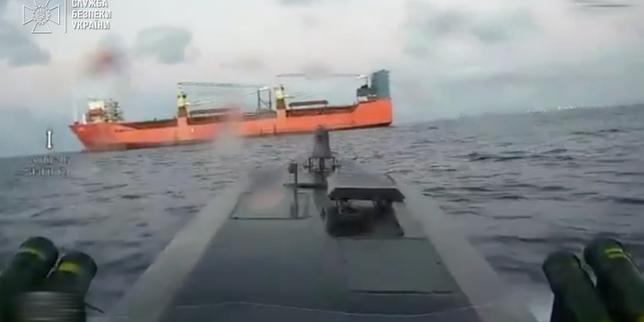
Modern naval warfare no longer requires a blue-water fleet to enforce a blockade or project power thousands of miles from a contested coastline. When Ukrainian President Volodymyr Zelensky claimed responsibility for striking two Russian vessels off the coast of Libya using uncrewed surface vessels, the operational boundaries of the Russo-Ukrainian conflict fractured permanently. Standard live-blog reporting treats this event as an isolated tactical anomaly in an ongoing war. That framing misses the structural reality. The strike demonstrates that low-cost, long-range maritime drones have converted commercial shipping lanes and peripheral logistics hubs into active combat zones, dismantling the sanctuary that distant geography once provided to Russian state and proxy assets.
The Geography of Maritime Sanctuary
To understand the mechanics of a strike in the central Mediterranean, one must first map the logistical architecture Russia built to bypass Western sanctions and Black Sea containment. Following the degradation of the Russian Black Sea Fleet through sustained uncrewed surface vessel (USV) campaigns, Moscow relied heavily on its Mediterranean logistical corridor. Ports along the Libyan coast, particularly Tobruk, have functioned as critical transshipment nodes. Through these hubs, Russia moves military hardware, fuel, and personnel to support its Africa Corps operations across the Sahel while operating a shadow fleet of vessels designed to obscure state ownership and evade maritime interdiction.
Russian naval doctrine assumed that once assets cleared the Turkish Straits—or operated exclusively outside the Black Sea—they remained immune to Ukrainian kinetic action. Ukraine possesses no conventional surface combatants capable of transiting the Bosporus, which remains closed to belligerent warships under the Montreux Convention. By executing a strike in Libyan waters, Ukrainian planners exploited a massive blind spot in Russian threat modeling. The distance between Ukrainian-controlled territory and the Libyan coastline exceeds 2,000 kilometers via maritime routes, rendering traditional shore-based anti-ship missiles irrelevant. The introduction of uncrewed systems into this theater proves that geographic separation no longer equates to operational security.
Three Pillars of the Out-of-Area Strike Doctrine
Executing a precision maritime strike far beyond standard communication horizons requires solving three distinct operational problems. While exact technical specifications of the platforms used in the Libyan operation remain classified, established principles of autonomous naval engineering dictate the required architecture.
- Over-the-Horizon Command and Control
A surface drone operating in the Mediterranean cannot rely on line-of-sight radio frequencies or localized mesh networks used in the confined waters of the Black Sea. Maintaining human-in-the-loop terminal guidance at continental distances necessitates low-Earth orbit satellite communications. This creates a direct dependency on commercial space infrastructure. The operator requires high-bandwidth, low-latency telemetry to identify specific hull profiles among dense commercial Mediterranean traffic, ensuring the munition strikes a legitimate military logistics vessel rather than a neutral merchant ship. - Hydrodynamic Endurance and Launch Vectors
Standard explosive USVs, such as early iterations of the Magura V5 or Sea Baby platforms, feature operational ranges between 800 and 1,000 kilometers. Reaching the Libyan coast requires either a radically redesigned hull with expanded fuel capacity and hyper-efficient propulsion, or a clandestine forward launch mechanism. Forward deployment via a disguised commercial mothership—essentially mirroring the Russian shadow fleet's own concealment tactics—reduces the required transit distance of the USV from thousands of kilometers to a few dozen. Both pathways represent a severe escalation in asymmetric naval capability. - Target Acquisition in Congested Littorals
The central Mediterranean is one of the busiest maritime transit corridors on Earth. Unlike the northern Black Sea, where commercial traffic has been heavily restricted and naval targets are easily isolated, the waters off Libya are crowded with legitimate cargo vessels, tankers, and fishing fleets. Target validation under these conditions requires multi-spectral electro-optical sensors paired with pre-strike intelligence, surveillance, and reconnaissance (ISR). The striking force must confirm the target's Automatic Identification System (AIS) manipulation, hull draft, and cargo signature before committing to terminal attack runs.
The Economics of Asymmetric Attrition
Traditional naval deterrence relies on capital-intensive platforms. A modern frigate or destroyer costs between $500 million and $2 billion, requires years to construct, and demands a crew of hundreds of specialized sailors. A maritime drone costs between $250,000 and $500,000, can be assembled in decentralized workshops within weeks, and risks zero friendly personnel during execution.
This cost asymmetry creates a ruinous financial equation for the defending force. Even if a Russian vessel successfully intercepts four incoming USVs using deck guns, helicopters, or electronic warfare, the fifth drone achieving hull penetration results in a catastrophic loss of cargo, vessel utility, and strategic momentum. For Moscow, the cost function of maintaining its Libyan logistics bridge just spiked exponentially.
- Insurance and Freight Premiums: Commercial and quasi-commercial operators willing to transport Russian state cargo through the Mediterranean will demand massive risk premiums, inflating the operational cost of Russia's African interventions.
- Escort Allocation: Russia must now divert scarce surface combatants from its Northern or Baltic fleets to escort logistical transports in the Mediterranean, stretching an already overextended naval maintenance cycle.
- Port Vulnerability: Host authorities in eastern Libya face acute diplomatic and economic pressure. Harboring vessels targeted by long-range precision drones exposes local port infrastructure to collateral damage and international scrutiny.
Known Facts Versus Operational Hypotheses
Rigorous intelligence analysis requires separating verified public claims from analytical deductions regarding execution.
- Verified Reality: President Zelensky officially claimed that Ukrainian maritime drones struck two Russian vessels in Libya. This public acknowledgment is itself a deliberate strategic signal, shifting the operation from deniable covert action to overt deterrence.
- Verified Reality: Russia utilizes Libyan ports as primary logistical gateways for moving military equipment and shadow-fleet cargo across the Mediterranean and into sub-Saharan Africa.
- Analytical Hypothesis (Launch Origin): Given the geographic constraints of the Bosporus and the range limits of known Ukrainian USVs, the drones were likely deployed from a covert commercial vessel operating in international waters rather than transiting directly from Ukrainian ports in the Odesa region.
- Analytical Hypothesis (Intelligence Sharing): Identifying two specific Russian vessels operating covertly off North Africa almost certainly required overhead satellite imagery or signals intelligence originating from partner networks monitoring Russian shadow-fleet movements.
Limitations of Long-Range USV Warfare
Uncrewed surface vessels are not a silver bullet capable of single-handedly dismantling global Russian logistics. Several physical and operational bottlenecks constrain the scalability of out-of-area drone campaigns.
Sea state remains the primary enemy of small uncrewed craft. Vessels measuring five to eight meters in length struggle to maintain speed, sensor stability, and satellite lock in rough Mediterranean winter swells. High waves degrade electro-optical targeting cameras and wash over low-profile satellite antennas, causing intermittent drops in command links during critical terminal phases.
Electronic warfare presents a second formidable barrier. While Russian vessels have struggled to jam frequencies across the entire Black Sea, localized defense around high-value transports or fixed port facilities is far easier to harden. High-powered GPS spoofing and directional radio-frequency jamming can sever the link between a USV and its operator during the final kilometers of an approach, forcing reliance on autonomous terminal guidance algorithms that are more easily decoyed by flares, chaff, or simple physical barriers like harbor booms.
Finally, diplomatic friction imposes strict operational ceilings. Unlike the Black Sea, which is a recognized theater of active war, the Mediterranean is bordered by NATO members and neutral states dependent on uninterrupted maritime trade. A single targeting error resulting in damage to a neutral oil tanker or environmental contamination near European coastlines would erode the international political support Ukraine relies upon for survival.
The Strategic Cascade
By extending its maritime strike envelope to North Africa, Kyiv has forced Moscow into a classic resource-allocation dilemma. Russia can no longer treat its global logistics network as separate from its Ukrainian theater of operations. Every vessel moving weapons through the Mediterranean, the Baltic, or the Arctic must now be evaluated against the threat of covert, low-cost uncrewed interdiction.
Defense planners and maritime security operators must immediately adjust risk models for all state-affiliated shadow fleets. Static port defenses and point-defense weapon systems on logistical vessels are insufficient against coordinated, multi-axis USV swarms guided by real-time satellite telemetry. Protecting maritime supply lines now requires continuous airborne intelligence, surveillance, and reconnaissance over international waters, persistent electronic spectrum monitoring, and strict physical access controls around neutral transshipment hubs. Without these layered countermeasures, any vessel tied to a belligerent supply chain remains vulnerable, regardless of how far it sails from the front lines.