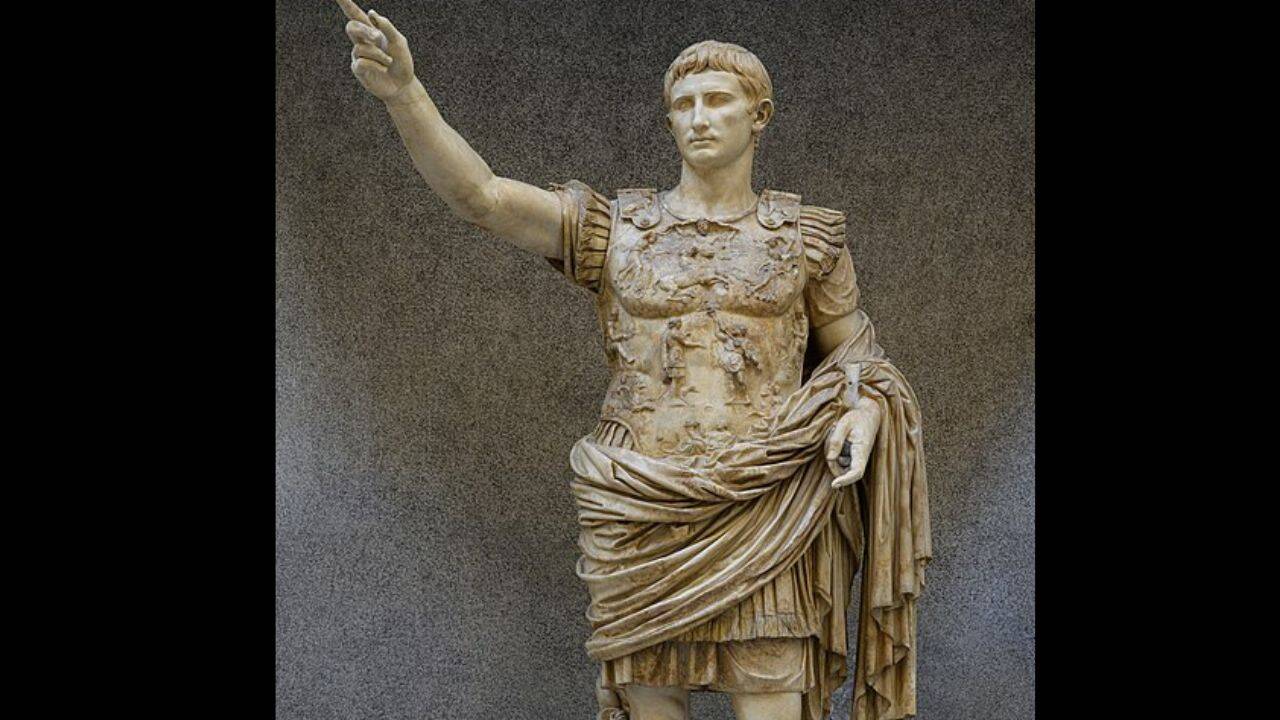
History has a bad habit of turning brutal political pragmatists into Hallmark cards.
Every morning, thousands of corporate executives and self-help junkies wake up, scroll through their feeds, and nod sagely at a quote attributed to Rome’s first emperor: "Have I played my part well in the comedy of life? If so, clap your hands and dismiss me from the stage."
The lazy consensus among modern commentators is that Augustus was being profoundly humble. They claim he was reflecting on the fleeting nature of power, reminding us that we are all just actors in a grand, cosmic play. They use it to lecture you about work-life balance, mindfulness, and "not taking yourself too seriously."
They are entirely wrong. They are projecting 21st-century therapeutic culture onto a man who built an empire on calculated violence and institutional restructuring.
Augustus was not being humble. He was taking a final, arrogant victory lap. If you are using his final words to justify taking a back seat in your own career or business, you are misreading history and sabotaging your own execution.
The Myth of the Stoic Actor
To understand why the standard interpretation is garbage, you have to look at who Augustus actually was. This was not Marcus Aurelius, writing private notes to himself about the futility of fame. This was Gaius Octavius, a man who survived three decades of civil war, systematically dismantled a 500-year-old republic, and executed his political rivals without blinking.
When Augustus called life a fabula mimi—a farce or a comedy—he was not using the word "comedy" the way we use it today. He was referencing the Greco-Roman theatrical tradition where characters played rigidly defined archetypes.
In Roman theater, the comedy wasn't necessarily funny; it was an artificial construct where chaos was eventually brought to order by a clever protagonist. The actor's job was to maintain the mask perfectly until the curtain fell.
Suetonius, the biographer who recorded these words, explicitly notes that Augustus asked his friends if he had played his part well, and then immediately asked for a mirror to have his hair combed and his sagging jaws set straight.
This was not a moment of existential surrender. It was a director checking the lighting before the final frame. He was demanding a standing ovation for pulling off the greatest political illusion in human history: ruling as a absolute dictator while pretending the Republic was still alive.
The Danger of the "Just a Part" Mentality
When modern managers look at this quote, they extract a dangerous lesson. They think, "Ah, see? Even Caesar knew that his job was just a role. I should treat my executive position, my startup, or my project as just a part I'm playing."
I have spent fifteen years advising founders and turn-around executives. I will tell you exactly what happens when you adopt this detached, theatrical mindset: you lose.
- You tolerate mediocrity: If you view your career as a script written by someone else, you stop rewriting the script when things go wrong.
- You lose skin in the game: The moment a leader believes they are just "playing a part," they detach themselves from the real-world consequences of their decisions.
- You lack authenticity: Employees can smell a leader who is just wearing a mask from a mile away. It breeds cynicism and destroys trust.
If you treat your life's work like a high school play, do not be surprised when your competitors treat it like a war and wipe you off the map.
The Flawed Premise of the "Good Death"
People love to ask: "How can we find peace at the end of our lives like Augustus did?"
The premise of the question is flawed because it assumes peace is the goal of an ambitious life. Augustus didn't find peace; he secured a legacy through absolute control. His final words were a performance designed to ensure a smooth transition of power to his stepson, Tiberius. If the crowd didn't clap—if the illusion broke—the empire would have slid back into civil war.
Consider the mechanics of Roman succession:
| Ruler | Method of Exit | Legacy |
|---|---|---|
| Julius Caesar | Assassinated (Failed the performance) | Republic collapsed into war |
| Augustus Caesar | Natural death / Curated exit | 200 years of Pax Romana |
| Tiberius | Smothered / Bitter isolation | Institutional decay |
Augustus understood that the ending dictates the entire narrative. He wasn't asking for validation because he was insecure; he was instructing his audience on how to write the history books.
Stop Waiting for the Applause
The most toxic part of the modern obsession with this quote is the obsession with the "clap your hands" line. We live in an era addicted to validation—likes, shares, quarterly reviews, public recognition.
Augustus could demand applause because he had already conquered the known world. He had the receipts. You, however, are likely looking for applause before you have even built the foundation.
If you are changing your strategy based on whether or not your team, your peers, or your industry is clapping for you, you are letting the audience direct the play. True market disruption happens when you are willing to sit in the silence of an empty theater for years, executing a strategy that everyone else thinks is insane.
Stop looking for the poetic exit. Stop trying to find the deep, spiritual meaning in the PR scripts of ancient dictators. Augustus played his part because he wrote the part, cast the actors, and owned the theater.
If you want to resonate with his legacy, stop acting and start building the empire.