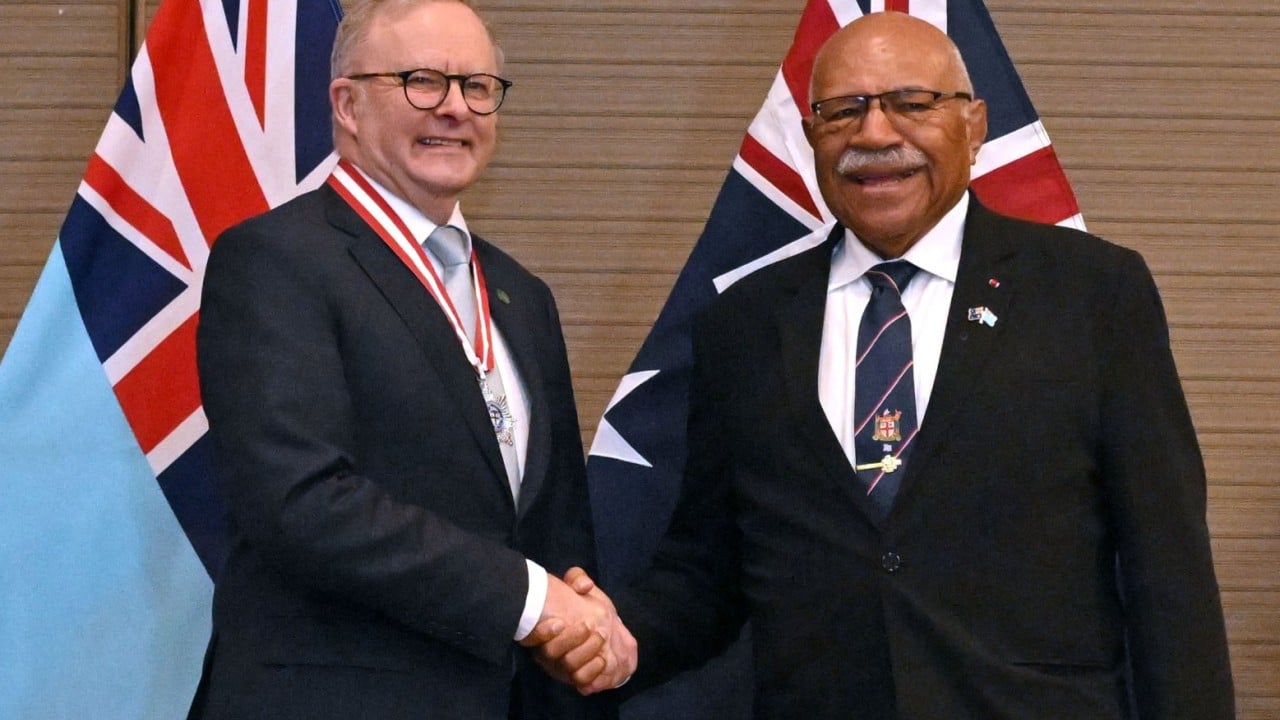
Australia just signed a massive mutual defense treaty with Fiji. If you think this is just another dry diplomatic photo-op with handshakes and kava bowls, you're missing the bigger picture. This deal fundamentally shifts the strategic balance in the South Pacific.
For the first time in its history, Fiji has entered into a formal military alliance. For Australia, it marks only the fourth time the nation has committed to a mutual defense pact, putting Fiji in the same tier of alliance as the United States, New Zealand, and Papua New Guinea.
Titled the Ocean of Peace Alliance, the agreement signed in Suva by Australian Prime Minister Anthony Albanese and Fijian Prime Minister Sitiveni Rabuka contains a heavyweight clause. Both nations are now legally bound to come to each other’s aid in times of crisis or external attack.
This isn't happening in a vacuum. Canberra is in a frantic, high-stakes race with Beijing for geopolitical influence, and this new treaty is a direct attempt to lock China out of the security architecture of the central Pacific.
The mechanics of the Ocean of Peace Alliance
Let's look at what this pact actually does. At its core, the treaty introduces a binding mutual defense obligation.
During the press conference in Suva, Albanese laid down the terms plainly. He noted that an attack on Fiji from an outside force would trigger Australia’s full support for Fiji and its sovereignty. It forces both nations to consult immediately on emerging security threats and act collectively to meet common dangers.
But the security arrangement didn't stop at military cooperation. The two leaders simultaneously signed the Vuvale Union, a comprehensive economic treaty. Under this plan, Australia will pump more than A$1 billion ($693 million USD) into Fiji over the next decade.
The money and the military pact are designed to anchor Fiji firmly into the Australian orbit across three specific areas.
- Deepened Security Integration: Coordinated military operations, intelligence sharing, and maritime domain awareness.
- Economic Resilience: Direct infrastructure investments to lessen Fiji's reliance on high-interest foreign loans.
- Maritime Law Enforcement: Upgrading Fiji’s capacity to patrol its massive Exclusive Economic Zone (EEZ) against illegal fishing and transnational drug syndicates.
Interestingly, this pact isn't meant to be an exclusive club. The framework is explicitly built to expand. The Australian Broadcasting Corporation noted that the Ocean of Peace Alliance will remain open for three other regional nations with active militaries to join later: Tonga, Papua New Guinea, and New Zealand.
Canberra is building a security wall across the Pacific
To truly understand why the Fiji treaty matters, you have to look at what Australia has been doing over the past few weeks. This isn't an isolated event. It is the latest block in a security wall Canberra is rapidly building across Melanesia and Polynesia.
Just days before flying to Suva, Albanese was in Canberra signing the Nakamal Agreement with Vanuatu’s Prime Minister Jotham Napat. That specific deal established Australia as Vanuatu’s preferred security and policing partner, explicitly preventing any foreign nation from establishing military bases on Vanuatu's soil. Combine that with Australia's 2025 security pact with Papua New Guinea, its 2024 treaty with Nauru, and the 2023 Falepili Union with Tuvalu, and a clear pattern emerges.
Australia is systematically tying the security of Pacific Island nations to its own.
The strategy kicked into overdrive after China shocked western capitals in 2022 by signing a secretive security pact with the Solomon Islands. The fear in Canberra and Washington was immediate: a Chinese naval base or permanent police presence right on Australia's maritime doorstep. By locking down explicit bilateral defense treaties with regional hubs like Fiji, Australia is trying to make sure that never happens again.
The delicate dance with Beijing
Fiji is the ultimate prize in this diplomatic tug-of-war. It holds the most dynamic economy in the Pacific Islands, possesses one of the few standing militaries in the region, and hosts the headquarters of the Pacific Islands Forum. Where Fiji goes, the rest of the Pacific often follows.
Fijian Prime Minister Sitiveni Rabuka is playing a delicate diplomatic game. He knows exactly how high the stakes are, but he's trying to keep the temperature low. After signing the treaty, Rabuka told reporters he didn't expect severe pushback from Beijing. He argued that the deal doesn't threaten Fiji’s relationship with China, nor does it hurt Australia's ties with the superpower.
Beijing sees things differently. Responding to Australia's string of new Pacific treaties, Chinese Foreign Ministry spokesperson Guo Jiakun issued a pointed caution. He stated that these arrangements should not target third parties or be used to engage in geopolitical games.
While Rabuka pitches a public message of neutrality, the text of the treaty tells a more assertive story. By choosing Australia as a formal defense ally, Fiji has drawn a clear line regarding who it trusts when the chips are down.
What happens next
The signing ceremony is over, and now the real work begins. If you are watching the region, keep an eye on these specific developments over the coming months.
First, look for the rollout of the A$1 billion Vuvale Union funding. The effectiveness of this alliance relies heavily on whether Australia can deliver tangible infrastructure improvements to everyday Fijians, proving that alignment with the West offers real economic security.
Second, watch the Solomon Islands. Prime Minister Albanese is already scheduled to visit Honiara next. He wants to negotiate a broader strategic treaty to replace or counter the existing security arrangements the Solomon Islands has with China.
Finally, see if Tonga steps up next. Given that the Ocean of Peace Alliance was built to include other Pacific militaries, Tonga is the logical next candidate to sign on to this collective defense framework.
Australia and Fiji just rewrote the rules of engagement for the South Pacific. By turning a long-standing friendship into a binding military alliance, they have raised the stakes for any foreign power trying to project force into these waters.