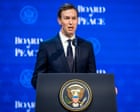
Diplomacy in the Middle East has always thrived in the shadows, but the optics of recent high-stakes maneuvering have shattered conventional diplomatic protocol. US negotiator Jared Kushner sat down in Egypt for a rare, closed-door summit with senior Hamas leader Khalil al-Hayya. This extraordinary engagement preceded an impending collision course with Israeli Prime Minister Benjamin Netanyahu in Jerusalem. At the center of this diplomatic storm lies a fragile, fifteen-point US-backed roadmap championed by the international Board of Peace. The blueprint demands the phased disarmament of Hamas alongside a corresponding Israeli military withdrawal from the Gaza Strip. Yet, as backdoor channels attempt to forge an implementation timetable, the fundamental architecture of the peace framework is fracturing under the weight of irreconcilable political demands.
To understand why this diplomatic intervention carries such immense weight, one must examine the mechanics of the current standoff. The fifteen-point proposal, formulated under the auspices of the Trump administration's Board of Peace, attempts to square a circle that has bedeviled international mediators for years. It envisions Hamas relinquishing its governing authority and surrendering its arsenal to an administrative technocratic committee, while Israeli forces progressively pull back from the territory.
However, sequence is everything, and sequence is precisely where the parties are locked in a fatal contradiction. Hamas leadership insists that Israeli forces must halt active operations and retreat to undefined territorial markers before any physical disarmament begins. Conversely, Netanyahu's government has flatly rejected the framework, asserting that the Israel Defense Forces will maintain their positions and tighten control over the enclave until every weapon is surrendered.
This friction transformed what was supposed to be a routine diplomatic consolidation into a high-stakes pressure campaign. Kushner's direct meeting with al-Hayya—facilitated alongside regional mediators from Egypt, Qatar, and Turkey—was designed to lock in Hamas's theoretical acceptance of the roadmap's disarmament benchmarks before confronting the Israeli leadership. By shoring up assurances from the militant group's leadership, the American envoy aimed to isolate Netanyahu diplomatically, presenting him with a fait accompli backed by a coalition of Arab states.
Regional heavyweights including Saudi Arabia and the United Arab Emirates wasted little time ratcheting up the pressure. In a joint regional statement, these powers assigned direct responsibility to Israel for obstructing peace, effectively aligning themselves with the structural parameters of the US-backed initiative. This creates an uncomfortable geopolitical squeeze for Netanyahu, who heads a domestic coalition heavily reliant on hardline factions that view any concession on Gaza's security posture as an existential threat.
Political survival in Jerusalem dictates a defiant posture. Netanyahu's Likud party has aggressively pushed back against international maneuvering, framing the coordinated regional pressure as an external attempt to engineer a political collapse of the current Israeli government. With domestic political pressure mounting, the Israeli prime minister finds himself at loggerheads not just with international mediators, but with the architects of Washington's Middle East strategy. Reports from diplomatic circles indicate that Kushner's private exchanges with Netanyahu have grown intensely confrontational, with the American side arguing that rejecting a plan tailored around Israel's own security demands ultimately undermines Israel's strategic objectives.
The core dilemma remains stark. Two million residents trapped in a devastated enclave wait for reconstruction funds and stabilization forces that cannot deploy while the security architecture remains undefined. International peace directors, former British prime ministers, and White House envoys can draft implementation schedules, but structural distrust runs too deep for paper commitments to hold. As long as disarmament is treated as a precondition by one side and withdrawal as a precondition by the other, backchannel diplomacy will continue to slam against an unyielding wall of political reality.