The United States Men’s National Team learned of their greatest tactical victory of the 2026 World Cup not on the training pitch, but on a ten-minute bus ride through Seattle. At 10:31 a.m. Eastern Daylight Time on Sunday, a message flashed inside the secure online portal of the U.S. Soccer Federation. FIFA’s independent disciplinary committee had just done the unthinkable. They erased the automatic one-match suspension of American star forward Folarin Balogun, rewriting more than sixty years of tournament precedent. The decision allows Balogun to lead the American line in Monday night’s knockout match against Belgium. It also marks the exact moment that political muscle openly shattered the rulebook of international football.
The technical justification provided by FIFA relied on a creative reading of Article 27 of its disciplinary code, placing Balogun on a one-year probation instead of enforcing his mandatory ban. But the true mechanism was far simpler. It required only a single telephone call from U.S. President Donald Trump to FIFA President Gianni Infantino. Discover more on a related issue: this related article.
By intervening directly to secure the availability of America's top goalscorer, the White House established a terrifying precedent for the sport. Football has long prided itself on the illusion that inside the white lines, every nation is equal. That illusion is dead.
The Anatomy of a Telephone Takedown
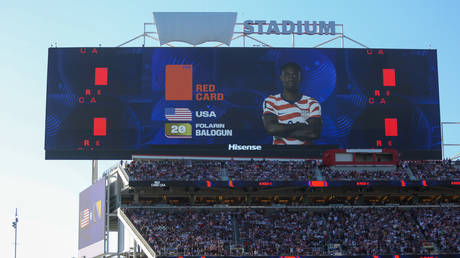
The crisis began in the 64th minute of the United States’ 2-0 victory over Bosnia and Herzegovina in the round of 32. Balogun, who had already scored the opening goal, chased a loose ball and stepped awkwardly, raking his cleats down the ankle of Bosnian defender Tarik Muharemović. Brazilian referee Raphael Claus did not pull out a card initially. Then the video assistant referee intervened. After a lengthy review at the pitchside monitor, Claus returned to show Balogun a straight red card. More analysis by CBS Sports explores related views on the subject.
The stadium erupted in fury. American players surrounded the official, arguing that the contact was accidental, a product of momentum rather than malice. Under standard FIFA regulations, the intent does not matter when the safety of an opponent is compromised. A straight red card carries an absolute, non-appealable one-game suspension.
Hours after the final whistle, the political machinery went to work. According to a person familiar with the matter who spoke on condition of anonymity, President Trump placed a direct call to Infantino. The conversation focused squarely on the economic and cultural stakes of the host nation losing its most marketable star before a prime-time knockout match. Trump viewed the red card not as a sporting infraction, but as a bureaucratic injustice threatening an American asset.
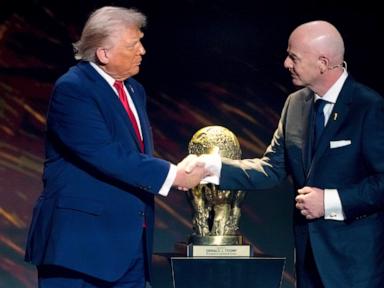
The relationship between the two men is well-documented. In December 2025, Infantino traveled to Washington to present Trump with a fabricated "FIFA Peace Prize" at a private event, an honor widely seen as flattery ahead of the tournament. When the host nation needed a favor, that relationship paid immediate dividends. Infantino personally requested a formal review of the incident by the disciplinary committee, a directive that effectively signaled how the governing body wanted the matter resolved.
On Sunday afternoon, Trump confirmed his involvement on social media, thanking FIFA for reversing what he termed a great injustice. The transactional nature of modern sports governance was laid bare for the world to see.
Weaponizing Article 27
FIFA’s legal department had to find a loophole that would hold up under intense public scrutiny. They found it buried in the text of Article 27, a provision typically reserved for administrative sanctions or minor infractions committed outside the field of play. The rule states that a judicial body may fully or partially suspend the implementation of a disciplinary measure, subjecting the individual to a probationary period of one to four years.
Article 27 Application: Folarin Balogun Case
+-------------------------+---------------------------------------------------------+
| Standard Penalty        | Automatic 1-match ban for straight red card             |
+-------------------------+---------------------------------------------------------+
| FIFA Modified Ruling    | Suspension delayed for a 1-year probationary period    |
+-------------------------+---------------------------------------------------------+
| Precedent Status        | First on-field tournament reversal since 1962           |
+-------------------------+---------------------------------------------------------+
| Enforcement Trigger     | Any similar violent conduct infraction before July 2027|
+-------------------------+---------------------------------------------------------+
By applying this clause to an active tournament red card, FIFA established a bizarre logical paradox. Balogun remains guilty of the infraction. The red card itself was not rescinded. Instead, the punishment was simply delayed. If Balogun commits another serious foul before July 2027, the one-match ban will be added to any new penalty.
The historical comparison illustrates the absurdity of this ruling. Not since the 1962 World Cup in Chile has a player seen a red card suspension set aside during the tournament. In that instance, Chilean star Garrincha was sent off in the semifinal but was allowed to play in the final after political pressure from the host government forced referees to alter their match reports.
FIFA pointed to a November case where Cristiano Ronaldo had a portion of a qualification ban deferred, but that occurred months before the tournament began, during a routine administrative window. Applying a probationary delay on a Sunday morning for a match taking place on Monday night is unprecedented. It turns the disciplinary code into a flexible document that can be bent depending on the geopolitical weight of the country making the appeal.
Fury and Mockery in Brussels
The response from Europe was immediate and unsparing. The Royal Belgian Football Association issued a scorching statement expressing total astonishment at the ruling. They accused FIFA of abandoning the fundamental principles of fair play to protect commercial interests.
Belgium coach Rudi Garcia did not hide his contempt when addressing reporters at his pre-match press conference in Seattle. Speaking through a translator, Garcia joked that he did not realize July 5th was April Fools' Day in Zurich. He noted that the Belgian federation was no longer just defending its own interests, but trying to protect the basic integrity of international sport.
The Belgian legal team spent Sunday afternoon consulting with experts to see if an emergency appeal could be filed with the Court of Arbitration for Sport. The logistical reality makes a formal injunction nearly impossible before the kickoff at Lumen Field. Garcia refused to comment on whether a boycott was discussed, focusing instead on the psychological damage done to the competition.
The anger extends beyond the Belgian camp. Several European football executives privately expressed dismay that the host nation could dictate disciplinary terms. The tournament was already facing criticism for its expanded forty-eight-team format and massive travel distances. Now, it faces a crisis of legitimacy.
The Tactical Reversal for Pochettino
While the executives argue in hotel lobbies, United States manager Mauricio Pochettino has been handed an unexpected tactical gift. For three days, the American coaching staff had been preparing a game plan that omitted their most effective attacking weapon. Balogun has scored three goals in the tournament, serving as the central focus of an otherwise young American attack.
Without him, Pochettino was facing two flawed options. He could have started Ricardo Pepi, who offers excellent physical presence but tends to slow down the transition speed of the wings. Alternatively, he could have turned to Haji Wright, a dangerous runner who has played only a single minute in this tournament and lacks chemistry with the starting midfield.
U.S. Striker Performance Matrix (2026 Tournament)
+------------------+---------------+------------------+-----------------------+
| Player           | Goals Scored  | Minutes Played   | Tactical Role         |
+------------------+---------------+------------------+-----------------------+
| Folarin Balogun  | 3             | 244              | Pressed/Channel Run   |
| Ricardo Pepi     | 0             | 86               | Hold-up/Target Man    |
| Haji Wright      | 0             | 1                | Late Sub/Winger       |
+------------------+---------------+------------------+-----------------------+
Balogun provides the perfect middle ground. He possesses the acceleration to stretch the Belgian central defenders, Wout Faes and Arthur Theate, while remaining strong enough to hold up long balls from the back. His availability completely changes how Belgium must defend.
Instead of squeezing the midfield to choke out Christian Pulisic, the Belgian defense must now drop deeper to protect against Balogun’s runs into the channels. This retreat creates immediate operating space for Weston McKennie and Malik Tillman in the central third of the pitch. Antonee Robinson will find open grass on the left flank as the Belgian right-back is forced to tuck inside to provide cover.
Pochettino welcomed the decision during his Sunday press briefing, stating that the team had been punished enough by playing the final thirty minutes against Bosnia with ten men. He dismissed the controversy surrounding the telephone call, noting that in South America and Europe, football is treated with a level of political gravity that Americans are only now beginning to understand.
The Cost of the Compromise
The immediate benefit to the American team is obvious, but the long-term cost to the sport is severe. FIFA has spent the last decade trying to distance itself from the corruption scandals that destroyed the reputation of its previous leadership under Sepp Blatter. Infantino has repeatedly insisted that the organization is transparent, modern, and governed by strict legal frameworks.
This weekend destroyed that narrative. By caving to a phone call from the White House, FIFA demonstrated that its independent judicial bodies are independent only until an important politician decides to interfere. The message sent to smaller nations is unmistakable. If a player from Bosnia, Morocco, or Ecuador receives a controversial red card, no president will call Zurich to save them. Their suspension will be served in full, enforced by the rigid majesty of the law.
The tournament will continue, and Monday's match will likely draw record television ratings inside the United States. Balogun will take his place at the center circle, a symbol of American sporting ambition and political exceptionalism. But if the United States wins and advances to the quarterfinals, their victory will always carry an asterisk written in black ink by the legal department in Zurich. Fair play was sacrificed for television ratings and political convenience, and the tournament may never recover its moral authority.