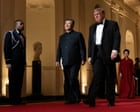
Diplomacy is rarely about what happens behind closed doors. It is about the choreography that precedes the meeting and the narrative that survives after the motorcades depart. When Beijing and Washington lock horns in high-stakes summits, the machinery of state media moves with a calculated precision that western capitals chronically underestimate. The optics of red carpets, synchronized handshakes, and meticulously stage-managed photo opportunities are not mere pleasantries. They are instruments of strategic positioning designed to project quiet inevitability.
For decades, foreign policy establishments in western democracies have operated under a comforting illusion. The belief persists that high-level engagement inherently bends authoritarian systems toward international norms. That proximity breeds alignment. That commerce erodes political divergence. This assumption has proven not merely flawed, but dangerous. When leaders meet across mahogany tables, the structural asymmetries between a centralized autocracy and a volatile democracy become painfully clear. One side operates with a multi-decade blueprint backed by absolute domestic control. The other operates on a frantic four-year electoral cycle constrained by legislative gridlock and partisan fatigue. Recently making waves lately: Why Blaming Kazakh Officials for the Caspian Sea Tragedy Misses the Entire Point.
Consider the mechanics of how these encounters are framed for domestic consumption. In western nations, a summit is judged by immediate deliverables. Did soybean exports increase? Was a preliminary tariff framework signed? Did the opposing leader look rattled or accommodating under media scrutiny? These metrics treat diplomacy like a corporate merger, reducing complex geopolitical friction points to quarterly earnings reports. This transactional mindset creates an inherent vulnerability. It prioritizes short-term political wins for an administration over long-term strategic positioning for a nation.
Beijing understands this weakness intimately and exploits it with clinical efficiency. Chinese statecraft treats summit diplomacy as a visual medium. Every frame broadcasted on domestic networks serves a singular purpose. It establishes the supreme leader as an equal partner shaping the global order alongside his western counterpart. The imagery communicates stability and permanence. By projecting an aura of dignified parity, Beijing achieves a vital diplomatic victory before substantive talks even begin. The substance of the agreement matters far less than the visual confirmation of status. Additional details regarding the matter are detailed by The Washington Post.
To understand why these summits consistently favor Chinese strategic interests, one must examine the fundamental divergence in negotiating philosophies. Western negotiators arrive with dense briefing binders filled with specific policy demands, regulatory compliance markers, and human rights grievances. They approach the negotiation table as litigators presenting a case. Conversely, Beijing approaches the encounter as an architect surveying territory. They are not interested in arguing over individual clauses in a trade text. They are focused on altering the underlying architecture of global trade and security norms.
This divergence creates a profound imbalance in outcomes. While western leaders leave the summit waving signed memoranda of understanding that promise incremental market access, Beijing secures systemic concessions that legitimize its state-directed economic model. The concessions extracted by western teams are frequently temporary or conditional upon domestic enforcement mechanisms that easily decay. Meanwhile, the strategic positioning gained by Beijing becomes permanent institutional reality.
The economic dimension of this dynamic reveals an even starker contrast. Decades of economic integration created a sprawling industrial interdependence that western strategists once celebrated as an anchor for peace. Today, that very interdependence functions as an asymmetrical constraint. Western manufacturing sectors grew dependent on supply chains anchored deep within Chinese industrial hubs. When bilateral tensions flare, western economies face immediate inflation, component shortages, and corporate anxiety. Beijing absorbed these vulnerabilities years ago by systematically building domestic redundancies and securing raw material monopolies across the developing world.
When a summit convenes under the banner of trade normalization or market stabilization, the western delegation is invariably shadowed by a coalition of corporate executives terrified of market disruption. This domestic business lobby acts as an internal pressure valve, consistently pushing for accommodation and compromise. A western leader sitting across from Xi Jinping does not merely represent a government. They represent a fractured corporate constituency that cannot stomach prolonged economic friction. This internal division is glaringly absent on the other side of the table.
The institutional memory of western foreign ministries has also suffered a profound atrophy. Rotational diplomatic corps, influenced by short-term political appointments, frequently lack the institutional patience required to counter a civilization-state that measures policy in centuries rather than congressional sessions. When a new administration takes office in Washington, it often spends its first two years dismantling previous initiatives before formulating a coherent counter-strategy. Beijing watches this cyclical instability with detached amusement, maintaining a consistent cadre of veteran negotiators who have dealt with successive western leaders for decades.
This structural continuity allows Beijing to play a long game characterized by strategic patience and tactical flexibility. If a particular summit yields unfavorable terms or hostile rhetoric, state media simply absorbs the blow, domestic messaging reframes the friction as western belligerence, and state planners quietly continue their work on critical technologies and supply chain autonomy. Nothing is rushed. Nothing is abandoned out of electoral panic.
The failure to grasp this asymmetry leads to recurring cycles of diplomatic disappointment. Commentators analyze summit communiques for signs of capitulation or reform, missing the larger structural drift. Every meeting that treats a systemic competitor as a standard negotiating partner helps legitimize that competitor's rise. It signals to developing nations across the global south that Beijing's model of state capitalism combined with authoritarian governance is not an outlier, but a co-equal pillar of the international system.
This dynamic plays out vividly in the arena of technological dominance. Western administrations routinely announce export controls, sanctions, and investment screenings designed to curb the advancement of rival technological sectors. Yet, when leaders meet at high-profile summits, these national security imperatives are frequently sidelined in favor of trade optics and agricultural export agreements. The disconnect between hard security strategy and commercial diplomacy creates dangerous policy incoherence.
Consider the critical domain of advanced semiconductors and rare earth processing. While western policy documents correctly identify these sectors as national security flashpoints, the diplomatic machinery often treats them as negotiable chips in broader trade bargains. This compartmentalization is an illusion. Beijing does not separate economics from national security. For the architects of Chinese industrial policy, trade is warfare conducted by other means. Every bilateral agreement that maintains market access without securing verifiable compliance on technology transfer reinforces their long-term trajectory.
The human element of these summits further compounds the imbalance. Western leaders are constantly auditioning for a demanding domestic media apparatus that hungers for dramatic narrative arcs. A summit must have winners, losers, turning points, and human moments. This performative pressure forces leaders into premature declarations of breakthrough. They claim to have secured historic commitments when they have merely received diplomatic platitudes designed to pacify domestic critics.
In contrast, the leadership in Beijing operates above the noise of a free press. Their public statements are measured, formulaic, and devoid of performative anxiety. They do not need to manufacture a triumphant narrative for evening broadcasts because the entire state apparatus reinforces a singular, unchanging narrative of national rejuvenation. This insulation from domestic political accountability gives Chinese negotiators an almost inhuman emotional discipline at the negotiating table. They can absorb silence, reject proposals without offering immediate alternatives, and walk away from tables without fearing an adverse news cycle the following morning.
The consequences of this diplomatic mismatch extend far beyond bilateral relations. As western publics grow weary of foreign entanglements and economic insecurity, the appetite for sustained strategic competition wanes. Leaders looking for quick domestic wins are perpetually tempted to declare victory based on superficial summit optics. They accept handshake agreements and hollow promises because the political cost of admitting persistent failure is too high.
Breaking this cycle requires a fundamental reckoning with how international power is exercised in the twenty-first century. It demands abandoning the comforting notion that periodic summits can bridge irreconcilable differences in governance and economic philosophy. It requires building enduring domestic coalitions that can sustain strategic pressure across multiple political cycles without fracturing under corporate lobbying or short-term market anxieties.
Until western capitals develop the institutional discipline to match Beijing's strategic patience, high-profile summits will continue to serve a predictable function. They will offer inspiring photo opportunities for western cameras while providing the strategic cover Beijing needs to consolidate its global ascent. The pomp is never just pomp. It is the smoke screen behind which the architecture of international power is quietly redesigned.