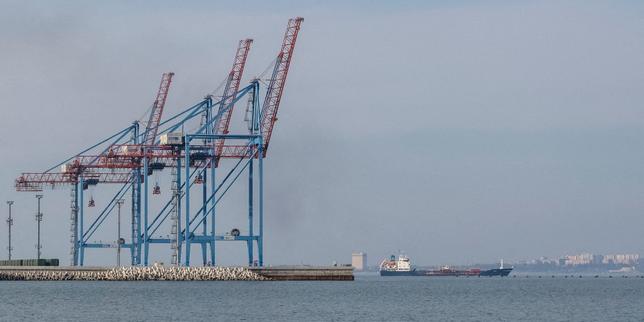
Ukrainian maritime traffic came to a grinding halt as Russian strikes targeted port infrastructure, leaving grain ships paralyzed at anchor and choking off critical global food supplies. While headlines focus on missile strikes and military rhetoric, the true force halting ships in the Black Sea is financial and structural. Commercial shipowners, faced with astronomical war-risk premiums and uninsurable hulls, have ordered their fleets to hold position. The immediate freeze on Ukrainian agricultural exports exposes a vulnerable truth about global commerce. Military force creates the crisis, but insurance underwriters and logistics bottlenecks dictate how deeply the damage cuts.
Commercial shipping runs on risk assessment. When port infrastructure in Odesa, Chornomorsk, and Pivdennyi comes under direct missile target, maritime insurers recalculate risk instantly. The resulting surge in war-risk insurance premiums acts as an effective economic blockade, making voyages financially non-viable long before a warship ever fires a warning shot across a vessel's bow.
The Financial Mechanics of a Modern Maritime Blockade
Naval blockades used to require physical lines of warships anchored off an enemy coast. Today, a blockade requires only targeted strikes on key port facilities paired with threatening marine notices.
Insurers at Lloyd's of London and other major underwriting syndicates respond to threats by declaring specific geographic sectors as High Risk Areas. Shipowners entering these zones must purchase Additional Premium insurance. When missile threats escalate, these premiums spike to several percentage points of the vessel’s total hull value for a single week-long voyage.
For a bulk carrier valued at $30 million, a 3 percent war-risk premium adds nearly $900,000 to the cost of a single trip. That cost completely wipes out the narrow profit margins typical of bulk grain transport. Captains remain at anchor because moving the ship means immediate financial loss or catastrophic uninsured asset destruction.
The economic pressure extends beyond the hull itself. Seafarer unions enforce double-pay rules and guarantees of compensation for crew members operating in active conflict zones. When crew costs double and hull insurance skyrockets simultaneously, charterers simply pull their contracts.
Why Alternative Routes Cannot Match Deep Water Capability
Policy discussions often tout rail networks and river barges through the Danube as permanent replacements for deep-water ocean ports. That assumption misunderstands basic transportation scale.
A single Panamax-class bulk carrier handles around 60,000 metric tons of grain. To move that same volume overland requires over 1,000 rail cars or roughly 2,000 heavy grain trucks. Ukrainian rail networks operate on a different track gauge than neighboring European Union nations, requiring lengthy border transfers or axle swaps that create massive backlog bottlenecks.
- The Danube River Route: Romanian ports like Constanța offer access, but shallow river passages limit barge drafts and cause severe congestion at canal choke points.
- European Rail Corridors: Border crossings lack the physical capacity to handle millions of extra tons of bulk commodities every month.
- Truck Transit: Fuel costs and driver shortages render long-haul truck transport economically unviable for low-margin grain commodities over vast distances.
The math is unforgiving. Shallow rivers and narrow rail lines cannot compensate for the sheer volume moved by deep-water ocean terminals.
Global Food Security as an Asymmetric Lever
Agricultural exports from the region feed hundreds of millions of people worldwide, particularly in North Africa, the Middle East, and parts of Asia. Halting grain shipments from Ukrainian ports drives up global wheat and corn futures within hours on the Chicago Board of Trade.
This reality transforms grain terminals into strategic pressure points. Interrupting the export chain triggers domestic inflation in import-dependent countries, generating diplomatic pressure from nations far removed from the actual combat zone.
Importing nations face stark choices. They must either pay premium prices to secure grain from alternative suppliers like Brazil or Australia, or face severe domestic food price spikes. The disruption in Odesa directly translates to higher bread prices in Cairo and Tunis.
Structural Weaknesses in Coastal Infrastructure
Port infrastructure is inherently fragile. A modern bulk terminal relies on giant gantry cranes, automated conveyor systems, massive storage silos, and precise grain elevation technology.
Destroying a grain elevator or damaging an automated loader takes hours. Rebuilding or replacing that equipment in a warzone takes months or years. Without functioning loading systems, even an unthreatened ship cannot load cargo at rates that make the voyage commercially viable.
Insurance Markets hold the Ultimate Veto
Governments can offer sovereign guarantees to back commercial vessels, but state-backed insurance programs struggle with administrative delay and limited capital pools compared to global reinsurance syndicates. Private underwriters hold the ultimate veto over whether a ship lifts its anchor.
Until marine underwriters see verified stability and active de-escalation in sea corridors, commercial vessels will remain at safe anchor outside active threat zones. The physical stop in Ukrainian ports represents more than an immediate trade interruption; it highlights how modern trade relies on the quiet consent of global financial risk markets.