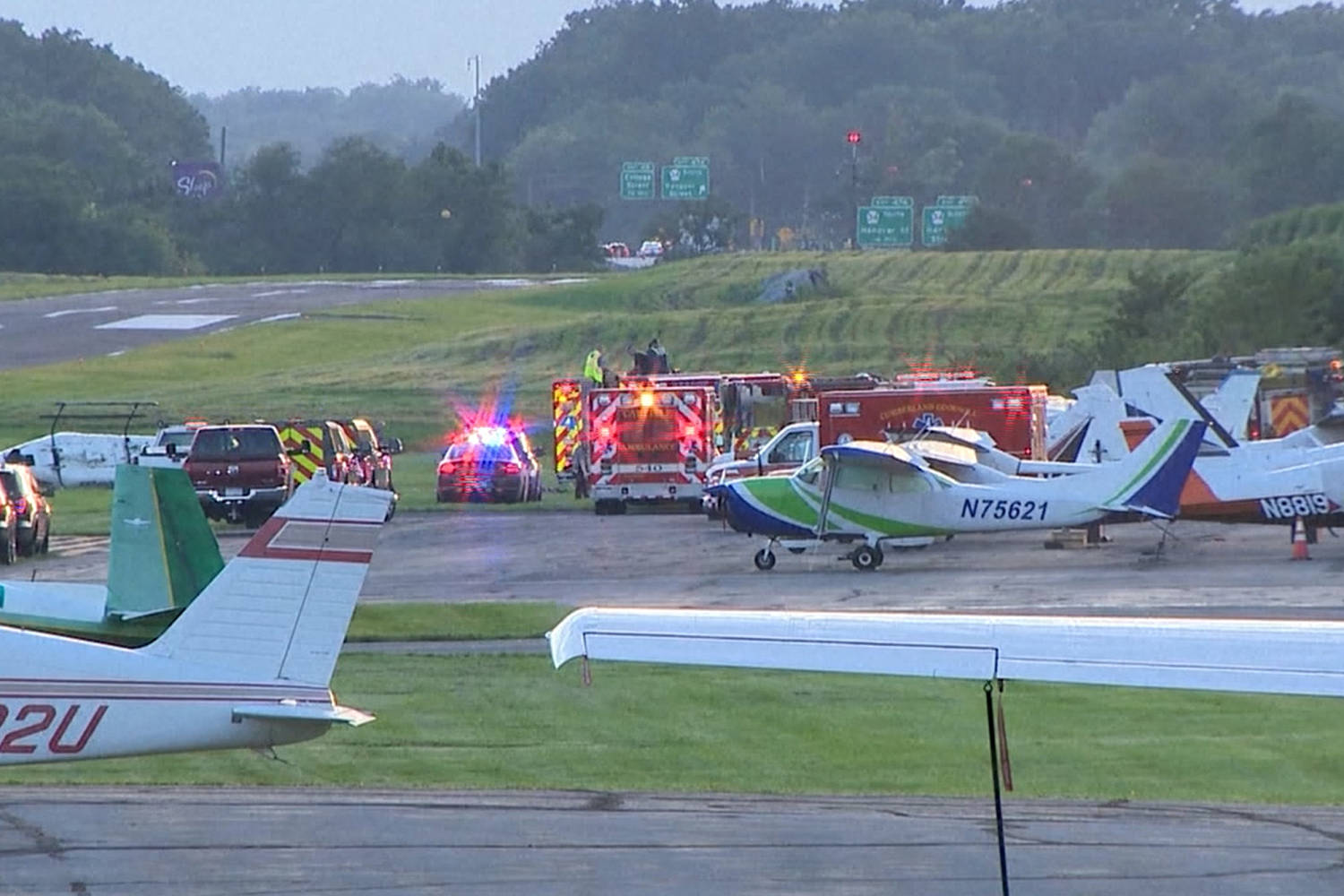
On a quiet August evening at Carlisle Airport in central Pennsylvania, the routine hum of a training flight dissolved into catastrophic structural failure. A Cessna 150 trainer aircraft and a Pennsylvania State Police Bell 407 helicopter collided near the threshold of a runway, instantly killing the pilot of the fixed-wing plane and leaving two state troopers trapped inside an inverted, burning wreckage.
When state authorities detailed the sequence of events, they pointed to a terrifying aerodynamic reality. The helicopter was hovering just feet off the grass adjacent to the tarmac. The Cessna, descending along the active runway, veered hard to the right at the final second and struck the rotorcraft from behind. For the two elite aviation troopers inside the Bell 407, the threat was invisible. Rotary-wing cockpits are notoriously limited in rearward visibility, meaning the crew had zero seconds to react before the Cessna sheared through their tail boom and rotor system.
The Dangers of Uncontrolled Airspace
Carlisle Airport is a non-towered facility. That single administrative designation shifts the heavy burden of safety entirely onto the eyes and ears of individual pilots rather than an air traffic controller stationed in a tower.
At a non-towered field, aircraft coordinate arrivals and departures through a Common Traffic Advisory Frequency (CTAF). Pilots announce their positions, intentions, and altitudes into a shared radio ether, building a mental picture of local traffic in their heads.
Yet, this system relies on absolute compliance, clear radio etiquette, and uninterrupted line-of-sight awareness. When a multi-million-dollar police helicopter conducting low-altitude hover exercises shares the same narrow patch of airspace with a lightweight aluminum training plane, the margin for communication error narrows to zero. Investigators from the National Transportation Safety Board and the Federal Aviation Administration are now tasked with sifting through audio logs on the CTAF frequency to determine whether a broadcast went unheard, misunderstood, or if visual saturation simply failed both flight crews.
Structural Vulnerabilities in Low-Altitude Proximity
The physical aftermath underscored the sheer violence of low-altitude kinetic energy exchanges. A Cessna 150 is constructed primarily of lightweight aluminum skin over an airframe designed for primary flight instruction, not impact absorption. When it smashed into the rear quarters of the Bell 407, the plane was literally cut into multiple pieces.
Meanwhile, the helicopter lost its vital tail rotor and primary blades, causing the craft to roll inverted and crash heavily onto its side.
That the two troopers survived is a testament to rugged cabin engineering and desperate human intervention. Trapped in a crushed, fuel-soaked cockpit with severe bleeding, one trooper managed to punch out a cabin window, clearing an escape hatch to drag his partner into the open air. They were airlifted to Penn State Hershey Medical Center, where medical staff confirmed stable conditions for both.
The Oversight Gap in Regional Aviation
Accidents like the one at Carlisle expose a simmering tension in American aviation. While commercial air travel under FAA radar control enjoys an astonishingly pristine safety record, general aviation at regional, non-towered airports operates in a different ecosystem altogether.
Military, police, and private training flights frequently mix at these smaller fields. State police aviation units require quiet, unobstructed spaces to practice tactical hovering, autorotation entries, and instrument approaches. Local flight schools need identical tarmac space for student pilots mastering touch-and-go landings. When these two high-demand missions intersect without a centralized traffic controller separating them, the safety buffer depends entirely on peripheral vision and luck.
As federal investigators map the wreckage and analyze radar tracks, the hard questions will focus on whether local airspace protocols at Carlisle require a structural overhaul. A pilot is dead, two veteran officers carry physical and psychological trauma, and an aviation community is left reckoning with the fragility of visual flight rules in crowded local skies.