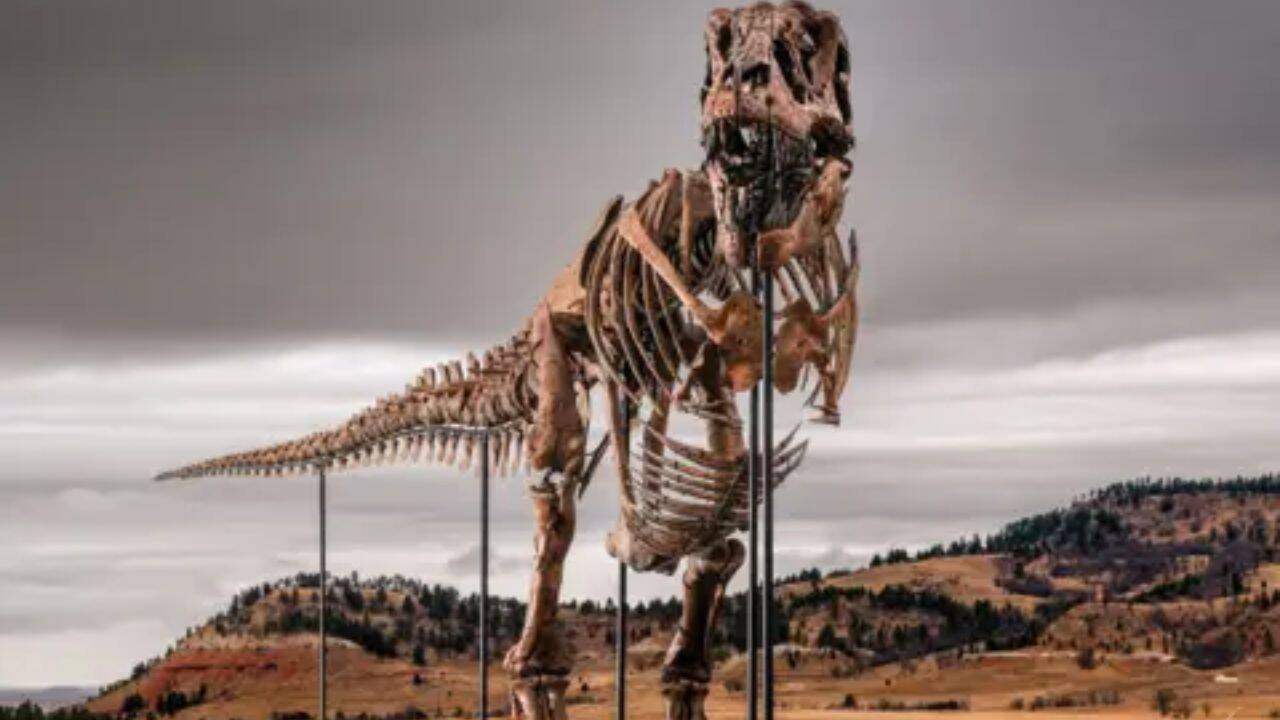
A 67-million-year-old Tyrannosaurus rex discovered on a private South Dakota ranch has sold for a record-shattering $50.1 million at auction. The sale cements the apex predator as the most expensive dinosaur fossil in history, far outstripping previous auction records and signaling a permanent shift in how humanity treats its prehistoric heritage. While the anonymous buyer celebrates a premier trophy, the scientific community is reeling. This transaction highlights a growing crisis where irreplaceable pieces of evolutionary history are transformed into high-yield alternative assets for the ultra-wealthy, leaving public institutions and researchers locked out of their own field.
The sale reflects a broader trend of privatizing the deep past. Over the last three decades, dinosaur fossils have evolved from scientific specimens housed in quiet museum basements into elite status symbols. The mechanics of this market are simple yet devastating for science. For a different perspective, check out: this related article.
Under United States law, fossil rights are tied directly to land ownership. If a prehistoric skeleton is found on federal land, it belongs to the public and must be deposited in an approved museum. If it is found on private land, it belongs entirely to the landowner. This legal framework makes the American West a playground for commercial diggers. They strike deals with struggling ranchers, dig up the bones with backhoes, and sell them to the highest bidder.
The Loophole in the American Dirt
The United States is virtually alone in its approach to paleontological heritage. In countries like Canada, Mongolia, China, and Brazil, fossils are considered state property. If a rancher in Alberta unearths a Tyrannosaurus on their property, the provincial government steps in to preserve it. The finder is rewarded, but the specimen belongs to the public. Further analysis on this matter has been shared by The Guardian.
This is not the case in America. Here, the law treats a 67-million-year-old carnivorous dinosaur no differently than a vein of coal or a barrel of crude oil.
This legal doctrine trace back to old English common law. It gives landowners ownership of everything from the heavens down to the center of the earth. In the Badlands of South Dakota, Wyoming, and Montana, this has created a modern gold rush. Ranchers who have struggled for generations to make a living raising cattle now realize they might be sitting on a multi-million-dollar lottery ticket.
Commercial fossil hunting outfits exploit this reality. They offer ranchers upfront cash or a percentage of the final auction price in exchange for digging rights. For a landowner facing rising equipment costs and unpredictable weather, the choice is obvious. Science cannot compete with that kind of money.
How Wall Street Metrics Invaded Deep Time
The financialization of paleontology did not happen overnight. It began in 1997 when a T. rex named Sue sold at Sotheby’s for $8.36 million. Museums were horrified by the price tag. Even then, it required a coalition of corporate sponsors, including McDonald's and Walt Disney Parks, to keep the bones in a public institution.
Since then, the market has exploded.
Ultra-high-net-worth individuals have entered the arena. They view these bones not as biological records, but as natural sculptures. They display them in high-rise penthouses, corporate lobbies, and private galleries. Art advisers now routinely steer clients toward natural history auctions, pitching dinosaur fossils as inflation-resistant assets with low correlation to traditional stock markets.
This shift has changed how auction houses market these items. Sotheby’s and Christie’s do not pitch these skeletons to academics. They pitch them to contemporary art collectors. They place a Cretaceous predator next to a Basquiat or a Warhol, framing the bones as the ultimate expression of raw, primal power.
This positioning distorts the entire valuation system. A fossil is no longer priced by its completeness, its scientific significance, or the unique pathology of its bones. It is valued by its dramatic presence. This aesthetic valuation ignores the very things that make a fossil valuable to science. A badly crushed skull might hold immense information about brain structure through CT scanning, but it looks terrible in a living room. Conversely, a highly restored, heavily painted skeleton looks magnificent under spotlights but is practically useless for research.
The Silence of the Unstudied Bones
When a fossil enters a private collection, it undergoes a form of scientific death.
Most reputable scientific journals have strict policies. They will not publish research on specimens that are not permanently curated in a public, accessible museum. There is a practical reason for this rule. Science relies on replication. If a researcher claims to have discovered a new muscle attachment site on a T. rex jaw, other scientists must be able to examine that jaw to verify the claim.
If the specimen is locked in a private estate in Dubai or a penthouse in Manhattan, that verification is impossible.
The owner could decide to sell the fossil tomorrow. They could ban researchers from their property on a whim. They could even let the bones degrade in an climate-uncontrolled room. Once a fossil goes private, it is lost to the collective knowledge of humanity.
Some collectors argue they are doing a public service. They point out that they often lend their specimens to museums or allow casts to be made. This argument is hollow. A plaster cast is not the original bone. It cannot be CT-scanned to reveal internal structures. It cannot be sampled for ancient biomolecules or isotopic data. Furthermore, a loan can be recalled at any moment, leaving a museum with an empty exhibit and an incomplete research project.
The private market also incentivizes secrecy. Commercial diggers rarely document the exact geological context of their finds with the precision of academic teams. They want to get the bones out of the ground quickly to minimize labor costs. But without knowing the exact layer of rock, the surrounding pollen, the micro-fossils, and the precise chemistry of the dirt, the skeleton loses half its story. A dinosaur is not just a pile of bones. It is a data point in a complex, ancient ecosystem. Strip away the context, and you strip away the science.
Ranchers and Outlaws in the Badlands
The high prices have also fueled a darker underbelly of poaching and theft. When a single bone can fetch tens of thousands of dollars, the temptation to trespass is immense. Public lands, which are vast and difficult to police, are prime targets.
Federal rangers in the West are stretched thin. They must patrol millions of acres of rugged terrain where a group of thieves can easily hide. These poachers use crude methods. They hack away at skulls with chain saws, destroying crucial anatomical features just to get the marketable parts out quickly.
Even on private land, the promise of massive payouts has frayed community ties. Neighbors suspect each other of stealing across property lines. Families split over how to divide the potential windfall of a fossil find.
Academic paleontologists who once enjoyed warm relationships with local landowners are now locked out. Ranchers who once welcomed university field crews for a cup of coffee and a small donation now demand market-rate access fees. They know that if the university finds something spectacular, it will be claimed by the public, depriving them of a potential multi-million-dollar sale.
Universities simply cannot pay these fees. Their field budgets are funded by modest government grants. A typical academic dig might operate on a budget of $15,000 for an entire summer. That is less than the cost of the shipping crates used to transport the $50.1 million T. rex to the auction block.
The Broken Trust of Public Museums
Museums find themselves in an impossible position. They are tasked with preserving the natural world, but they are being priced out of the market by the very people who sit on their boards.
Many museum trustees are wealthy collectors themselves. This creates a deep conflict of interest. A trustee might donate money to a museum, but they might also outbid that same museum for a key specimen at auction.
Some institutions have tried to adapt by partnering with private donors. The donor buys the fossil, and the museum displays it. But this arrangement gives private individuals immense leverage over public institutions. The donor can dictate how the specimen is displayed, who gets to study it, and when it must be returned. It turns public museums into glorified storage units for private wealth.
This dynamic also distorts public perception. When people see these astronomical prices, they begin to view fossils as commodities. They bring common rocks to local museums, expecting to be told they are worth millions. When the museum curator gently explains that the specimen is a common piece of fossilized wood worth nothing, the visitor often leaves angry, convinced the museum is trying to cheat them.
This commercialization erodes the civic purpose of paleontology. These bones do not belong to the history of a single nation, let alone a single wealthy individual. They are the physical remains of life on Earth. They belong to everyone. Selling them to the highest bidder is a form of cultural vandalism, akin to auctioning off the blocks of the Great Pyramid to decorate private gardens.
The $50.1 million sale will only accelerate this crisis. Every rancher in the West is now looking at their dirt with new eyes. Every commercial outfit is upgrading its equipment. Every billionaire is looking for their own prehistoric trophy. As the price of deep time continues to rise, the window for understanding it is rapidly closing.