You know that moment before takeoff when flight attendants demonstrate how to buckle a seatbelt and pull on a yellow life vest? Most passengers tune it out completely. They scroll on their phones, adjust their neck pillows, or stare out the window.
Those brief announcements weren't created by risk-averse corporate lawyers trying to dodge lawsuits. They exist because 52 people lost their lives off the coast of Puerto Rico in 1952. They survived a plane landing in the ocean, only to drown because nobody knew where the life jackets were hidden or how to get out before the aircraft sank. Learn more on a similar topic: this related article.
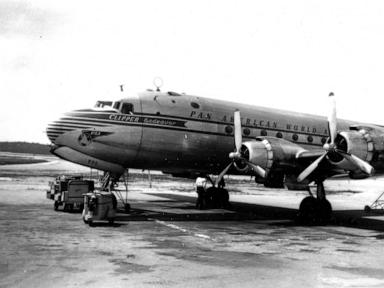
Now, 74 years later, deep-sea explorers using autonomous sonar drones have finally located the wreckage of Pan Am Flight 526A, resting 2,000 feet beneath the surface.
The Forgotten Disaster That Changed Air Travel
On Good Friday, April 11, 1952, a Douglas DC-4 named the Clipper Endeavor took off from San Juan, Puerto Rico, bound for New York City with 64 passengers and 5 crew members. Minutes into the flight, two engines failed due to poor maintenance. The pilots executed a textbook ditching on rough ocean waters 11 miles offshore. Additional reporting by National Geographic Travel highlights related perspectives on the subject.
The plane didn't explode or disintegrate. All 69 people survived the initial impact with the water.
Panic instantly took over. Passengers didn't know where life vests were stored, nor had anyone ever explained how to use them. In 1952, preflight briefings didn't exist. The cabin crew scrambled to haul heavy life rafts through the cabin as water poured in. Afraid of the cold open ocean, many passengers hesitated to leave the floating airframe.
Three minutes later, the plane tipped up and plunged into the sea. Only 17 people made it out alive.
Investigators at the Civil Aeronautics Board quickly realized the horrifying truth. Most of those 52 deaths were entirely preventable. The disaster forced regulators to mandate mandatory passenger safety demonstrations, standardized life vest locations, and clearer exit signage across commercial aviation.
How Searchers Found a Needle in the Atlantic
Finding a 74-year-old plane at the bottom of the sea requires patience and a fair bit of luck. The hunt began in 2019 when Russ Matthews, president of the Air/Sea Heritage Foundation, spotted a historic reference to a luggage tag from the crash washing ashore on a Florida beach decades prior.
Matthews spent years digging through archives from Pan Am, the U.S. Coast Guard, and Puerto Rican judicial hearings. The breakthrough came from an unexpected source: a map drawn by U.S. Air Force pilots who happened to be flying a training mission nearby in 1952 and witnessed the ditching from above.
Synthesizing those eyewitness coordinates with historical weather data, searchers mapped out a target area of 10 square nautical miles.
They teamed up with Deep Sea Vision, an undersea exploration firm led by Tony Romeo—whose own father worked as a Pan Am mechanic and pilot. In April 2026, while transit-sailing past Puerto Rico between offshore projects, Romeo’s vessel deployed an autonomous sonar drone designed to hunt underwater mines.
On its very first sweep over the target grid, the drone's sonar scanned right across the intact fuselage and tail section of the Clipper Endeavor.
Why Safety Demonstrations Aren't Going Anywhere
When crisis strikes at 30,000 feet or during a forced ocean landing, panic resets the human brain to zero. Muscle memory takes over.
Aviation safety experts point directly to the Pan Am crash as the turning point where passenger psychology became part of aircraft design. Before 1952, safety equipment was aboard planes, but passengers were treated as passive cargo. After 1952, industry regulations recognized that passengers must know how to save themselves in the brief window between impact and sinking.
Modern airlines don't do safety demonstrations to pass the time before takeoff. They do them because human beings freeze when they're scared.
If you ever need to get out of an aircraft in two minutes, knowing whether your life vest is under your seat or under your armrest saves lives.
What You Should Do on Your Next Flight
Instead of completely ignoring the flight attendants on your next trip, take five seconds to do three simple things:
- Count the number of seat rows between your chair and the two nearest emergency exits, both in front of you and behind you. If the cabin fills with smoke, you won't be able to see.
- Reach down and feel under your seat cushion to confirm the life vest container is actually there.
- Take a quick glance at the plastic safety card in the seat pocket to check how the emergency door handles pull on that specific aircraft model.
A few seconds of situational awareness costs nothing, but it honors a hard-learned lesson from 1952 that made flying the safest way to travel on the planet.