The air in the rehabilitation center does not smell like the forest. It smells like wet cotton, sterile disinfectant, and the heavy, metallic tang of an oxygen tank hissing against the quiet.
Outside, the island of Borneo breathes through a shroud. For weeks, the horizon has not been blue. It is a bruised, sulfurous yellow, the color of an old bruise under skin. The peat lands, dried to the consistency of gunpowder by months of unnatural heat, catch fire underground. They burn out of sight, beneath the roots, sending plumes of acrid smoke upward until the canopy itself becomes a chimney.
In a concrete enclosure meant for healing, a single orange form lies motionless.
We call them wildlife rescues in the headlines. We write neat little paragraphs about respiratory illness, humidity levels, and veterinary interventions, as if an animal is a broken machine waiting for a spare part in a workshop. But stand close enough to hear the wet, rattling wheeze of a young male orangutan fighting for air, and the bureaucratic language evaporates.
His name is secondary. Let us call him Giri, though the keepers use a number on a clipboard. Giri was found curled at the base of a charred ironwood tree, too weak to climb, his rust-colored fur matted with ash and soot. When the rescue team lifted him into the transport crate, he did not bare his teeth. He pressed his face into the rough wire mesh, seeking something—anything—that felt like the mother he had lost to the advancing line of orange light three weeks prior.
Smoke does not care about conservation status. It does not read the red lists published in air-conditioned offices thousands of miles away. Smoke is democratic in its cruelty. It fills the delicate alveoli of a human child sleeping in a village fifty miles downwind, and it fills the vast, complex lung architecture of an ape whose DNA shares ninety-seven percent of our own.
Consider what happens when a forest burns. We tend to think of fire as a sudden, violent wall—a wall of orange teeth chewing through green wood, documented by dramatic drone footage that plays on evening news broadcasts. But the true horror of the Bornean fires is slow and subterranean. It is the peat. Ancient layers of decomposed vegetation, packed tight over millennia, smolder beneath the surface at six hundred degrees. They release carbon stored since the dawn of human civilization, turning the sky into a ceiling of lead.
For an arboreal creature, the ground is already a place of danger. To be forced down from the high canopy by smoke is an admission of defeat. Giri did not come down because he wanted food. He came down because the air fifty feet up had become poison.
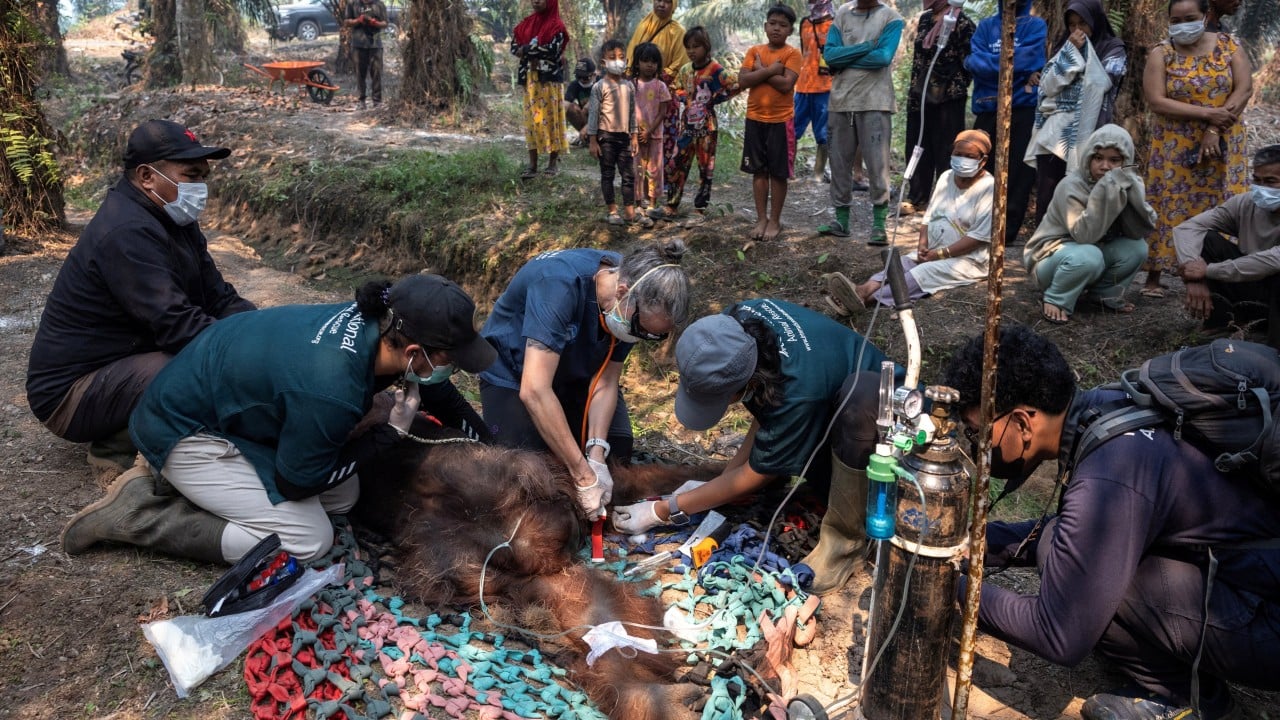
Dr. Aris, a veterinarian who has spent twenty years pulling animals from the ash, knows the sound of smoke inhalation better than anyone. It is a distinct, bubbling rattle.
"People think the burns are the worst part," Dr. Aris says, wiping sweat from his forehead with the back of a sterile glove, his eyes red-rimmed from weeks of exposure. "The burns heal. Skin knits back together, even if it leaves a scar. But the lungs? The lungs are a different story. Once the fine particulates coat the respiratory tract, inflammation sets in. The tissue forgets how to expand. Every breath is a small war."
In the treatment room, a nebulizer hums. A clear plastic mask is gently strapped over Giri’s muzzle. He blinks slowly, his amber eyes reflecting the fluorescent lights of the clinic. There is an agonizing intelligence behind those eyes—a recognition of captivity, of fear, and of profound exhaustion. He tries to pull the mask away with long, leathery fingers, his movements sluggish, lacking the electric snap of a healthy wild primate.
This is the invisible cost of our modern hunger. Every acre of rainforest cleared for palm oil plantations, every hectare drained for speculative agriculture, acts as a fuse. When the dry season arrives, the fuse reaches the powder keg. We consume the products on supermarket shelves thousands of miles away, wrapped in glossy packaging that never mentions the word smoke, never mentions the rattling breath of an ape in a concrete room.
We have built an economic engine that runs on the liquidation of ancient living systems, and we are surprised when the smoke gets in our eyes.
Giri’s chest rises and falls, a rhythmic, desperate effort. The nebulizer mist swirls inside the plastic chamber, carrying medicine designed to open his swollen airways. Outside, the rain is late this year. The monsoon clouds gather over the Java Sea, dark and heavy, but they hesitate, hovering above the burning earth like ghosts unwilling to descend.
If you sit with an orangutan long enough, time begins to warp. Their movements are deliberate, measured, as if they carry the memory of the forest’s slow, patient clock inside their bones. To watch one struggle for the simple act of drawing air into the body is to witness a profound inversion of the natural order. We have taken the creatures who taught us how to climb, how to inhabit the green world, and we have forced them to learn the artificial rhythm of medical machinery just to survive the world we made.
The treatment finishes. The hum of the machine dies away.
For a long moment, the room is entirely silent, save for the wet, heavy sound of Giri breathing on his own. It is a fragile sound, hanging in the dim air between recovery and the ash-choked horizon outside. The door to the enclosure remains shut. The forest waits, patient and burning, just beyond the wire.