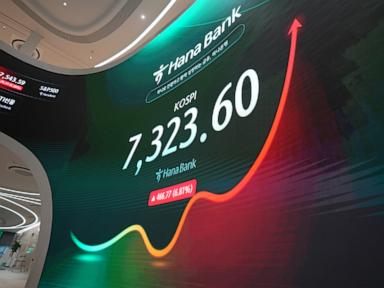
The glowing green numbers on a trading floor in Seoul do not look like human anxiety. They look like mathematics. But if you stand close enough to the glass, you can hear the collective intake of breath.
For weeks, the global economy felt like a room losing oxygen. In the United States, everyday consumers were watching the numbers on the grocery scanner climb with aggressive consistency, pushing the annual cost of living up by 3.5%. The Federal Reserve stood in the wings, its finger hovering over the interest rate trigger. Everyone knew what a pull of that trigger meant: a deliberate cooling of the economy, a tightening of the vice on investments, and the quiet fracturing of corporate budgets worldwide.
Then, a single report crossed the wires. It wasn’t perfect, but it wasn't as bad as feared.
Wall Street exhaled first. The S&P 500 clawed back 0.4% of its previous losses, closing at 7,543.59. The Nasdaq composite, heavy with tech giants whose valuations rely on future promises, jumped 0.9%. It was a relief rally born not of triumph, but of temporary survival. And like a wave traveling across a dark ocean, that sigh of relief rippled westward across the Pacific, waking up the Asian markets with a sudden, unexpected surge of adrenaline.
Consider Min-jae, a hypothetical but entirely representative semiconductor engineer in Gyeonggi Province. He doesn't look at the bond yields every morning, but he knows when the market is bleeding. When tech stocks plunged the day prior—wiping out chunks of value from heavyweights like Micron and Nvidia—the air in his office was thick. Silicon chips are the literal nerve center of the modern world, yet their value swings wildly on the whims of American macroeconomic data.
When the Seoul market opened on Wednesday, that tension snapped. South Korea’s Kospi index didn't just rise; it surged by 7.1% to 7,343.37. It was a violent, beautiful rebound driven by a sudden rush back into semiconductor giants like Samsung Electronics and SK Hynix. In Tokyo, the Nikkei 225 climbed 0.9% to 68,353.91. Australia’s S&P/ASX 200 ticked up 0.2%. Even Hong Kong’s Hang Seng found its footing, edging up 1.6%.
For a few hours, the narrative was clear: U.S. inflation was slowing down, the probability of the Fed hiking rates in the coming weeks dropped below 17%, and the global machinery could keep humming.
But financial markets are never permitted a pure victory.
While the equity screens flashed green, a darker reality was hardening in the waters of the Middle East. The fragile Memorandum of Understanding between the United States and Iran, signed just a month ago, had dissolved. Military strikes were being exchanged. The Strait of Hormuz—the vital chokepoint through which a massive portion of the world's energy flows—was turning into a geopolitical flashpoint. Iran's paramilitary Revolutionary Guard issued a stark warning: if their ports remained blockaded, the region’s energy exports would belong to everyone or no one.
Suddenly, the victory over inflation felt fragile. The price of benchmark U.S. crude rose to $80.20 a barrel. Brent crude, the global yardstick, climbed toward $85.88.
This is the central paradox of our current economic reality. We celebrate the easing of consumer price indexes while ignoring the tankers altering their courses in the Gulf. We rejoice that the 10-year Treasury yield dropped to 4.58%, forgetting that it was sitting comfortably at 3.97% before the regional drums of war began to beat.
The numbers tell us that the economy is stabilizing, but the geography tells us we are one miscalculated drone strike away from another supply chain shock.
Even within Asia, the optimism was uneven. In Shanghai, the Composite index slipped 0.4% to 3,952.04. The drop followed a government report revealing that the Chinese economy had slowed sharply to a 4.3% annualized pace in the second quarter, down from 5% in the first three months of the year. It is a stark reminder that while the American consumer dictates the rhythm of global interest rates, local structural realities still hold immense power.
We live in a world where an analyst in a Tokyo high-rise can watch the U.S. dollar inch down to 162.16 Japanese yen and feel a sense of tactical clarity, while a ship captain looks at the horizon in the Gulf of Oman with profound dread. Both realities coexist. Both shape the wealth of nations and the cost of a gallon of milk.
The markets rose on Wednesday because, for a fleeting moment, the immediate threat of a domestic economic choking hazard receded. The Fed might stay its hand. The chips will keep shipping. But the green numbers on the screen are not a permanent truce; they are merely a brief pause in a much larger, global negotiation between hope and hazard.