Annoyance has a distinct temperature. It is the lukewarm sting of stale coffee at 7:00 AM, the damp chill of a missed bus, or the sudden, sharp heat rising up your neck when a gas station card reader refuses to acknowledge your existence.
We have all stood on that oil-stained concrete. You insert the debit card. You pull it out. The tiny monochrome screen blinks back at you with bureaucratic indifference. See Cashier. You sigh, look at your watch, calculate the three minutes of your life you are about to lose walking past racks of lukewarm hot dogs and energy drinks, and push open the glass door.
Most of the time, that minor hardware failure is just friction. A tiny tax on your patience.
For a college student in North Carolina named Christian, that stubborn card reader was the catalyst for a life-altering windfall.
The Architecture of a Tuesday Afternoon
To understand why a two-million-dollar lottery win hits differently when you are twenty-one, you have to remember the specific arithmetic of student poverty. When you are in college, money is not an abstract number in a wealth-management portfolio; it is a physical weight you carry around in your head every single day. It is the mental math you do in the grocery store aisle to make sure your debit card will not decline over a carton of eggs. It is the low-grade anxiety that hums beneath every semester, whispering that one blown tire or one unexpected textbook fee could derail your entire spring.
I remember that exact feeling from my own years scraping by on part-time wages—counting quarters in my cupholder just to put two gallons of regular unleaded into a sedan with a permanently illuminated check-engine light. At that age, buying a twenty-dollar scratch-off ticket is not a casual impulse. It is a calculated risk. It represents two cheap lunches, or a week of laundry, or a tank of gas that gets you to your morning lecture.
On a seemingly ordinary day in North Carolina, Christian pulled up to a local gas station. His goal was simple: fuel up and get on with his day. He stepped out of his car, popped the fuel door, and slid his card into the pump's payment terminal.
Nothing happened.
The screen refused to cooperate. The magnetic stripe reader—worn down by thousands of commuters, humid Carolina summers, and relentless exposure to the elements—glitched. It would not process the transaction at the island.
Pause right here and consider the branching paths of human behavior. Nine out of ten people in that exact situation will curse under their breath, get back into their cars, and drive two blocks down the road to a competitor with working pumps. Life is too short to stand in line inside a convenience store just to buy twenty dollars' worth of fuel.
Christian did not drive away. He locked his door, walked across the asphalt, and stepped inside the store to pay the clerk directly.
Friction as a Mechanism of Fate
In behavioral psychology, there is a concept known as choice architecture—the idea that the physical layout of our environment subtly dictates our decisions. Gas stations are masters of this. When you pay at the pump, you are insulated from impulse buys. You interact with a machine, pump your fuel, and leave. The moment a card reader fails, however, the architecture changes. You are forced across a threshold into a space engineered to capture your attention.
Inside the store, standing at the counter to prepay for his gas, Christian’s eyes fell on the illuminated glass case displaying North Carolina Education Lottery scratch-off tickets.
Let us be entirely honest about the math of lotteries: they are, by design, a losing proposition. State lotteries operate on strict statistical probabilities, and the house always maintains a massive mathematical edge. If you look at a scratch-off ticket purely through the cold lens of expected value, buying one makes no sense at all.
Yet human beings do not live inside spreadsheets. We live inside stories, and occasionally, we buy a piece of cardstock not because we believe the math favors us, but because for three minutes, it allows us to dream about what freedom feels like.
Christian decided to buy a $20 scratch-off ticket—specifically, a game called 200X The Cash.
Think about what that twenty-dollar bill meant to a student. He was already inside the store because a machine had inconvenienced him. He was already reaching into his wallet. Had that outdoor card reader functioned properly, he never would have seen the glass case. He never would have made eye contact with the clerk. He never would have handed over that extra twenty dollars.
He took the ticket, walked back out to his vehicle, and scratched away the metallic coating.
The Anatomy of Disbelief
When people imagine winning the lottery, they usually picture screaming, jumping up and down, or popping champagne. The reality, documented across hundreds of winner interviews, is almost always the exact opposite: silence.
The human brain is remarkably bad at processing sudden, catastrophic good fortune. We are evolutionarily wired to handle immediate threats—a swerving car, a sudden drop, a loud noise—by flooding our bloodstream with adrenaline. We are not wired to process the sudden disappearance of every financial problem we will ever face before the age of thirty.
When Christian uncovered the matching numbers and saw the "$2 MILLION" prize staring back at him from the cardboard, his first reaction was not celebration. It was confusion. He stared at the ticket. He checked the rules printed on the back. He looked at the numbers again, convinced he had misread a decimal point or misunderstood the game's mechanics.
This is the quiet, surreal purgatory of the newly minted winner. For a few hours—or a few days—you are walking around in your old life, wearing your old clothes, driving your old car, carrying a piece of paper in your pocket that is worth more than most people earn in thirty years of full-time labor. You cannot leave it in your glovebox. You are terrified to leave it on your kitchen counter. You find yourself checking your pocket every forty-five seconds just to make sure the cardboard hasn't dissolved into thin air.
When Christian finally made the drive to the North Carolina Education Lottery headquarters in Raleigh to claim his prize, the abstract numbers became cold, hard legal reality.
The Real Math Behind a Two-Million-Dollar Headline
Whenever a headline announces that someone won two million dollars, a predictable chorus of armchair accountants immediately chimes in with the same question: How much did he actually get?
Let us break down how North Carolina lottery payouts work, because the mechanics of windfall money are rarely as simple as the giant cardboard check makes them look.
Winners of top-tier annuity prizes in North Carolina face a fundamental fork in the road:
- The Annuity Option: The winner receives the full advertised $2 million, paid out in twenty annual installments of $100,000 before taxes. It is a steady, reliable safety net that guarantees an upper-middle-class baseline income for two decades.
- The Lump-Sum Option: The winner takes the cash value of the prize all at once, which is significantly lower than the advertised jackpot because the state isn't investing the money over twenty years on your behalf.
Christian chose the lump sum.
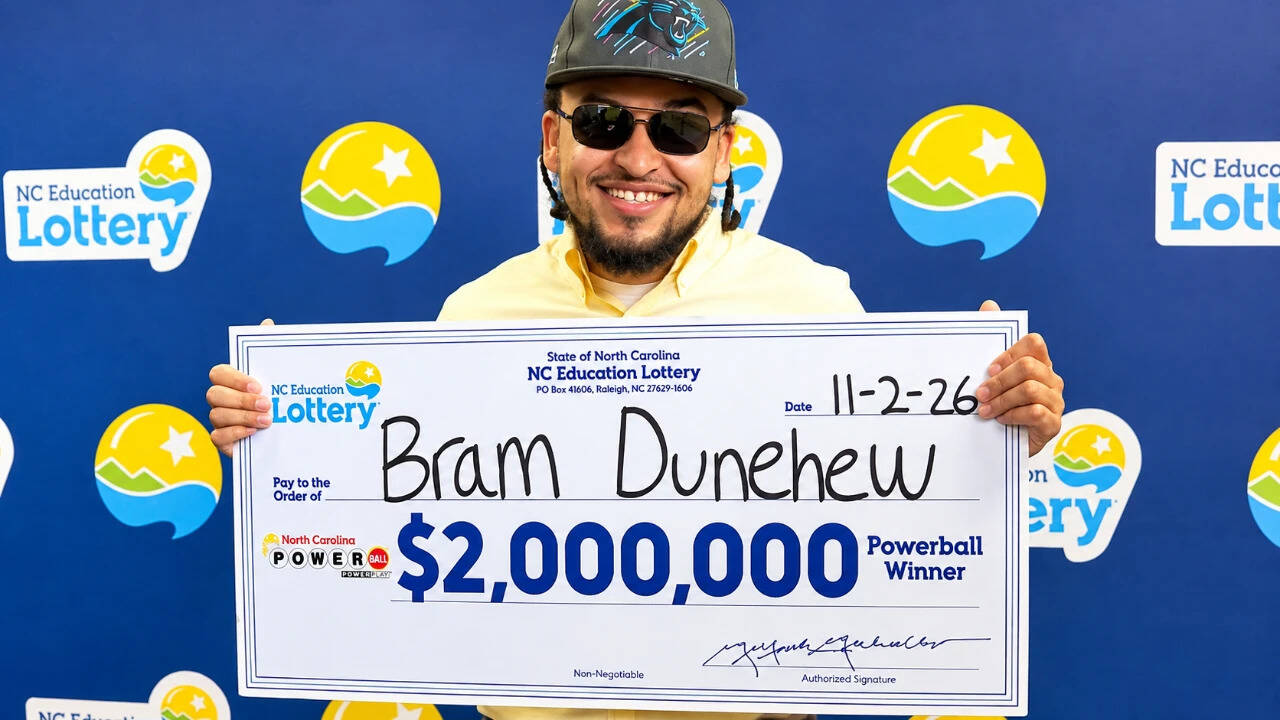
In his case, the cash option amounted to $1.2 million. Before the state ever cut the check, mandatory federal and state tax withholdings kicked in—24% off the top for federal taxes, plus North Carolina’s state income tax rate. When the dust settled and the tax man took his statutory share, Christian walked away with $858,006 deposited directly into his bank account.
Some cynics look at that drop—from $2 million down to $858,006—and call it a rip-off. Those people have clearly never been twenty-one years old with $858,006 sitting in a checking account.
To appreciate what that number actually means, consider a hypothetical comparison. Imagine two graduates walking across the stage at a North Carolina university next spring. The first graduate leaves with the national average student loan debt—roughly $37,000—and starts an entry-level job paying $50,000 a year. If that graduate saves aggressively, perhaps $500 a month, it will take them over a decade just to clear their debt and build a modest emergency fund. They will spend their twenties negotiating rent increases, calculating interest rates, and delaying major life milestones.
Now look at the second graduate—Christian—walking off that same stage with nearly nine hundred thousand dollars in liquid cash, zero debt, and the entire runway of his adult life ahead of him.
Even if he never touched the principal and simply parked that $858,006 in a conservative, diversified index fund averaging a historical 7% annual return, that money would generate roughly $60,000 a year in passive growth—before he ever clocked in for a single hour of work. He did not just win money; he bought back forty years of compound interest before his career had even officially begun.
What He Chose to Do With the Noise
Sudden wealth is famous for destroying people who lack an anchor. History is littered with cautionary tales of lottery winners who burned through millions in thirty-six months on depreciating luxury cars, bad business ventures pitched by distant cousins, and lifestyle inflation that spiraled out of control.
When lottery officials asked Christian what he planned to do with the money, his answer revealed a level of grounded maturity that money cannot buy. He didn't talk about supercars, beachfront mansions, or dropping out of school to live on a yacht.
He said he planned to use the money to finish his education and invest for his future.
Read that again. A college student suddenly hands himself the financial freedom to never sit through another 8:00 AM lecture, never write another ten-page research paper, and never stress over another midterm exam—and his immediate instinct is to finish his degree.
Why? Because when you remove financial desperation from education, learning transforms. College stops being a desperate scramble for a credential that will pay off your loans, and becomes what it was always supposed to be: an opportunity to build skills, explore ideas, and enter the world on your own terms. When you don't need the job, you can wait for the right job. You can start a business without fearing bankruptcy. You can say no to toxic workplaces because your rent is already paid for the rest of your life.
The Invisible Lessons of a Broken Machine
We spend so much of our lives trying to engineer friction out of our days. We want one-click checkouts, instant digital payments, tap-to-pay terminals, and seamless routines where nothing ever goes wrong and nobody ever slows us down. We treat every minor inconvenience—a delayed flight, a jammed printer, a broken gas pump—as a personal insult from the universe.
Yet human history is full of breakthroughs and windfalls that only happened because something broke. Penicillin was discovered because Alexander Fleming left a petri dish uncovered by mistake. Post-it Notes exist because a chemist failed to make a strong adhesive. And a college student in North Carolina is debt-free today because a cheap plastic card reader outside a convenience store refused to read a magnetic stripe.
You cannot plan for luck. You cannot force a $20 scratch-off ticket to beat one-in-a-million odds, and you certainly should not treat the lottery as a financial strategy. The math will always remain ruthless, and for millions of people who walk into convenience stores every day, that twenty-dollar bill simply vanishes into state education budgets.
Still, there is a quiet wisdom buried inside Christian’s story that has nothing to do with gambling and everything to do with how we move through the world.
The next time you are standing on oil-stained concrete, staring at a blinking screen that tells you to go inside and see the cashier, take a breath before you get angry. You never really know what a minor detour is trying to put in your path.
Christian locked his car door, walked across the asphalt, and stepped inside.