Education is usually sold to us as an escalator. You step on at the bottom, hold the handrail, and let the machinery lift you predictably toward a credential, a career, and a future. But sometimes, mid-rise, the stairs simply vanish. The gears lock up. The metal teeth grind to a halt, and you are left standing in the dark, staring at a drop that wasn't on the map.
Consider Maya. She isn't a real person sitting in a designated holding cell of statistics, but she is every student who packed a backpack last semester only to find the front doors padlocked by a sudden school closure. Picture the weight of her canvas bag against her shoulder—heavy with three notebooks she will no longer need, a laptop with a dying battery, and the specific, hollow panic of someone whose timeline has just been ripped in half. If you found value in this post, you should read: this related article.
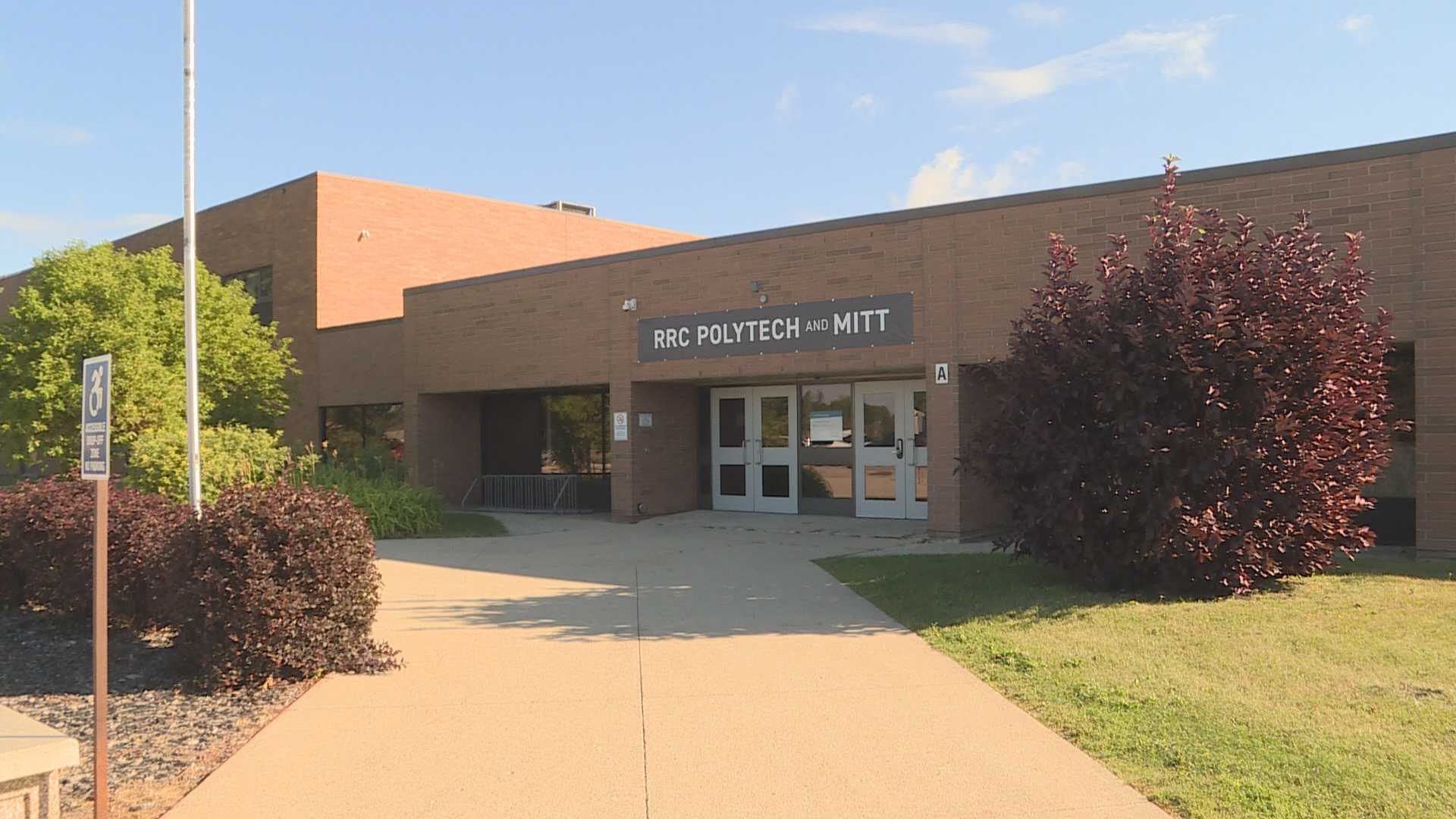
When an institution like the Manitoba Institute of Trades and Technology campus undergoes a rocky transition, the official reports talk about logistics. They mention credit transfers, administrative hurdles, student placement metrics, and the architecture of continuity. They make it sound like moving furniture from one room to another.
It is not moving furniture. It is uprooting a life. For another look on this story, see the recent update from Al Jazeera.
There is a distinct kind of silence that settles over a classroom when the anchor is cut. You can trace the lineage of educational disruptions back through decades of economic shifts. When schools fold or transition, the casualties are rarely numbers on a balance sheet. They are people learning how to weld, how to code, how to care for the sick, whose days suddenly fracture into phone trees, waiting rooms, and the agonizing dread that their time and tuition have evaporated into thin air.
The return to a former campus looks triumphant in photographs. Smiles. Handshakes. Officials pointing at freshly painted walls as if to say, Look, the machine is moving again. But step closer. Listen to the murmur in the hallways.
Change is terrifying when it is forced upon you.
We forget that learning requires a rare, fragile currency called psychological safety. You cannot master a complex trade or absorb advanced technical skills if your nervous system is convinced the floor is about to drop out from beneath you again. When a campus closes and reopens under a cloud of administrative strain, the students do not return as blank slates. They return as veterans of an invisible war. They look at their new instructors not with immediate trust, but with the guarded squint of survivors checking for tripwires.
Yet, human resilience is an absurdly stubborn thing.
Give people a half-broken system, and they will carve shortcuts through the drywall. Watch how friendships form in the margins of these transitions. Two strangers sharing a thermos of lukewarm coffee outside a newly designated building, comparing notes on whether their old credits will count toward the new curriculum. That shared grievance becomes mortar. They build a community out of the rubble because the alternative is standing still, and standing still is a luxury nobody can afford.
The transition back to a familiar physical space with an unfamiliar administrative heartbeat carries its own strange geography. The walls are the same. The parking lot holds the same memories of late-night cramming sessions before practical exams. But the air feels different. It tastes like caution.
Administrators talk about stabilization. They use phrases like moving forward. But the students know the truth of the terrain. They know that a fresh coat of paint on an old campus does not automatically erase the months of limbo spent refreshing their email inboxes at midnight, waiting for a verdict on their futures.
History tells us that institutions are remarkably fragile, while human drive is remarkably dense. Schools can fail. Funding can dry up. Mergers can stumble through bureaucratic mud. But the impulse to acquire skill, to build competence, to outsmart circumstance—that does not vanish just because a door gets locked.
Walk through the workshops and labs now. The smell of metal shavings and ozone is back. The quiet focus of hands learning how to shape raw materials into functional reality has returned to the benches. It is not a seamless miracle. It is a messy, grinding, beautiful salvage operation.
They are back at the desks. The lights are on. But the map has changed forever, and they are holding the pen.



