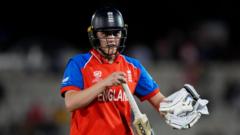
The sight of an elite athlete walking off the pitch voluntarily is rarely a sign of strategic genius. When England captain Nat Sciver-Brunt retired out on 48 during Tuesday’s tense four-wicket victory over Ireland at Southampton, the collective intake of breath across English cricket was audible. Nominally, it was framed as a precaution, a calculated exit with nine runs left to chase. In reality, it exposed the structural fragility of England's Women's T20 World Cup campaign and a high-stakes medical gamble that may have backfired.
Sciver-Brunt is the centerpiece of this England side, a player whose tactical acumen and explosive all-round ability dictate the team's ceiling. Having spent the entire summer recovering from a torn left calf suffered in late April while playing for The Blaze, her return to action just last week felt ahead of schedule. The official line from the England camp immediately following the Ireland match was one of calculated calm, citing simple tightness. Yet, the scheduled scan on that same left calf tells a far more urgent story about the pressure to rush superstar players back into major tournaments.
Elite sport operates on thin margins, but the management of calf soft-tissue injuries requires an exactitude that defies condensed tournament schedules. By allowing their captain to return to active tournament play without resuming her bowling duties in full training, England management prioritized a short-term batting cushion over long-term physical sustainability.
The Myth of the Precautionary Retirement
Public relations in modern sport dictates that every negative physical symptom is labeled a precaution until an MRI proves otherwise. Sciver-Brunt spoke to broadcasters with a detached coolness, brushing aside the idea of a structural recurrence. Her wife and former international teammate, Katherine Sciver-Brunt, offered a similarly optimistic assessment on the radio, noting that a lack of tears in the dressing room pointed away from disaster.
This optimism ignores how calf muscle architecture functions under explosive stress. When a player suffers a grade-two or grade-three tear, the healed scar tissue remains less elastic than the original muscle fibers. The act of turning quickly, accelerating for a second run, or digging out a slower-ball yorker places immense shear force on the transition zone between the muscle and the tendon. Tightness is not a random occurrence; it is the final neurological warning shot fired by a fatigued muscle group on the verge of structural failure.
England arrived in Southampton with a clear blueprint but an immediate top-order collapse to 35 for three forced Sciver-Brunt into a prolonged rescue mission. Alongside Heather Knight, she steadied an innings that threatened to unravel against an energetic Irish bowling attack led by Orla Prendergast. The 64-run partnership demanded physical exertion over 49 balls on a surface made damp by a pre-match downpour. By the time Sciver-Brunt hit her fourth boundary and felt the muscle lock, the damage was already done.
The Structural Dependency Crisis
The deeper crisis facing England coach Jon Lewis is that this squad is structurally incapable of absorbing the loss of its captain. Unlike the Australian setup, which features a plug-and-play assembly line of top-order all-rounders, England’s tactical balance hinges entirely on Sciver-Brunt filling multiple critical roles simultaneously.
When fit, she balances the side by allowing England to field an extra specialist bowler or an additional dynamic finisher like Freya Kemp or Dani Gibson. Without her, the top order loses its emotional anchor. The swift dismissals of Amy Jones, Danni Wyatt-Hodge, and Alice Capsey within a chaotic ten-ball window showed how quickly this batting unit can panic when forced to dictate terms without their captain waiting in the pavilion.
England Top-Order Collapse vs Ireland (Southampton)
==================================================
Score: 27/0 -> 35/3 in 10 deliveries
- A. Jones: Dismissed via mistimed slice to mid-on
- D. Wyatt-Hodge: Dismissed identical fashion to extra cover
- A. Capsey: Cleaned up by O. Prendergast slower-ball yorker
If the upcoming scan reveals a secondary tear or a significant strain, England's path through Group B becomes an absolute minefield. While Scotland awaits at Headingley on Saturday, looming matches against the West Indies and New Zealand will demand a level of middle-order resistance that England failed to display in their absence of leadership during the recent home series against India.
The Modern Tournament Dilemma
The broader sporting landscape is littered with examples of medical departments clearing star players under intense institutional pressure, only for the athlete to break down within days of their return. The modern international calendar leaves no room for progressive rehabilitation. A player must transition from non-running status straight into the crucible of a World Cup where net run rate demands maximum intensity from ball one.
England’s decision-making process ahead of the tournament opener against Sri Lanka was clearly driven by desperation rather than clinical milestones. Allowing a player to participate in a global tournament while still sheltered from bowling in practice creates an asymmetry in their physical preparation. The body cannot be compartmentalized; a batsman still needs to sprint, decelerate, and twist with the same intensity as a bowler.
The medical staff now faces an uncomfortable ultimatum. If the scan returns clear of major structural damage, do they risk playing her against Scotland to secure a semi-final berth, or do they enforce a strict period of rest that leaves the team vulnerable to a tactical ambush?
Management must realize that playing a compromised asset is often more dangerous than blooding a fully fit replacement. Tammy Beaumont stands ready to assume captaincy duties, and Maia Bouchier offers an aggressive, albeit less experienced, top-order alternative. Relying on the hope that a recurring calf issue will magically resolve itself mid-tournament is an exercise in denial. England must prepare for a reality where their best player cannot save them, and they must do so before the tournament moves out of their grasp entirely.