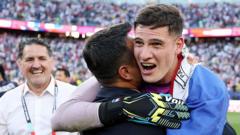
Paraguayan goalkeeper Orlando Gill just made World Cup history by orchestrating a stunning penalty shootout victory against Germany, but his sudden rise exposes a deeper crisis within South American club football. While global headlines fixate on the romantic narrative of a father who sold his under-20 national team jersey and training boots in 2022 to fund medical care for his premature son, Lautaro Daniel, the reality is far harsher. Gill’s sacrifice was not a poetic choice; it was the direct result of systemic financial instability, chronic wage delays, and the lack of basic labor protections for players outside the elite tier of South American football.
The Myth of the Romantic Sacrifice
Mainstream sports journalism loves a poverty-to-premiership arc. It frames the desperate liquidation of personal belongings by Orlando Gill as a heartwarming testament to paternal devotion. His wife, Melissa Avalos, shared on social media that the family had "absolutely nothing" when their son was fighting for his life, forcing the 6-foot-6 goalkeeper to sell his clothing, sneakers, and most prized youth relics. Meanwhile, you can find related events here: Why American Soccer Fans Are the Real Unexpected Winners of the World Cup.
While the sentiment is deeply moving, the framing is dangerous. It masks a structural failure. Gill was not an amateur hobbyist; he was a professional footballer coming through the youth ranks and playing for Club Sportivo San Lorenzo in Paraguay.
The fact that an elite young athlete representing his country at the under-20 Copa América had to pawn his official gear to pay for emergency healthcare reveals an industry that exploits raw talent while failing to guarantee a basic living wage. In mid-level Paraguayan football, contracts are often precarious, and salaries are frequently deferred for months at a time. For players at this level, a sudden medical emergency is not an inconvenience; it is a financial catastrophe. To see the full picture, we recommend the recent report by FOX Sports.
The San Lorenzo Paradox
A bizarre institutional overlap defines Gill’s career. He developed at Sportivo San Lorenzo in Paraguay, a club perpetually caught in the volatile elevator between the first and second divisions. His breakthrough only occurred when he migrated across the border to join a club with an almost identical name: San Lorenzo de Almagro in the Argentine Primera División.
+---------------------------+-----------------------------------+
| Club                      | Orlando Gill's Institutional Path |
+---------------------------+-----------------------------------+
| Sportivo San Lorenzo      | Youth development, low pay,       |
| (Paraguay)                | wage delays, relegation battle    |
+---------------------------+-----------------------------------+
| San Lorenzo de Almagro    | December 2023 loan, reserve team  |
| (Argentina)               | grind, permanent buy-out in 2025  |
+---------------------------+-----------------------------------+
The transition between these two entities highlights the stark economic stratification within South American football. At the Paraguayan San Lorenzo, Gill faced a revolving door of short-term goalkeeping imports and a lack of institutional patience. Tito Peralta, the Paraguayan club’s president, openly admitted that Gill was never afforded sustained trust at home. Every season brought a new foreign or veteran signing to displace him, keeping his earning potential depressed and his career stagnant.
It required an intervention from Peralta, who utilized his personal network to contact the newly elected president of Argentine San Lorenzo, Marcelo Moretti, to engineer a loan move in late 2023. Even then, Gill had to endure the anonymity of the Argentine reserve squad before his contract was made permanent in early 2025. This step up the economic ladder saved his career, providing the financial stability that allowed him to finally focus entirely on performance rather than survival.
Systems of Insecurity
To understand why Gill was forced to liquidate his possessions, one must examine the broader economic ecosystem of domestic South American leagues outside of Brazil and the absolute top tier of Argentina.
- Contractual Precarity: Many domestic contracts lack enforceable guarantees regarding timely payments, leaving players vulnerable to the cash-flow whims of club directors.
- The Exposure Trap: Young players are frequently expected to accept substandard wages in exchange for "exposure," under the assumption that a future transfer to Europe or Brazil will retroactively compensate for years of poverty.
- Medical Safety Net Failures: Minor clubs rarely provide comprehensive medical coverage that extends to the immediate families of players, leaving athletes entirely dependent on a fragile public healthcare system during a crisis.
When Gill stood in the mixed zone at the Gillette Stadium in Boston, draped in the Paraguayan flag and holding a Player of the Match trophy, his voice trembled. He directed his gratitude toward his past self for not giving up in the mud of the Paraguayan lower leagues. Yet, relying on the sheer psychological resilience of young men to overcome institutional neglect is an unsustainable business model for the sport.
The World Cup Stage as a Mirror
Gill's tournament path in 2026 mirrors his life: a harsh beginning followed by defiant survival. After a brutal 4-1 thrashing by the United States in the opening match, the global press was ready to dismiss Paraguay. Instead, Gill anchored back-to-back clean sheets against Turkey and Australia to drag his team through as a third-placed qualifier.
Against Germany, a footballing superpower structured on corporate stability and state-of-the-art academy infrastructure, the disparity was total. Gill faced down world-class attackers for 120 minutes, making five critical saves, before denying Kai Havertz and Nick Woltemade in the definitive shootout.
This historic upset makes for spectacular television, but it shouldn't blind observers to the underlying reality. For every Orlando Gill who survives the system, outlasts the unpaid months, and finds a lifeline in a foreign league, dozens of equally talented South American players are forced out of the game entirely by the same economic pressures. The jersey Gill sold in 2022 is gone forever, a physical reminder that in modern football, survival often requires trading away the history you fought to build.