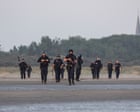
Footage of beach skirmishes between migrants and French police reveals only the final, desperate seconds of a much longer economic and geographic pipeline. When an inflatable dinghy pushes off from the northern French coast toward British waters, it triggers a cascade of tactical failures, political theater, and maritime hazard that standard news coverage consistently misses. Behind the viral video clips lies an industrial logistics network operating in plain sight along European shores.
For years, policymakers have treated this movement as a simple border control breakdown. That framework is fundamentally flawed. To understand why small boat crossings persist despite billions spent on enforcement, you must examine the supply chains of low-grade maritime equipment, the mechanics of localized policing on vast European coastlines, and the perverse incentives baked into international asylum architecture.
The Industrial Supply Chain of Cheap Inflatables
A modern Channel crossing does not begin on the sand. It starts in wholesale distribution warehouses across Europe and Asia, where bulk orders of heavy-duty PVC rafts, outboard motors, and cheap life jackets change hands.
Smuggling syndicates abandoned the traditional container truck method years ago. Cargo scans at major freight ports became too sophisticated, and thermal imaging made hiding human cargo inside refrigerated trailers a high-risk gamble. The pivot to maritime small boats shifted the operational model from centralized logistics to decentralized retail acquisition.
Organized networks use front companies to purchase modular watercraft. These boats arrive uninflated in standard courier boxes. They are stored in suburban garages or rural barns across northern France, far from the immediate gaze of local authorities.
- The Hull: Cheap, oversized PVC rafts designed for recreational river use, hastily modified to carry twenty to forty people without structural reinforcement.
- The Propulsion: Low-horsepower outboard motors, often stripped of serial numbers to prevent tracking back to commercial marine suppliers.
- The Safety Theater: Substandard foam flotation devices or rigid plastic vests that offer minimal thermal protection in waters where hypothermia sets in within minutes.
When French police seize a stash of thirty dinghies on a Tuesday, syndicates replace them by Friday through alternative distribution channels. The economics favor the criminal enterprises. A single successful crossing generates tens of thousands of euros in fees collected from desperate passengers, funding the rapid replacement of confiscated hardware.
The Geography of Enforcement Frustration
Patrolling hundreds of kilometers of open coastline with finite personnel creates structural vulnerabilities that police cannot plug. The French littoral features miles of remote dunes, quiet estuaries, and accessible beaches where vehicular access meets shallow water.
When officers attempt intervention, they face a volatile mix of crowd dynamics and physical confrontation. Viral footage captures the chaos on the beach, but it rarely shows the operational bind facing frontline security forces.
Operating in heavy gear on shifting sand against groups desperate to launch creates an almost impossible tactical environment for law enforcement officers.
If officers use aggressive crowd-control tactics, they risk capsizing overloaded boats in the surf, leading to immediate mass drowning casualties. If they hold back, the vessel departs, shifting the crisis to British maritime search and rescue teams. The tactical dilemma forces police into a reactive posture. They arrive after intelligence alerts or civilian tips, often too late to stop the embarkation process safely.
The British Policy Feedback Loop
The political debate in London focuses relentlessly on deterrence legislation, Rwanda deportation schemes, and naval interdiction proposals. Yet, domestic enforcement measures often produce unintended behavioral changes among migrants already stationed in northern camps.
When the British government signals tougher restrictions or impending legal barriers, the reaction in French transit hubs is counterintuitive. Instead of discouraging departures, harsher rhetoric accelerates them.
- The Urgency Effect: Migrants rush to launch before new laws take effect, leading to higher volumes of dangerous night crossings during poor weather windows.
- The Black Market Inflation: As passage becomes legally riskier, smuggling syndicates raise prices, compelling migrants to take on greater debt or perform illicit labor to secure a seat.
- The Destination Lock: Alternative legal pathways remain severely restricted, leaving unregulated maritime transit as the sole remaining functional mechanism for entry.
Efforts to outsource policing through financial aid packages paid to France have bought cooperation, yet money alone cannot alter the basic laws of fluid dynamics and coastal geography. Every barrier erected at Calais or Dunkirk merely pushes departure points further down the coast toward Normandy or deeper into isolated estuaries.
The Maritime Reality
Once clear of the surf zone, the journey enters international shipping lanes that rank among the busiest commercial waterways on earth. A rubber dinghy loaded past maximum capacity sits low in the water, virtually invisible to the radar of massive container ships traversing the Dover Strait.
The danger is not merely administrative or political. It is mathematical. Water temperatures in the English Channel rarely rise above conversational levels, even in mid-summer. A passenger swept overboard encounters shock currents that render swimming impossible within seconds.
Governments debate jurisdiction while private cargo vessels and volunteer lifeboats pull freezing survivors from the water. Until the economic engines driving displacement meet effective structural countermeasures, the small boats will continue to launch from the sand, indifferent to the political storms raging across European capitals.