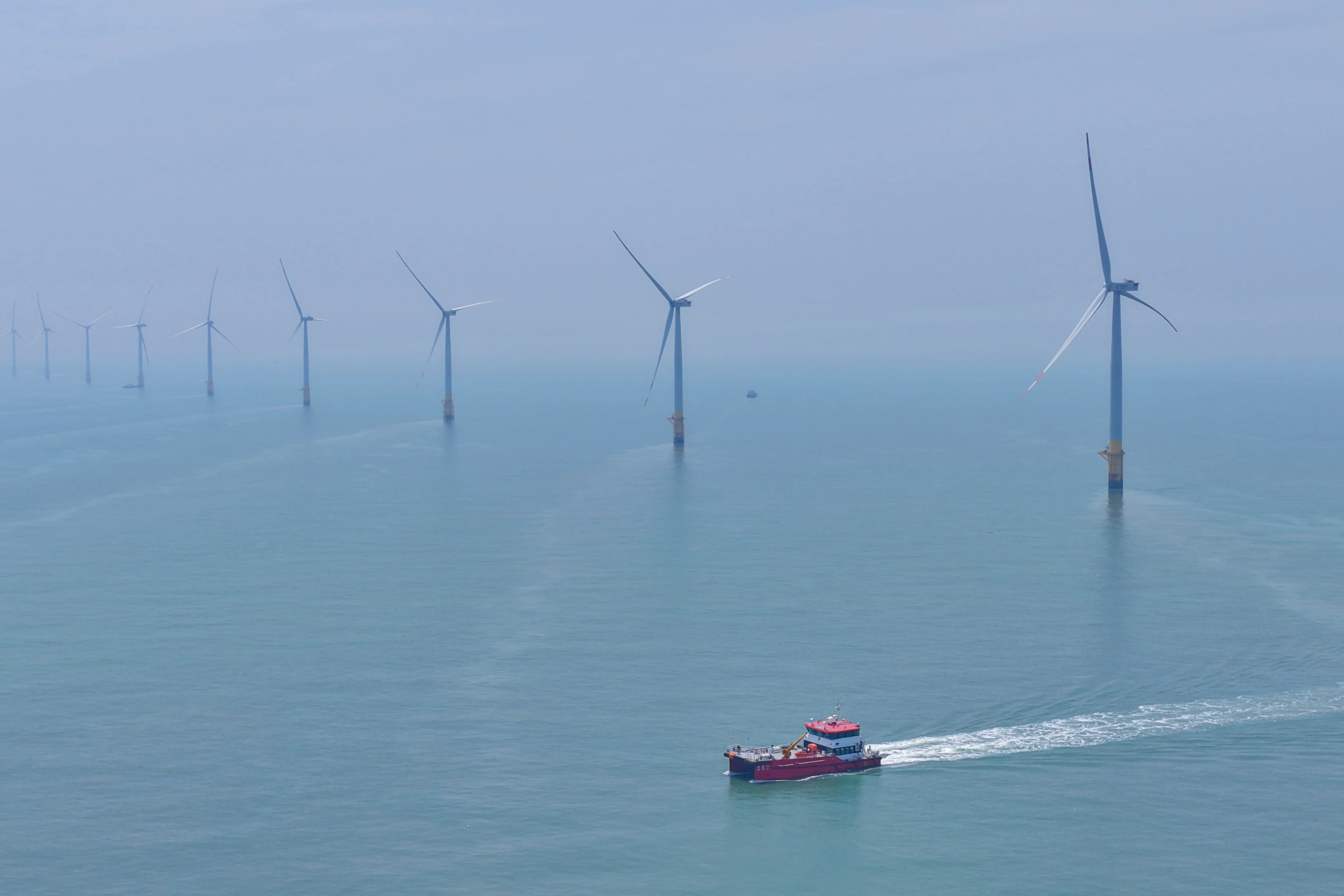
China and the United States remain the two largest carbon emitters on the planet, yet their trajectories have violently diverged. While American emissions have plateaued and begun a slow, politically contested decline from a peak reached nearly two decades ago, China is aggressively bending its own emissions curve through an unprecedented industrial buildout of clean energy. Beijing is not doing this out of sudden ecological altruism. It is doing it because renewable energy and electrification have become the ultimate weapons of economic dominance and energy security.
For decades, Western climate policy has operated on a comfortable assumption. The West would innovate, set moral targets, and gradually transition away from fossil fuels while developing nations slowly caught up. That assumption is dead. China still burns more coal than the rest of the world combined, and its total carbon footprint remains roughly double that of the United States. Yet when you look at the rate of change—the velocity of grid transformation, manufacturing scale, and electrification—Beijing is executing an energy transition that makes American efforts look like a rounding error.
The Anatomy of Two Diverging Grids
To understand why China is moving faster, you have to look at the physical infrastructure on the ground rather than the press releases coming out of Washington and Beijing.
In the United States, the clean energy transition is largely a story of fuel switching. Over the past fifteen years, American utilities retired aging coal plants and replaced them primarily with cheap, abundant natural gas unlocked by the shale revolution, alongside a steady addition of wind and solar. This lowered US carbon emissions by roughly 15 to 20 percent from their 2007 peak. It was an easy win. Now comes the hard part. Replacing natural gas with zero-carbon power requires building massive amounts of high-voltage transmission lines, upgrading local distribution networks, and navigating a labyrinth of local permitting laws.
In America, building a single interstate transmission line can take a decade or more due to environmental reviews, state-by-state regulatory battles, and local landowner lawsuits. The US electrical grid is essentially three separate, aging networks held together by bureaucratic duct tape. Even with hundreds of billions of dollars in federal tax credits from the Inflation Reduction Act, physical bottlenecks are choking the deployment of wind and solar projects. Hundreds of gigawatts of clean power sit stuck in interconnection queues, waiting years just to plug into the grid.
China operates under entirely different rules. Beijing treats its electrical grid not as a regulated utility market, but as a strategic military-industrial asset.
Over the past few years, China has installed more solar capacity in a single year than the entire world did just a few years prior. It is building ultra-high-voltage transmission lines across thousands of miles to move solar and wind power from the sparsely populated deserts of Inner Mongolia and Xinjiang directly to the manufacturing hubs on the eastern coast. When Beijing decides a province needs a transmission corridor, the concrete is poured within months, not decades.
The Coal Paradox
Critics in the West routinely point out that China is still permitting and building new coal-fired power plants. They use this fact to argue that Beijing's climate pledges are a mirage. That reading misses the structural reality of how China uses coal.
China suffered severe power shortages and rolling blackouts in 2021 and 2022 when drought crippled its hydropower output and industrial demand spiked. For the Chinese Communist Party, blackouts are an existential political threat. Consequently, Beijing approved a wave of new coal plants to serve as grid insurance.
However, the utilization rates of these coal plants—known in the industry as capacity factors—have been steadily dropping. Instead of running 24 hours a day as baseload power, Chinese coal plants are increasingly being forced to act as expensive backup batteries, ramping up only when the sun sets or the wind dies down. China is building coal to prevent blackouts, while simultaneously building so much wind, solar, and nuclear power that the coal plants are being cannibalized out of the market.
Manufacturing Dominance as Climate Policy
The fundamental difference between the American and Chinese approaches comes down to industrial strategy. Washington approaches emissions as an environmental regulation problem and a consumer subsidy challenge. Beijing approaches emissions as a global supply chain monopoly.
Look at the three pillars of the modern clean economy—solar panels, lithium-ion batteries, and electric vehicles. China controls over 80 percent of the global manufacturing capacity across almost every stage of the solar supply chain, from polysilicon refining to final module assembly. It dominates battery cell production and the refining of critical minerals like lithium, cobalt, and graphite.
Because China built massive overcapacity in these sectors, prices have collapsed globally. Solar panels and battery packs have become so cheap that deploying them in China is no longer a climate sacrifice; it is the cheapest way to generate and store electricity.
- Electric Vehicle Adoption: In China, plug-in vehicles have surged past the 40 percent mark of all new car sales, driven by brutal domestic price wars and companies like BYD that produce affordable models without relying on Western-style luxury markups. In the United States, EV adoption hovers around 8 to 10 percent, slowed by high vehicle prices, charging anxiety, and political polarization.
- Battery Storage: China is deploying grid-scale battery storage at a pace that dwarfs the rest of the world, solving the intermittency problem of renewable energy faster than Western grid operators thought possible.
- Electrification of Everything: While the US debates gas stoves and heat pumps in culture war skirmishes, China is systematically electrifying heavy industry, public transit, and freight logistics. Nearly every city bus in China's major metropolises is already electric.
This industrial reality creates a massive headache for Washington. The United States wants to lower emissions, yet it cannot allow its domestic manufacturing base to be wiped out by cheap Chinese imports. This has forced the US government to erect massive tariffs on Chinese EVs, batteries, and solar components. By protecting American workers from Chinese industrial overcapacity, Washington is simultaneously making the green transition more expensive and slower for American consumers. It is a policy trap with no clean exit.
The Accounting Illusion of Western Decarbonization
When Western analysts celebrate the gradual decline of US and European emissions, they often gloss over a massive accounting loophole. Over the last thirty years, the United States did not simply eliminate its heavy industrial emissions; it exported them.
By offshoring steelmaking, cement production, chemical refining, and consumer goods manufacturing to Asia, America cleaned up its domestic air and lowered its national carbon ledger. Meanwhile, China became the factory of the world. A massive portion of China's coal-fired emissions is directly tied to manufacturing smartphones, appliances, clothing, and industrial components destined for American big-box stores.
Economists track this through consumption-based emissions, which adjust a country's carbon footprint for international trade. When you account for the carbon embedded in imported goods, the American emissions decline looks far less impressive. The US simply outsourced its smokestacks to Guangdong and Jiangsu, and then lectured Beijing about the smoke.
Now, China is cleaning up those very smokestacks while keeping the factories. If China successfully decarbonizes its massive manufacturing base using cheap domestic renewables and nuclear power, it will gain an insurmountable competitive advantage in a carbon-constrained global economy. European carbon border taxes, designed to penalize dirty imports, will end up hurting slower-moving Western competitors while Chinese factories sail through with low-carbon certification.
Where the Chinese Model Breaks Down
To argue that China is doing better on emissions trajectory is not to suggest its system is flawless or sustainable without severe friction. The authoritarian efficiency that allows Beijing to build solar farms and high-speed rail at breakneck speed also creates massive economic distortions.
Local governments in China are deeply indebted, yet they continue to funnel state-backed loans into clean tech manufacturing to meet Beijing's growth targets. This has created a deflationary bloodbath in the solar and EV sectors. Dozens of Chinese solar and battery firms are bleeding cash, surviving only on local government subsidies. Eventually, a brutal wave of bankruptcies and consolidation will sweep through the industry, wiping out billions in capital.
Furthermore, China's energy consumption per capita is still rising as hundreds of millions of citizens move into the middle class, buy air conditioners, and demand higher living standards. Even if China's carbon emissions peak ahead of its official 2030 target—a milestone many energy analysts believe may have already arrived or is imminent—peaking is not the same as falling fast.
Plateauing at over 11 billion metric tons of carbon dioxide per year is still a catastrophic level of pollution for the global atmosphere. China's sheer scale means that even a sluggish decline from its peak will keep global temperatures rising well past international targets unless Beijing can slash emissions at a rate no industrialized nation has ever achieved.
The American Wildcard
The United States, by contrast, suffers from the exact opposite set of flaws. America has unmatched innovation, deep capital markets, and some of the best wind and solar geography on earth, particularly across the Great Plains and the Southwest. When American entrepreneurs and engineers are unleashed, they create transformative technologies, from next-generation geothermal to small modular nuclear reactors.
Yet American climate policy is hostage to a broken political cycle. Every four years, the federal government threatens to rip up its own energy strategy. Investors face whiplash as administrations swing from aggressive climate subsidies to deregulation and fossil fuel expansion. You cannot build multi-decade energy infrastructure when tax incentives, environmental rules, and permitting laws are rewritten every presidential election.
At the local level, American democracy has given a veto to almost anyone who dislikes the sight of a wind turbine or a power line. Environmental laws originally designed in the 1970s to stop toxic waste dumps and oil spills are now routinely weaponized by wealthy homeowners and fossil fuel interests to block solar farms and transmission corridors. The US has regulated itself into physical paralysis.
The Geopolitics of Electrons
The race between the United States and China is no longer just about who produces the most oil or controls the sea lanes of the Middle East. It is a battle over who controls the supply chains of the electric age.
China recognized early on that it is vulnerable in a fossil-fuel world. It lacks vast domestic oil reserves and relies heavily on imported crude that must pass through the Strait of Malacca, a narrow maritime chokepoint easily blockaded by the US Navy in a conflict. Transitioning to domestic wind, solar, hydro, and nuclear power—and electrifying its transport fleet—is Beijing's ultimate insurance policy against foreign energy blackmail.
The United States, sitting atop the world's largest oil and natural gas boom in history, lacks that same existential urgency. As the world's top oil and gas producer, America enjoys total energy independence. Cheap fossil fuels keep the US economy humming, keep gasoline prices low for voters, and generate massive export revenues. Because fossil fuels work so well for the American economy right now, the political will to endure the messy, expensive disruption of rebuilding the entire electrical grid simply isn't there.
This is the core paradox driving the global climate crisis. America's fossil fuel abundance has made it complacent, turning its clean energy transition into an ideological luxury item debated in courtrooms and legislatures. China's fossil fuel vulnerability forced it to treat clean energy as a matter of national survival, triggering an industrial mobilization on a wartime scale.
Until the United States fixes its permitting paralysis, modernizes its fractured grid, and builds a coherent industrial policy that survives election cycles, it will remain stuck in second gear. Beijing will continue to dominate the clean energy supply chain, capture global export markets across the developing world, and bend its massive emissions curve downward—not to save the planet, but to own the twenty-first century.