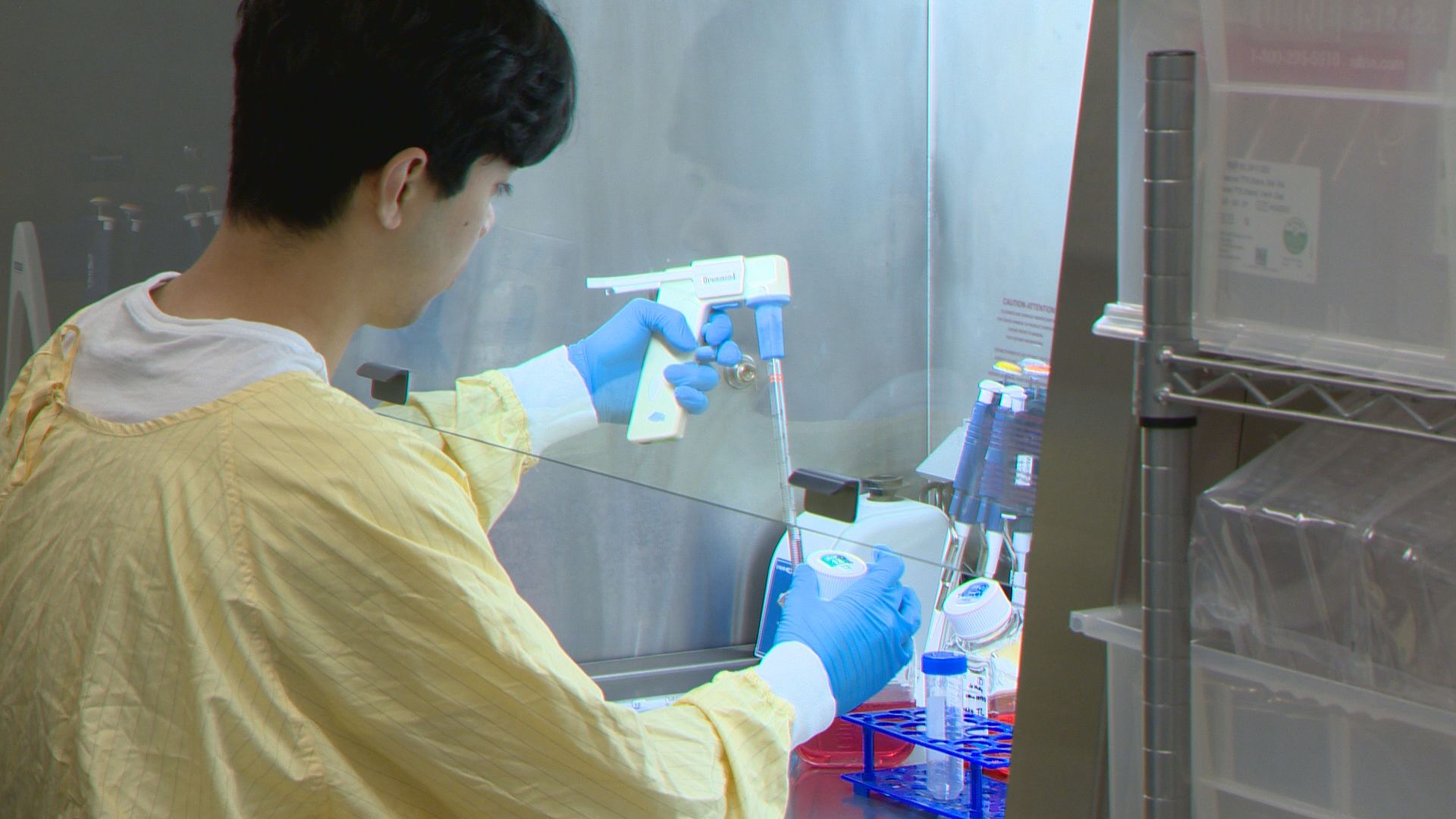
For over a decade, cellular immunotherapy has promised a revolution in oncology that it could only partially deliver. While chimeric antigen receptor T-cell therapies, known as CAR-T, successfully cleared blood cancers like leukemia and lymphoma from thousands of patients, they consistently hit a brick wall when facing solid tumors. Breast, lung, brain, and soft-tissue cancers remained largely impervious. The immune cells engineered in laboratories to hunt down malignancy would find themselves starved of targets, physically blocked, or chemically neutralized the moment they entered the dense, hostile environment of a solid tumor.
A quiet collaboration between the University of Calgary and McMaster University has recently cracked open a new door in this stalemate, though the path ahead remains treacherous.
Researchers at the Riddell Centre for Cancer Immunotherapy and the Charbonneau Cancer Institute have moved an experimental, first-in-class CAR-T therapy called GCAR1 from the laboratory bench to human subjects. Published in companion papers in Nature and Nature Cancer, the research targets an aggressive protein known as GPNMB. Unlike traditional therapies that only look for a flag on the cancer cell itself, this approach attacks both the malignant cells and the protective cellular architecture surrounding them. It is an aggressive shift in strategy, treating a tumor not as an isolated cluster of rogue cells, but as a fully fortified ecosystem.
Yet, as with all early-stage oncology breakthroughs, the intoxicating headlines obscure a much colder, more complicated reality. The initial clinical trial involved exactly two patients. While the data collected offers a profound blueprint for future medicine, it also underscores the immense volatility, astronomical costs, and sheer physical toll of bringing living medicines to the front lines of human health.
The Fortress in the Flesh
To understand why the Calgary discovery matters, one must first understand the fundamental failure of first-generation cellular therapies in solid masses. Blood cancers are liquid. They circulate openly in the bloodstream, making them easy targets for engineered T-cells. A solid tumor behaves entirely differently. It builds a physical wall of dense extracellular matrix, twists the local blood supply to choke off oxygen, and secretes a chemical soup that actively puts incoming immune cells to sleep.
Oncology researchers refer to this as an immunosuppressive microenvironment. When standard CAR-T cells manage to penetrate this barrier, they quickly become exhausted. They burn out, lose their ability to replicate, and are ultimately consumed by the very tissue they were designed to destroy.
The Calgary and McMaster teams bypassed this defense by identifying GPNMB, a marker found not just on the surface of rare solid tumors like alveolar soft-part sarcoma, but also on the surfaces of tumor-associated macrophages. Macrophages are supposed to be the immune system's frontline defenders. Instead, solid tumors routinely hijack them, turning them into traitorous sentries that shield the tumor from attack and stimulate new blood vessel growth to feed the malignancy.
By engineering GCAR1 to recognize GPNMB, the scientists built a weapon that simultaneously attacks the castle walls and the garrison defending them. In preclinical mouse models of glioblastoma, a notoriously lethal brain cancer, the therapy wiped out detectable tumors entirely. The engineered cells did not just kill the cancer; they dismantled the infrastructure that allowed it to survive.
The Human Toll of Single Patient Trials
The transition from mice to humans is where most medical breakthroughs go to die. In this instance, the translation happened with unusual speed, moving from laboratory synthesis to regulatory approval and human injection within a remarkably short timeframe.
The first human subject was Stéphanie Alain, a Canadian mother diagnosed with advanced alveolar soft-part sarcoma, a rare and relentless muscle-and-bone cancer that had spread throughout her body. Conventional treatments, including heavy chemotherapy and radiation, had failed. She had run out of options.
Alain became the first person to receive GCAR1 in a highly controlled, single-patient clinical trial. The therapy did not cure her, but it altered her trajectory. Her doctors reported that the engineered cells extended her life expectancy by eighteen months, giving her two more Christmases with her young son before she eventually succumbed to the disease.
From an investigative and clinical standpoint, Alain’s true legacy lies in the tissue she left behind. Her willingness to undergo repeated, highly invasive lung biopsies before and after the treatment allowed the data science team, led by Dr. Sorana Morrissy, to dissect exactly how the therapy behaved inside a living human ecosystem. The team generated data from dozens of blood samples, mapping thousands of individual cells to track the battle between the engineered T-cells and the sarcoma.
What they discovered was a roadmap for optimization. They saw exactly where the therapy began to flag and how the tumor tried to adapt.
Armed with that data, the clinicians treated a second patient, Kent B., a fifty-five-year-old Calgary resident whose sarcoma had metastasized extensively to his lungs. He had been told by his primary care team that nothing more could be done. This time, the researchers paired the GCAR1 infusion with a companion immunotherapy designed to prevent the T-cells from exhausting themselves.
The results changed the narrative. Subsequent CT scans revealed that a major lesion in his lungs shrank from over two and a half centimeters down to less than one centimeter. Other smaller tumors vanished completely from the imaging.
The Commercial Bottleneck and the Philanthropy Trap
While the clinical response in the second patient is undeniably encouraging, the broader rollout of therapies like GCAR1 faces a systemic crisis that the medical community rarely discusses openly. Living medicines are profoundly difficult to manufacture, aggressively expensive, and virtually impossible to scale under current pharmaceutical frameworks.
Consider what actually happens during a CAR-T treatment cycle. A patient’s blood is drawn, and their T-cells are harvested via a complex apheresis process. Those cells are then shipped to a specialized biomanufacturing facility where they are genetically rewired using a modified virus to express the new receptor. They are grown in bioreactors, checked for quality, frozen, shipped back to the hospital, and infused back into the patient, who must first undergo lymphodepleting chemotherapy to clear space in their body for the new cells.
This is not a pill manufactured by the millions in a factory. It is a bespoke, boutique medical procedure tailored to an individual’s genetic code.
Currently, commercial CAR-T therapies for blood cancers carry a wholesale price tag ranging from $375,000 to nearly $500,000 per patient. That does not include the cost of prolonged hospitalization, intensive care monitoring for severe side effects like cytokine release syndrome, or the multi-disciplinary medical teams required to administer the treatment. When applied to solid tumors, which may require multiple doses or complex combination drugs to keep the T-cells alive, the costs could easily skyrocket past a million dollars per patient.
Furthermore, the initial success of GCAR1 was not funded by a major pharmaceutical conglomerate looking to scale a product. It was kept alive by local philanthropy. Funding from organizations like the Alberta Cancer Foundation and individual donors allowed the Calgary team to build the necessary local biomanufacturing infrastructure to produce these cells independently.
This creates a dangerous gap between academic discovery and public accessibility. If a therapy requires millions of dollars in charitable donations just to treat two people in a single province, it remains a luxury blueprint rather than a viable public health solution. Without massive, structural overhauls in how biological drugs are manufactured and paid for, breakthroughs like GCAR1 risk becoming high-tech options available only to the few who manage to secure a spot in a boutique clinical trial.
Beyond Sarcoma
The researchers are already moving to expand the trial to four additional medical centers across Canada, looking to validate the findings in a larger cohort of patients. The stakes are immense because the target protein, GPNMB, is far from unique to rare sarcomas. It has been identified as a key driver in clear cell renal cell carcinoma, which affects the kidneys, and in glioblastoma.
Simultaneously, other researchers at the institution are attacking the solid tumor barrier from entirely different angles. A parallel team led by Dr. Arshad Ayyaz recently identified a specific gene that acts as an invisibility cloak for colorectal cancer cells. When that single gene was knocked out in preclinical models, the tumors suddenly became completely visible to the body's natural immune system, resulting in total eradication when paired with standard checkpoint inhibitors.
These distinct lines of research point to a singular conclusion. The era of trying to blast cancer away with indiscriminate toxins is ending, replaced by an era of molecular warfare where the battlefield must be meticulously mapped down to the individual gene and cell.
The timeline for these developments is measured not in months, but in decades. Regulatory approval, multi-phase safety trials, and the stabilization of manufacturing processes typically take ten to fifteen years before an experimental compound becomes a standard routine option at a local clinic. For patients currently facing terminal diagnoses, that timeline is a structural tragedy. The science is moving faster than ever before, but it is still running a race against a clock that moves entirely too fast for those in the waiting room.
The success of the second patient in Calgary proves that the barrier around solid tumors can be breached. It proves that the immune system can be forced to tear down the very infrastructure that protects a malignancy. The immediate challenge shifting onto the medical establishment is no longer just a question of biology. It is a question of logistics, industrial manufacturing, and economics. Discovering the cure means very little if the system cannot afford to build it for the people who are dying while waiting for it.