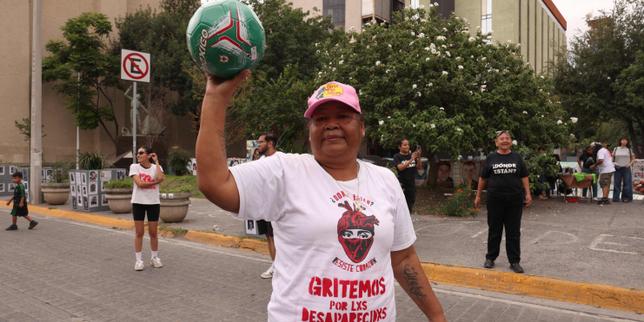
The Calculated Strategy of Mexico's Searching Mothers
Activists in Mexico are leveraging global football tournaments to force state accountability for over 100,000 forced disappearances. They disrupt the festive atmosphere of international matches to capture the attention of foreign media and visiting fans. This strategy aims to bypass a domestic political apparatus that systematically minimizes their crisis. By turning a sports spectacle into a human rights stage, these collectives exploit the tension between corporate entertainment and national reality. It is a desperate, calculated move to convert international eyeballs into leverage against state apathy.
The strategy hinges on a harsh truth. The Mexican government spends millions to project an image of a modern, safe, tourism-friendly nation during major sporting events. When the World Cup or international qualifiers come to town, the official narrative shifts entirely to celebration, economic growth, and cultural pride. For the colectivos—the self-organized groups of mothers searching for their missing children—this manufactured optimism is an opening. They know that while local authorities can ignore a protest outside a state capitol, they cannot easily hide a mass demonstration outside a stadium filled with international broadcasters.
This tactic represents a profound shift in the mechanics of human rights activism in Latin America. It moves the battleground from the courts, where cases languish for decades, to the global court of public opinion.
The Infrastructure of Bureaucracy and Silence
To understand why mothers are forced to target football stadiums, one must look at the total breakdown of the domestic justice system. Mexico officially records more than 110,000 disappeared persons, a number that grows daily. The vast majority of these cases never see a courtroom. The state infrastructure for investigation is not merely underfunded; it is structurally designed to stall, misplace files, and exhaust the families of the victims.
Forensic backlogs are staggering. Mass graves are discovered regularly, often by the mothers themselves, who use rods and shovels to search fields based on anonymous tips. The state, overwhelmed or complicit, leaves thousands of remains unidentified in morgues and makeshift repositories.
+-----------------------------------------+-----------------------------------------+
| Domestic Action Reality                 | International Spotlight Strategy        |
+-----------------------------------------+-----------------------------------------+
| Local police files face endless delays. | International media bypass local censorship. |
| Bureaucrats ignore daily sit-ins.     | Corporate sponsors fear brand damage.   |
| Threat of local cartel retaliation.     | High-visibility crowds offer safety.    |
+-----------------------------------------+-----------------------------------------+
The institutional response is often gaslighting. Authorities frequently suggest that the missing ran away, joined cartels, or chose to disappear. This shifts the blame onto the victims and their families. By taking their grief to the gates of a stadium, the mothers reject this narrative. They present the public with a stark contrast: the joy of a goal versus the agony of an empty chair at home. They force fans to acknowledge that the ground beneath the stadium is inextricably linked to the country's hidden graves.
When Corporate Interests Clash with Human Rights
International sports bodies like FIFA operate on a principle of strict political neutrality. They fine teams for political banners, sanction players for social messages, and demand that host nations guarantee a friction-free environment for sponsors and fans. This corporate bubble is precisely what the mothers aim to pop.
When a mega-event arrives, the stakes change for everyone involved.
- Corporate Sponsors: Brands spending tens of millions of dollars do not want their logos framed next to images of mothers holding photos of missing teenagers.
- Broadcasters: Television networks covering the tournament are forced to decide whether to cut away from protests outside the venue or include them in the pre-game package.
- Local Authorities: The police face a public relations nightmare. Cracking down violently on grieving mothers in front of international cameras looks far worse than the protest itself.
This creates a temporary zone of relative safety for the activists. In their home villages and towns, searching for the missing is incredibly lethal. Cartels target the mothers because their excavations uncover body dump sites, drawing unwanted security attention. Local police, often compromised by organized crime, offer no protection. But in the bright lights of an international football match, the cost of silencing these women rises exponentially for both the state and criminal organizations. The global camera acts as a shield.
The Mechanics of the Stadium Protest
The execution of these protests requires precise planning. Activists do not simply show up with signs; they coordinate to maximize visual impact. They buy tickets in blocks to display banners inside the arena, or they orchestrate massive marches that block the primary arrival arteries for team buses and VIP convoys.
They use the language of football against the system. Red cards are held up, not for fouls on the pitch, but for state corruption. Chants are adapted. The collective roar of the crowd is hijacked to chant the names of the missing. It disrupts the consumer experience of sports, forcing the spectator to become a witness.
The Fragile Limits of Sports Activism
This strategy is effective at generating short-term visibility, but it faces severe structural limitations. The international media cycle is notoriously fickle. Journalists arrive for the tournament, cover the protests as a poignant human-interest side story, and then leave once the trophy is lifted. The structural violence remains unchanged after the stadiums empty out.
Furthermore, there is a growing backlash from sections of the public. Football is a religion in Mexico, a rare source of collective escapism from the daily grind of economic hardship and insecurity. Some fans view the protests as an unwelcome intrusion into a sacred, joyful space. They argue that sports should remain separate from the nation's trauma. This creates friction between the activists and the very public they are trying to mobilize.
       [Global Media Attention spikes during tournament]
                             │
                             ▼
         [State promises temporary investigations]
                             │
                             ▼
         [Tournament ends; international media exits]
                             │
                             ▼
       [Bureaucracy stalls; status quo resumes]
The state has also learned to adapt. Instead of using overt force, authorities often use containment strategies. They set up security perimeters kilometers away from the stadiums, keeping protesters out of sight of the main camera positions under the guise of crowd control and traffic management. They offer empty promises of high-level meetings with families, timed precisely to coincide with the duration of the tournament, only to abandon those commitments once the international spotlight dims.
Beyond the Ninety Minutes
The reliance on sports tournaments reveals a deeper, more troubling reality. It shows that normal democratic channels in Mexico have completely failed these families. When citizens must rely on a corporate sporting event to get their government to look at evidence of mass murder, the social contract is broken.
The mothers understand this better than anyone. They are under no illusions that a banner at a football match will instantly bring their children home. They do it because every other door has been slammed in their faces. They do it because the alternative is total erasure. As Mexico continues to host major international sporting events, the tension between the beautiful game and the country's grim reality will only intensify. The mothers will be waiting at the gates, ensuring that the celebration cannot happen in peace while their families remain broken.